The rise of China’s new coffee culture

The scale of China’s coffee industry has reached RMB 265.4 billion yuan in 2023. The per capita coffee consumption has reached 16.74 cups in 2023, almost double the figure of 9 cups in 2016. (2024 market survey)

Once upon a time every non-Chinese, when asked about the favourite drink of the Chinese, would answer: tea. Foreigners brought coffee with them and introduced that brew to their Chinese friends and business relations. As a result, a number of Chinese in major port cities, where the foreigners were typically concentrated, acquired a taste for that brew as well. Today, tea is still the leader by a massive margin, though coffee is charging forward in leaps and bounds. Manager Wang of Damin Food (Zhangzhou, Fujian), a manufacturer of instant teas and coffees, still remembers that when he was at university in Zhangzhou, there were at most 10 coffee shops in the entire city. When he moved back a couple of years ago, there was one street alone with 10 coffee houses. That’s how things are changing, and we are starting to see real growth outside the metro cities. A trend towards coffee culture has developed over the last half-decade largely through the influence of cosmopolitan Beijing and Shanghai, the drivers of Chinese fashion. Now, the coffee shop has become a common and popular place that many people of moderate income can afford going to. The following table shows the value of the Chinese coffee market in the period 2020 – 2024.

However, the annual consumption amount per capita in China in 2024 was only 9 cups, far behind 300 cups for Japan and Korea, and the world average of 240 cups. This is due to the fact that coffee consumption is large in the cities, but still small to non-existent in the countryside. There is room for an annual increase rate of 15-20% for the coming years. Young white-collar workers in cities like Beijing and Shanghai consume 100 to 150 cups of coffee annually. Coffee drinking has added many new expressions to the Chinese language.
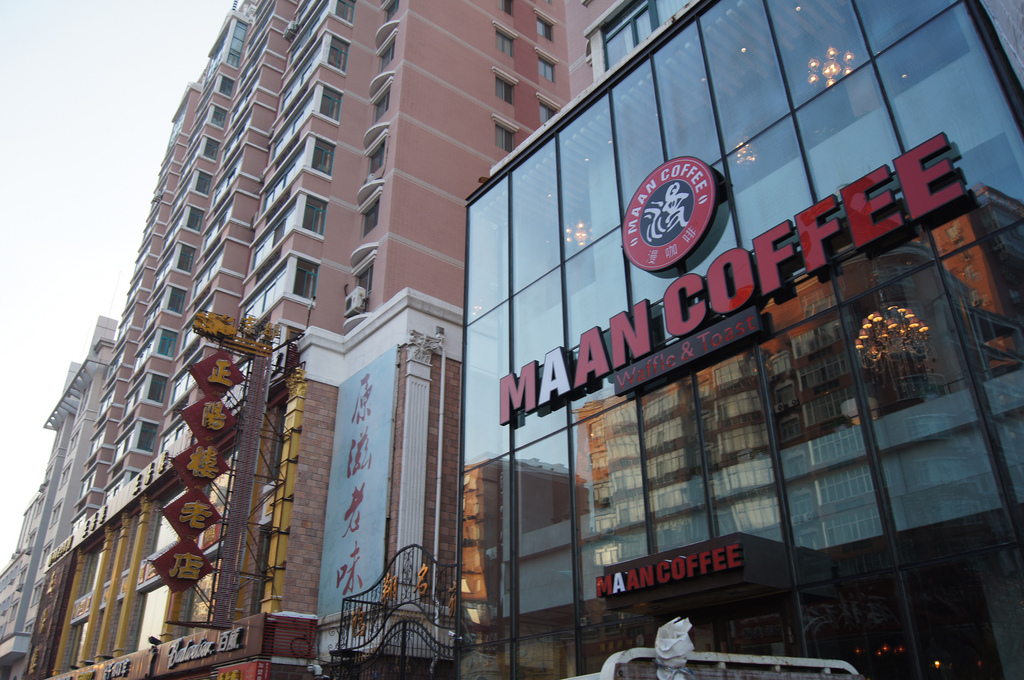
MaanCoffee

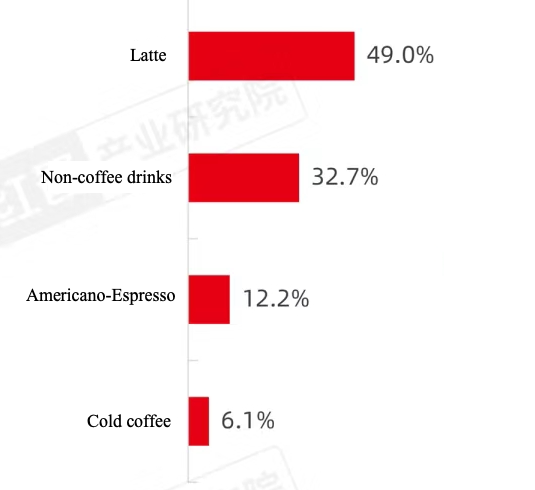
The following table shows the different types of coffee and the degree in which Chinese consumers ordered it in coffee chains in September 2024
China’s oldest domestic instant coffee
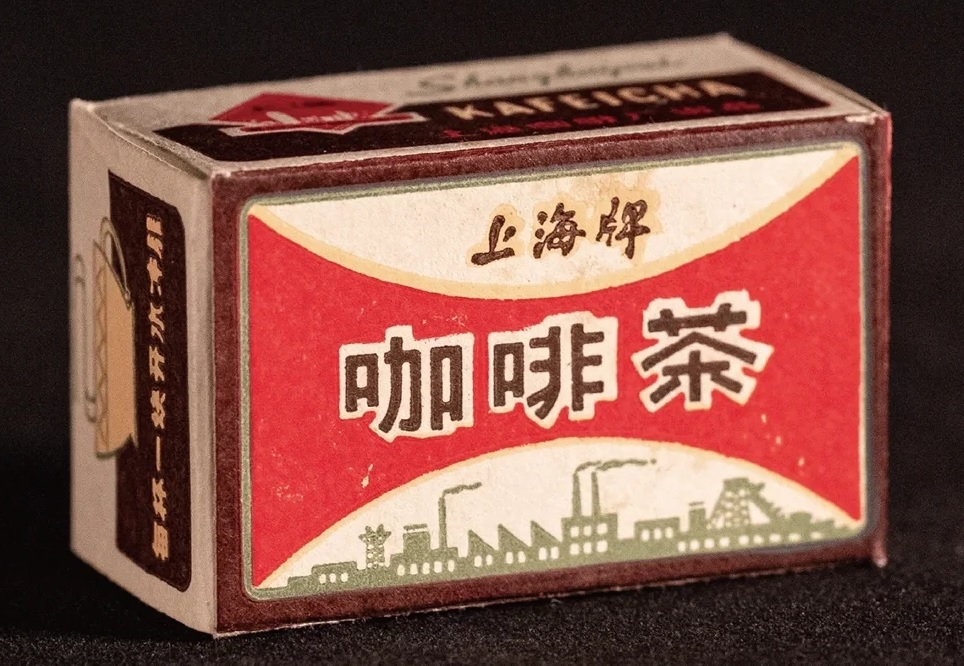
In 1935, Zhang Baocun founded the Desheng Coffee Shop on Shanghai’s Jiang’an Temple Road (currently: Nanjing West Road). The company was renamed State Operated Shanghai Coffee Factory in 1959. After the founding of the PRC, private enterprises were gradually reorganised from ‘private-public joint operation’ to ‘state operated’. This renaming indicates that the company had reached that final stage. A year later, the company started producing a kind of instant coffee, ground coffee beans and sugar pressed into blocks. You only needed to poor boiling water over it to get a cup of coffee. Because the general public was not used to coffee drinking, the product was named: kafeicha, literally ‘coffee tea’.

Vietnam major source

Vietnamese coffee beans accounted for 49% of those imported by China in 2017. However, other coffee exporting nations like Colombia and Brazil have all set up promotion offices in China. Chinese coffee imports grew by 16% year-on-year in 2017, compared with about 2% in the United States, the world’s largest coffee consumer. The following table shows the import and export figures of coffee beans in the period 2019 – 2023.

Surprise from Ethiopia
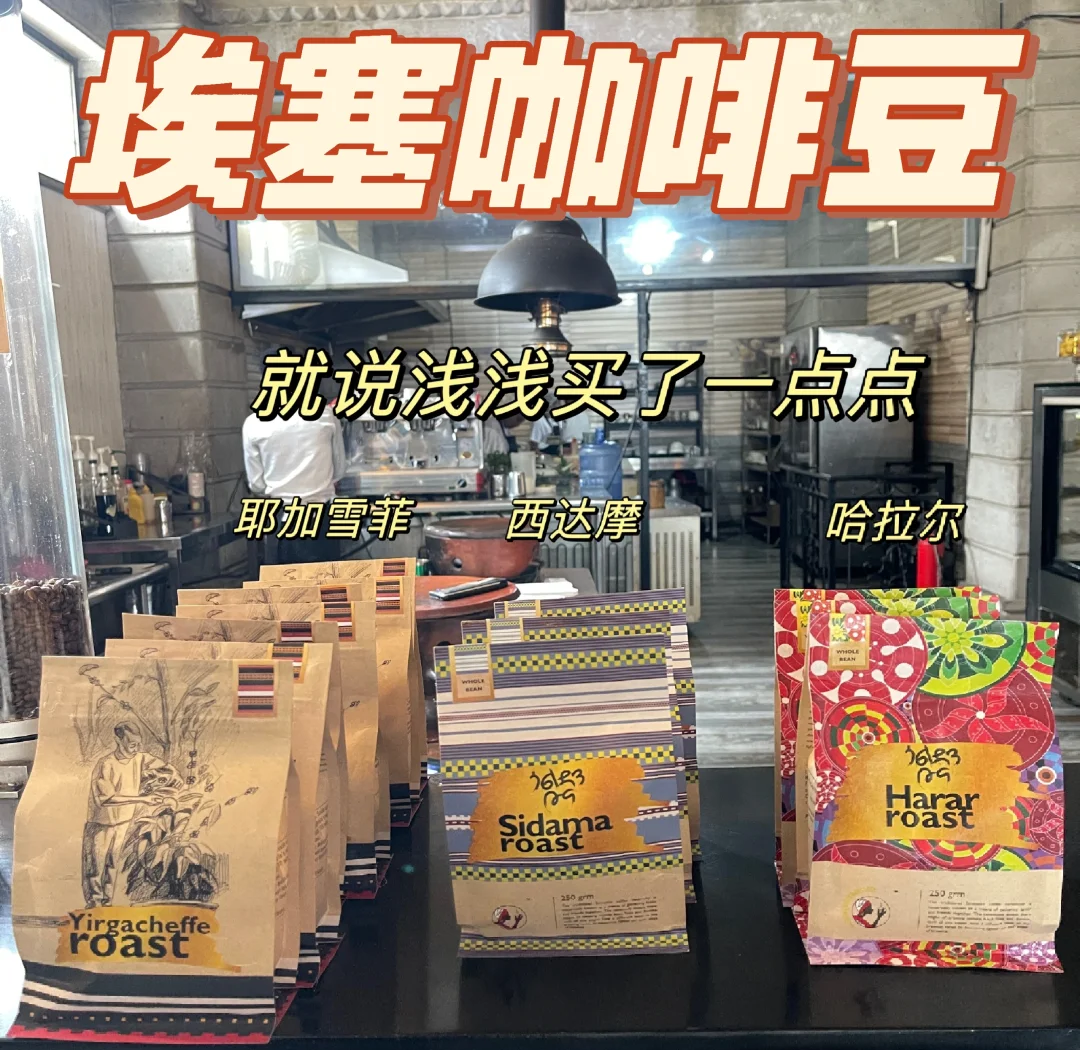
The China (Puyang) Ethiopia Coffee Industry Demonstration Park, which imports raw coffee beans from Ethiopia, has established a complete production chain in 2020, from roasting and extraction to freeze-drying and packaging. With an annual output of 1000 mt of freeze-dried coffee powder, the park can supply around 500 mln cups of coffee each year. Their products have also reached international markets, with exports to countries like Australia and Malaysia.

Market on the rise

China’s currently low average rate of coffee consumption, in tandem with its status as the most populous nation on earth, add up to real market potential, especially as sales of ready-to-drink (RTD) coffee products are soaring. Research carried out earlier this year shows that thus far the most significant strides have occurred in the instant coffee market, which reached over US 1 billion in retail sales in 2012. However, since 2011, RTD coffee has consistently boasted the strongest volume growth of any Chinese beverage category. The RTD coffee segment growth of 22%. Fresh coffee, though, remains a niche product. Its demand, due largely to its convenience, is mostly from recent adopters who tend to be unfamiliar with fresh coffee preparation methods and who often lack the appliances needed to make it. In terms of flavour, instant coffee’s ability to be packaged as a mix with sweeter and other additives appeals to the Chinese palate, which generally prefers milder, milkier coffee to the stronger, acid profiles often evoked by fresh coffee. Indeed, the most popular type of instant coffee in China, which accounted for 52% of the segment’s sales in 2012, are three-in-one mixes that include a mix of instant coffee, creamer and sweetener. Nestlé’s Nescafé is the dominant player in both instant and RTD markets, accounting in 2012 for half of the entire RTD market, and just shy of three-quarters of the instant market. While the brand has a global instant share of 46%, its strength in China is unsurprising, though the strength of its RTD sales in the country is very different to its global weight of just 3% share.

Foreign trade

The following tables show the development of China’s coffee-related imports and exports.

The competing forces

According to analysts, currently, on China’s coffee shop market, there are three distinct competing forces: Chinese domestic, European and American, and Korean and Japanese. They are engaging in different strategies to strengthen themselves. For instance, Sculpting in Time is trying to take the advantage of e-commerce. In December 2014, it established a professional coffee website, Hello Coffee, where visitors can see all relevant information about coffee making and consumption. Hello Coffee says it is China’s first B2C coffee website. Starbucks places more emphasis on fast coffee serving in the shop. It also takes measures to encourage consumption outside of the coffee shop. Mid 2018, Starbucks is present in 147 Chinese cities with a total of 3362 outlets, including 7 cities with 100+ outlets. Shanghai is the largest with 663 stores. Starbucks has announced that it intends to run 6000 outlets by 2022. Costa Coffee, a British multinational, plans to open 900 more stores in China by 2020, which will give it 1344 shops in the country.

Starbucks China has in 2024 lost its dominant position in the on-premises coffee market in China as local coffee rivals have emerged. Starbucks’ brand share in the specialty coffee and tea shops category in China dropped from its peak of 41% in 2017 to 14% in 2024.

Korean coffee shops are dedicated to business alliance. What is more, Korean coffee shops, such as Caffe Bene, Maan Coffee and Zoo Coffee, have entered China’s market. However, this business alliance mode does not seem to work smoothly. In the course of 2015, Caffe Bene started to show cash flow problems and soon the Chinese mother company stopped injecting further capital in the venture. You can still see several Caffe Bene outlets operating in Beijing, but shops in other cities have closed down one after another. Insiders believe that the chain will disappear complete during the first months of 2016. Zoo Coffee is also reporting problems in developing the Chinese market. The management has decided to quit the franchising system and only operate wholly owned outlets. It has also stated that it wants to alter its ‘Korean’ image to avoid Zoo Coffee running in the same problems as Caffe Bene.

Founded in 2019, Nowwa Coffee opened its first store in Shanghai and operated over 1800 stores across 150 Chinese cities in 2025 – making it the sixth largest operator.

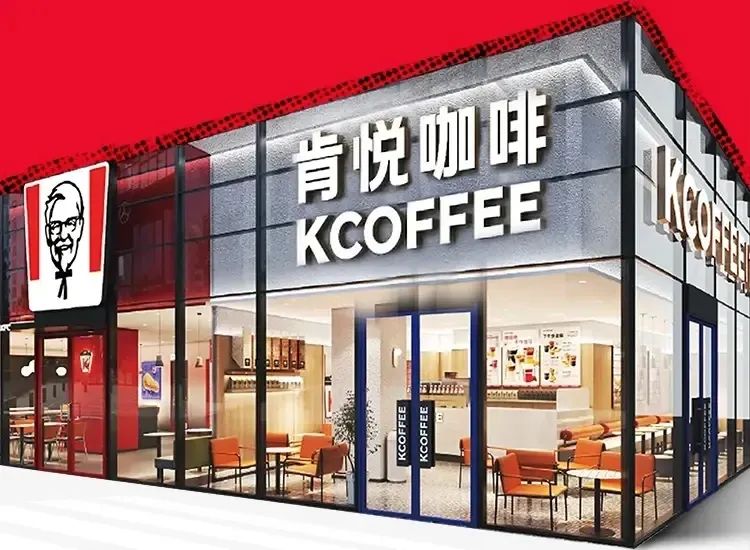
McDonalds already operated a chain of McCafés in China and KFC joined its competitor in 2024 by opening a coffee chain of its own: KCcoffee.
Industry insiders believe that chain coffee shops should be prepared to face the challenges from fast-food restaurants and convenience stores as well as milk tea stores. According to these analysts, coffee shops should focus on their unique service rather than size, since consumers might stay there for a long time, thus increasing their operating costs. Also, they suggest coffee shops host some activities in order to boost their business and advertise themselves. Actually, there is also a third force emerging in this market: the private coffee shop. It needs a lot of courage, but there are single Chinese coffee entrepreneurs who do not want to tie themselves to one of the big names and set up their own, often single-store, coffee shop. One of my favourites is Taoyuan Miaoji, located in an alley opposite the main gate of the University of International Business and Economics (UIBE). It is an ideal spot for a quiet talk with friends.
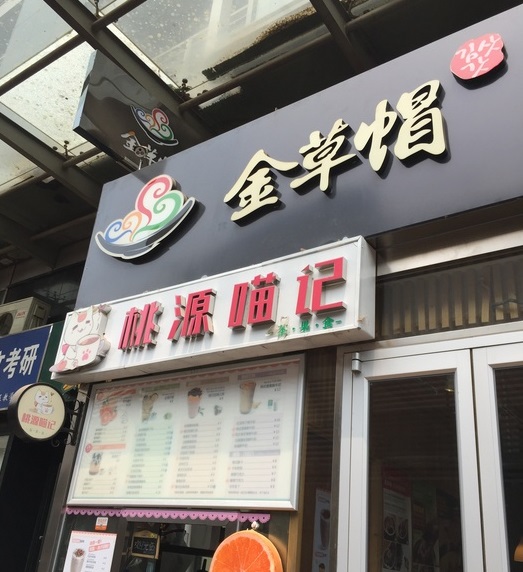
TiaoyuanMiaoji

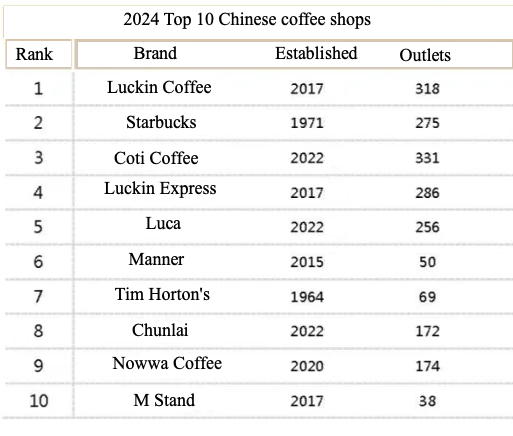
The following table shows the Top 10 coffee shops as per end of 2024.
Here are some maps showing the distribution of major chains in 2024
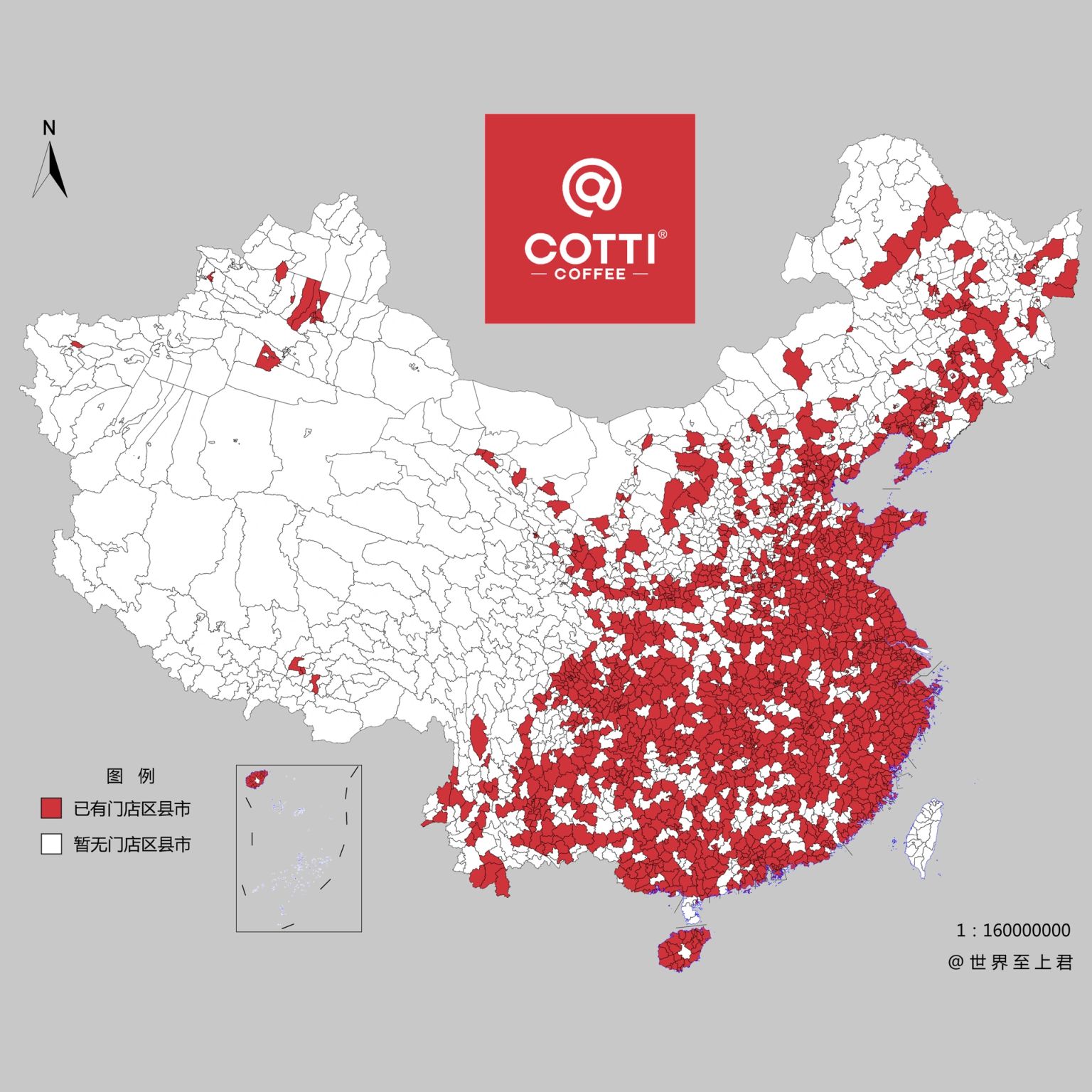
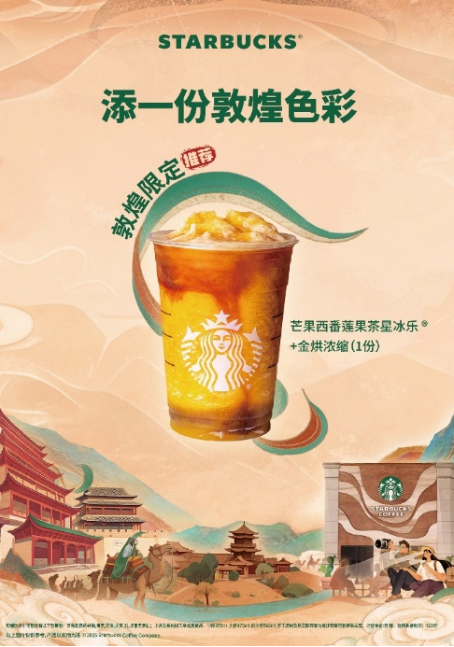
It is clear that coffee chains were still mainly distributed in the eastern half to one third of the country. However, the development of these and other chains has been fast and is still going on. Starbucks’ distribution shows very few outlets in Gansu province yet in 2024. However, a year later, the company started to cooperate with Dunhuang, China’s most famous caves with Buddhist frescoes, incorporating Buddhist imaging in its advertising. The top text says: ‘Adding some Dunhuang flavour’. The mango passionfruit coffee in the picture is, according to the ad, restricted to the Dunhuang scenic area. A nice cultural gesture, but that restriction may limit its commercial effect.
Categories

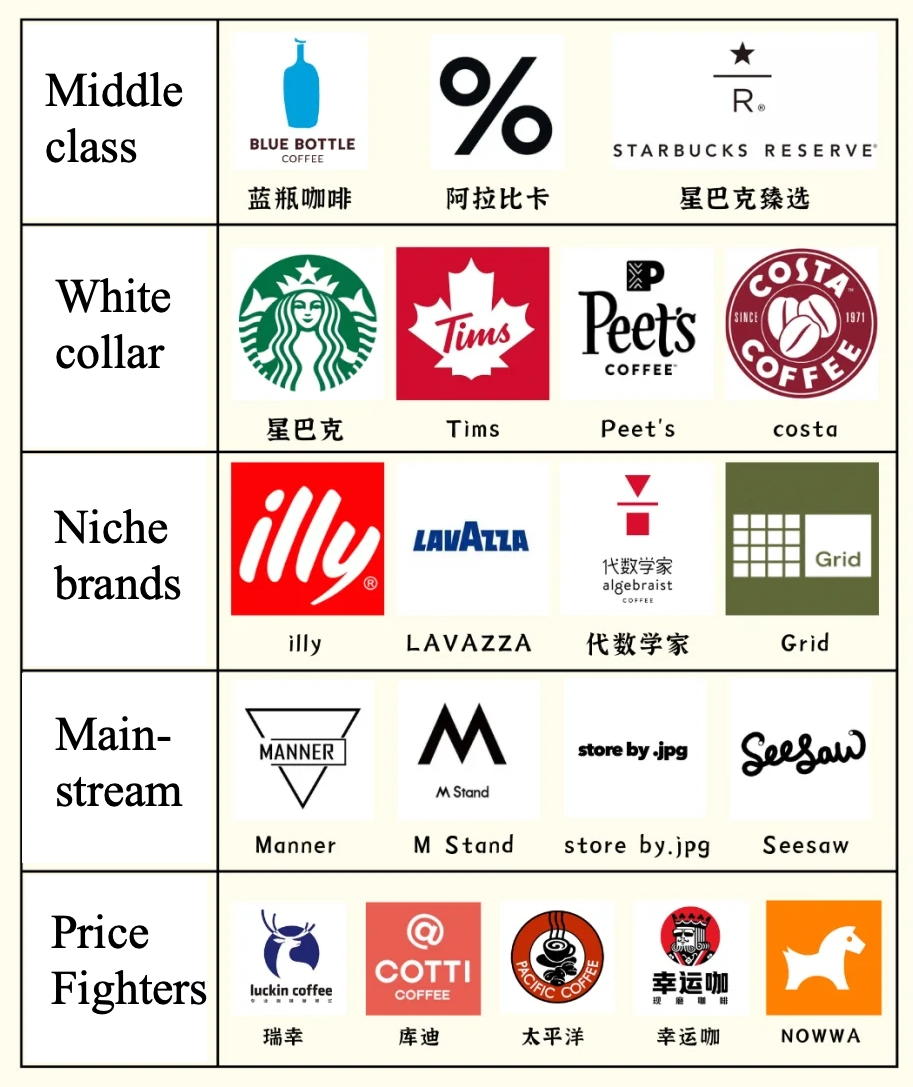
The following diagram shows the coffee chains operating in 2024, arranged in five different categories.
Starbucks as measure for development

The site Dudihui is a blog consisting of infographics about Beijing. A blog posted mid 2018 compares the size and development of the various districts of Beijing. One of the dimensions in that infographic is the number of Starbucks outlets in the district. It is shown in the following picture.

It is the strongest sign of the symbolic value of coffee shops on present day China. An interesting detail is that the Chaoyang Distr. with its foreign embassies and CBD has more coffee shops that the university district Haidian.

Starbucks’ business in China got into trouble in 2024, when Luckin Coffee finally reached its primary goal: more outlets in China than Starbucks (see below). The ever growing number of domestic chains also proved a major challenge.

The German connection: from Hannover to Changde

Coffee is often associated with Italy, but Germany has played an outsized role in its history too. The paper filter was invented by a Dresden housewife, and the city of Emmerich am Rhein was home to one of the first automated drum roaster. Now, there’s another reason to turn to Deutschland for your java fix, with the arrival of Hanover Coffee in China. Founded by Andreas Berndt in 2011, the former marketing man opened the first premium coffee bar and bean shop in Hanover, which has since grown to supply private customers, high-class hotels, restaurants, companies, and cafés in Germany with over 30 different types of coffee beans. Last year, Berndt’s sons, Fabian and Flemming, came out to China to set up their first overseas branch. Now operating out of a roastery in Changde, Hunan province, where a ‘German Town’ has been erected (the photo shows the roastering plant in that town). They use a the medium roast, also known as a Vienna roast, which is not too light or dark. The coffee beans are roasted at around 190 degrees Celsius, or as low as possible, to preserve the full aroma. They use a Probat drum roaster from Germany. Their green beans are checked in Germany before they’re shipped to China and checked again.

Luckin Coffee – playing the nationalist card . . . with ups and downs
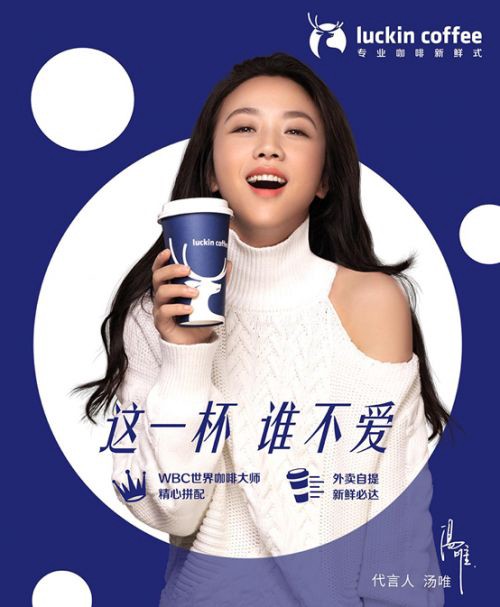
The nationalist trend in Chinese politics is also entering the fierce competition in the coffee market. Newcomer Luckin (Ruixin) Coffee, with its HQ in the coastal city of Xiamen, opened 525 stores in the first four months of 2018. It has wooed more than 1.3 million customers and created an internet frenzy by challenging coffee giant Starbucks. With investment of more than RMB 1 billion from Lu Zhengyao, CEO of car rental company Ucar Inc, and other founding members, Luckin Coffee aims to grab some of Starbucks’ market share with a combination of delivery services, lower prices and smaller-sized stores-a brand strategy it calls Any Moment. Qian Zhiya, CEO and founder of Luckin Coffee, and previously an executive at UCar, said the goal is to offer Chinese consumers an alternative to Starbucks. “The market will not only have Starbucks. Every country has their own coffee brand,” Qian said. Luckin Coffee said their secret ingredient for creating “a decent cup of coffee” is their select Arabica coffee beans, world-leading coffee machines and professional baristas. Of its stores already in operation, 294 are brick-and-mortar cafes between 30 to 50 square meters in size. Some 231 receive delivery orders only. Qian said, in the future the delivery kitchens will comprise less than 15% of the total. Luckin is also using high tech to distinguish itself.

Luckin Coffee even started to involve the courts in its competition with Starbucks in May 2018. Luckin accused Starbucks of monopolistic activities, because it prohibits owners of properties in which it has set up shop to also sell space to competitors. This case will be hard to win for Luckin, as I can name numerous locations in various cities in China where Costa Coffee or Pacific Coffee have opened outlets very close to a Starbucks shop.

Luckin Coffee announced on July 11, 2018 that it had raised USD 200 million in a fundraising round that values the company at USD 1 billion. Investors are said to include Singapore sovereign wealth fund GIC. The company intends to open another 2500 outlets in 2019.

Lucking Coffee got listed on the Nasdaq Stock Exchanges in 2019. It priced its initial public offering at $17 per share. However, in March 2020, the company came out with an announcement that its COO Liu Jian fabricated more than USD 310 mln worth of transactions in 2019, almost half of the company’s roughly $732 million in sales of that year. The NASDAQ decided to oust Luckin in June 2020.

Following this down period, Luckin then entered its second period of aggressive expansion. Luckin’s financial results for 2022 showed the full extent of its recovery: Revenue exceeded USD10 billion for the first time, and the company turned a profit for the first time in its history. According to Luckin’s earnings report for the first quarter of 2023, net profits have increased 27 times year-on-year. It has opened a new store on average every two hours, including its first foray overseas in Singapore. What was powering Luckin’s recovery was its new strategy of targeting China’s so-called “sinking market” — mostly third- or fourth-tier cities in China. In fact, for the coffee industry, the “sinking market” basically covers second-tier cities and below.

In spite of all the mistakes and mishap, Luckin Coffee surpassed Starbucks China, at least in number of outlets in the course of 2024. Against the background of the US – China trade war, this coffee war between the US-based Starbucks and the domestic street fighter Luckin has gained an interesting political dimension.

One of the original founders of Luckin Coffee, Lu Zhengyao and Qian Zhiya. left the company with a number of employees and established a coffee chain of her own in 2022: Cotti Coffee. Half of Cotti’s core team are former Luckin employees, and pricing and products are also almost identical to Luckin’s. Cotti is even more aggressive in its expansion. While Luckin took 11 months to reach 1000 stores nationwide, Cotti did so in just five months. It took Starbucks 16 years.

More and more

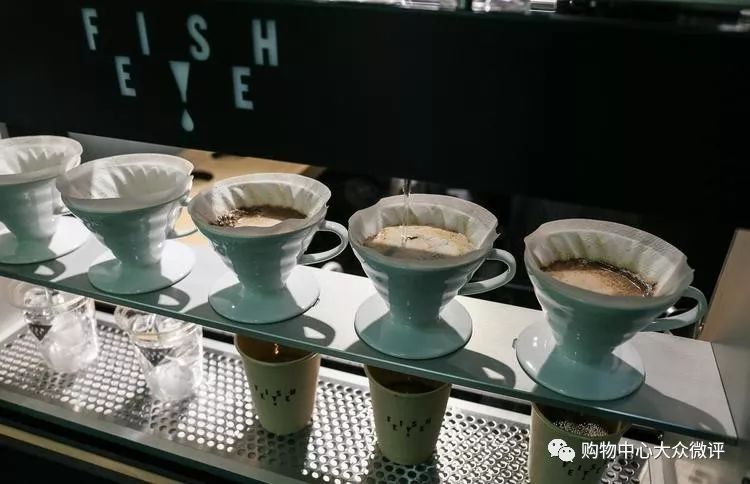
More domestic coffee entrepreneurs are following the example of Lucking Coffee. A newcomer worth watching is Coffee Box. This chain emphasises coffee drinking as a total experience. Coffee Box picks business districts of major cities as the locations for its ‘experience shops’. A more locally concentrated chain is Buzztime Coffee in Shanghai. This chain opens relatively small outlets in areas where restaurants and small shops are concentrated, as a more homely alternative for the more crowded and noisy coffee shops. Shanghai-based Unibrown Coffee (2017), owned by Shanghai Jiajia Electronics, is playing the high-end ‘specialty coffee’ card. Greybox Coffee (2017) and Soloist fall in the same category, but then geared to those who are passionate about coffee. Soloist baristas do not want to be addressed with ‘waiter (fuwuyuan)’ but with ‘coffee master (kafeishi)’, in an effort to link the Chinese term for barista to their own brand. A lesser known newcomer is Beijing-based Coffee08. Minicoffee (Xiaojia) specialises in milk coffees. Uin Coffee positions itself as a high tech coffee maker. ParCoffee is also based in Shanghai, with its most famous coffee cup shaped outlet near Huashi Plaza. The number and speed of new coffee concepts launched in China is so high, that keeping this post up-to-date is a genuine challenge. A catching feature of Fish Eye Coffee (see following photo) is filter coffee; you can watch your brew appear drip by drip.
Uin Coffee (2018) seems to concentrate on high-end office buildings. It als operates coffee vending machines. Coffee Now (2015) is China’s first producer of cups like those of Nespresso. Seesaw Coffee (2017) is once more Shanghai-based, aiming at coffee lovers preferring a quiet elegant ambiance.

Bestar Coffee was launched in Shanghai in 2022, with coffee + artisan ice cream as its distinctive feature.

Lucky Cup, the coffee brand of tea chain Mixue launched in 2017, is known for its ultra-low pricing strategy: a latte for RMB 10 yuan and an Americano for RMB 5. Compared to Starbucks’ and Luckin’s average cost of RMB 40 and 20, respectively, Lucky Cup’s prices are more attractive to younger people in less affluent cities.

Saturn coffee: instant coffee in a cup

Hunan’s provincial capital Changsha is a growing coffee city in China. One typical phenomenon of Changsha is the large number of tiny coffee shops, with only place for 3 – 4 customers at a time. It is also the home of the creator of a new type of instant coffee: Saturn Bird. The company came up with a breakthrough an instant coffee that completely dissolves within a few seconds. No stirring required. It adopted bright, eye-catching (and recyclable) packaging for its coffee pods. Late 2019, Saturnbird Coffee consecutively completed Series A and Series A+ rounds of funding, led by Tiantu Capital, securing RMB tens of millions. FreesFund invested in the preceding round of financing, which was valued at RMB 10 mln.

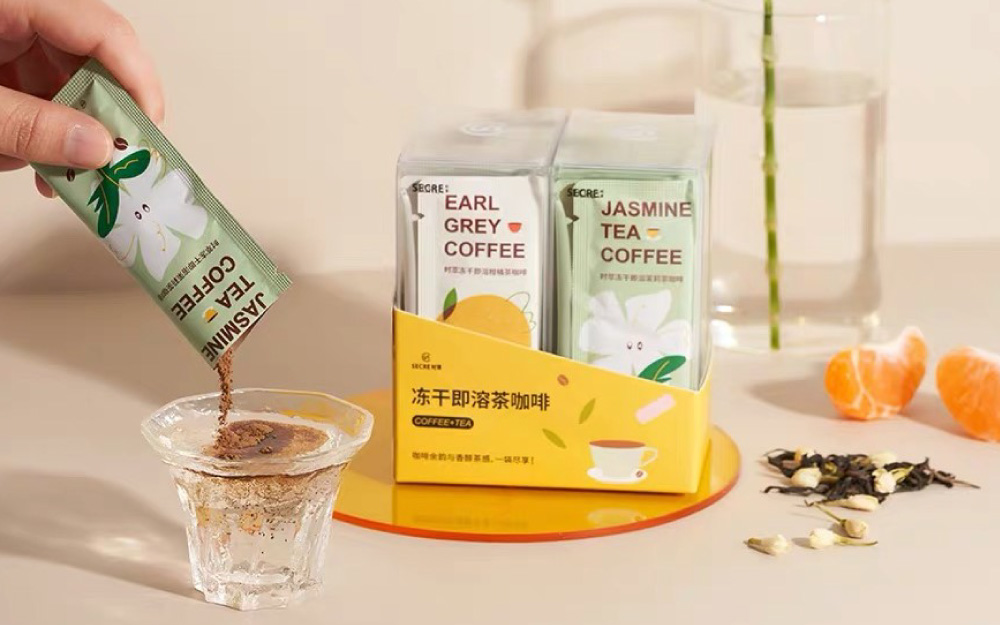
Another domestic brand of instant coffee is Secre Coffee. Secre Coffee was founded by former executives of major coffee businesses and tech firms, including Starbucks and Uber. Its estimated sales reached around RMB 120 mln in 2020. Secre adopts a tea-inspired product strategy and its product range includes Earl Grey Coffee and Jasmin Tea Coffee.
The Chinese coffee scene is also attracting private foreign investors. Read this interesting human interest story about a Canadian coffee grader who started his own coffee shop in the northern port city of Dalian.

The Russians are back

The Russian coffee brand Lebo opened its first coffee shop in China in Harbin in 2021. Harbin had a large Russian community in the decades after the Russian Revolution until the establishment of the PRC.

Blue Bottle Coffee’s Debut in Shanghai
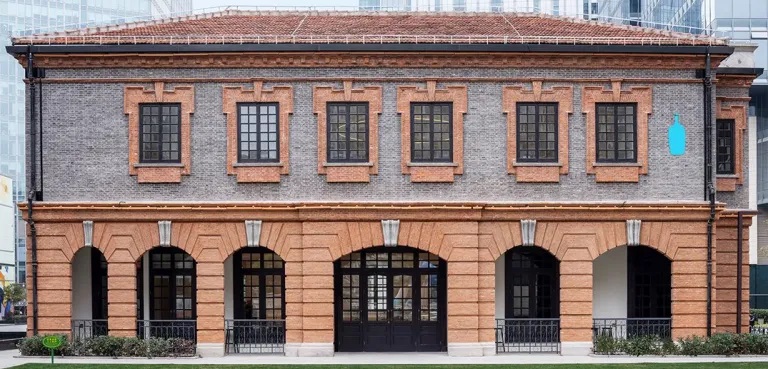
Blue Bottle is a coffee roaster and retailer headquartered in California, United States. In 2017, Nestlé acquired around 68% of Blue Bottle Coffee’s stake. By then, the brand had 40 stores worldwide. Five years later, its number of stores has been expanded to 100, and the Shanghai store is the first one that Blue Bottle Coffee opened in the mainland of China. The coffee store opened on February 25, 2022. Some people woke up at 6 am just to get a cup of Blue Bottle coffee, and on average, it took 3 hours for consumers to get in line and enter the store. The company has adapted to the Chinese palate. At the Blue Bottle Coffee Shanghai store, consumers can have local snacks to match the coffee, such as mung bean pastry (lüdougao) and mahua, a kind of fried dough food.

Medicinal coffee

Coffee has become such a lucrative product, that even an old established traditional Chinese pharmacy like Tongrentang has started a medicinal cafe that serves various types of coffee enriched with medicinal herbs.

Fruit-flavoured coffee

Shanghai based S.Engine Coffee launched an orange flavoured coffee (or should we say coffee flavoured orange juice?) in 2021. Chinese love to add fruit flavours to all types of foods and beverages.

OrangeCoffee

Strategic alliances

Strategic alliances are one way for foreign players to get a foothold in the Chinese market. Lavazza is cooperating with the shopping mall chain Parkson in operating a chain called Coffii & Joy.

In 2020, China’s Internet giant Tencent entered into a strategic alliance with Tim Hortons, investing in Tim’s entry into China. Tim plans to open more than 1,500 stores in China within 10 years. Statistics show that 80% of Tims China’s sales come from WeChat applets. Tims and Tencent jointly built the first esports themed coffee shop in China, also opened in Shanghai in November 2020, providing users with a strong social attributes “esports + coffee” life scene. Tims Coffee China CEO Lu Yongchen revealed at the end of 2020 that he has made an overall profit in all its stores. Previously set up shop plan, is expected to be shorter.Tims Coffee currently has nearly 200,000 members and a monthly repurchase rate of 40%.

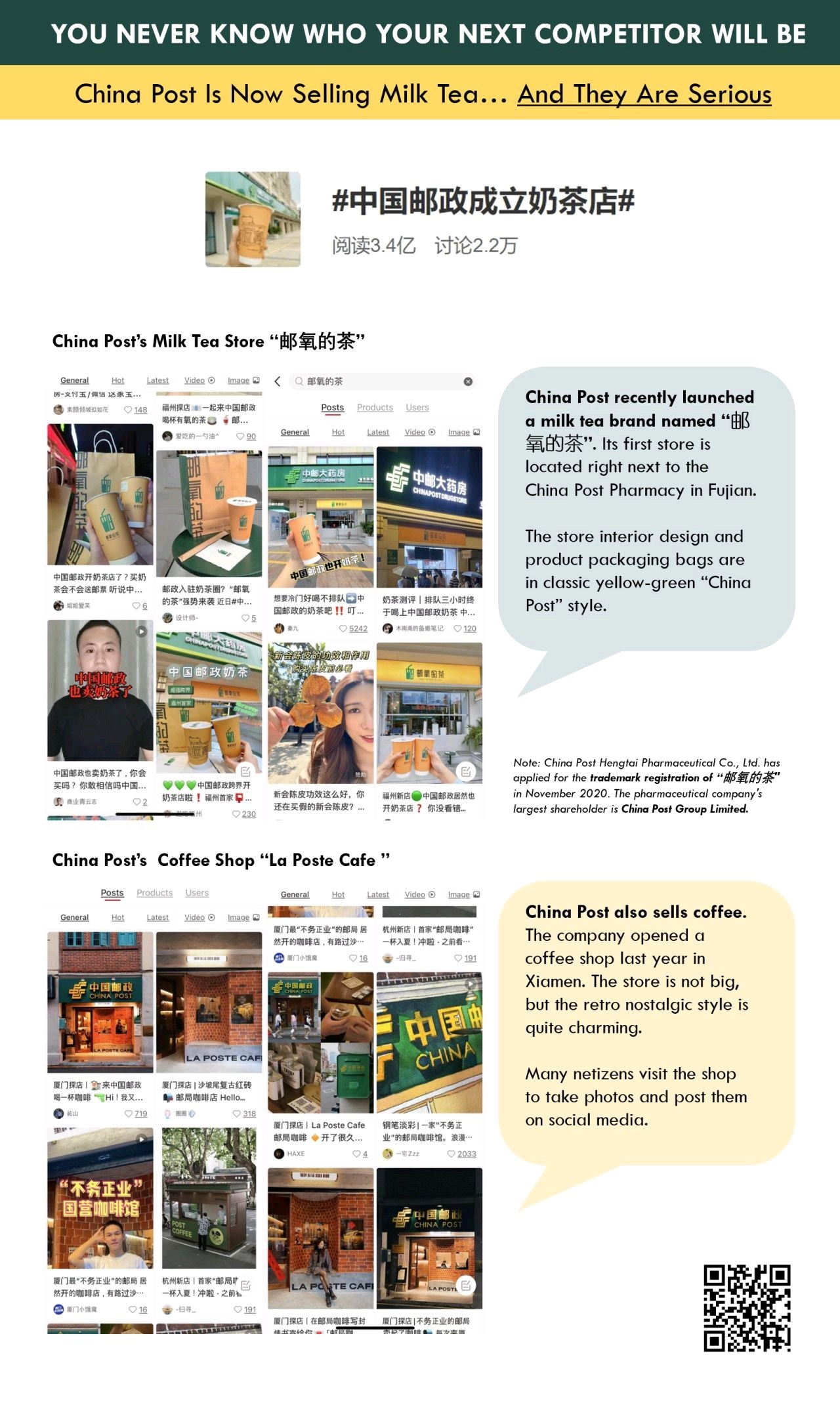
Coffee is now regarded as such a money maker, that the most unexpected parties are venturing to tap this market. China Post got the idea in 2021 that it could use the obsolescent post offices to add or turn them into coffee shops. The first one was opened under the fancy French name La Poste Café.
Coffee on the road

A huge, and still growing, market for coffee in China is: the express way. China’s network of express ways is still growing and so is the number of Chinese going on self-drive holidays. Gas stations along the express ways have turned into full-grown resting areas, often including several restaurants and shops. Coffee is a good way to stay alert behind the wheel, so gas stations have become a place for coffee shops and coffee vending machines.

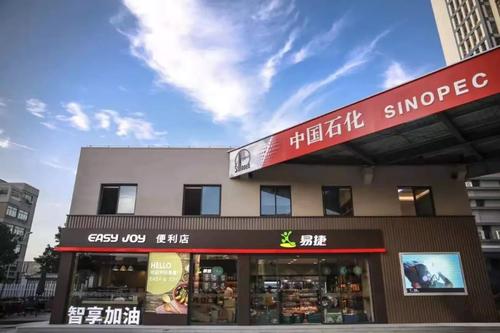
Sinopec, one of China’s top gasoline makers and distributors, has started a coffee brand of its own, called Easy Joy, to complement the services in its own gas stations. To reinforce the ‘gasoline image’ of the chain, it advertises its coffees with octane numbers: ’92 95 08′. On December 22, 2020, Sinopec Easy Joy announced the establishment of a joint venture with the Internet coffee brand “Lian Coffee,” the main gas station convenience store coffee business. On the same day, “Easy Joy coffee” Beijing first store settled in Beijing Longyu Yuquan gas station, officially open for business.
Coffee without baristas

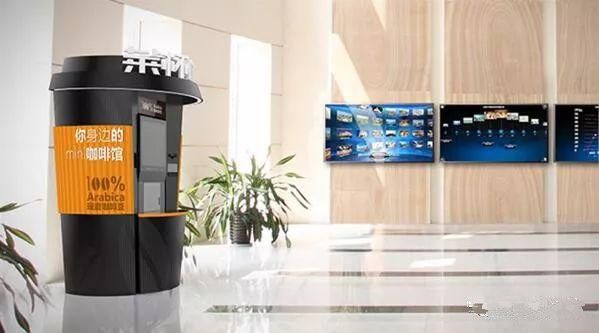
Laibei Kafei (2015), a transliteration of the Chinese expression for ‘give me a cup of coffee’, is China’s first supplier of coffee vending machines. Supermarkets, shopping malls, etc., can place them in suitable locations to provide coffee to their patrons,  with all the issues that come with establishing a coffee corner with life baristas.
New coffee shop adds modern flavour to Palace Museum
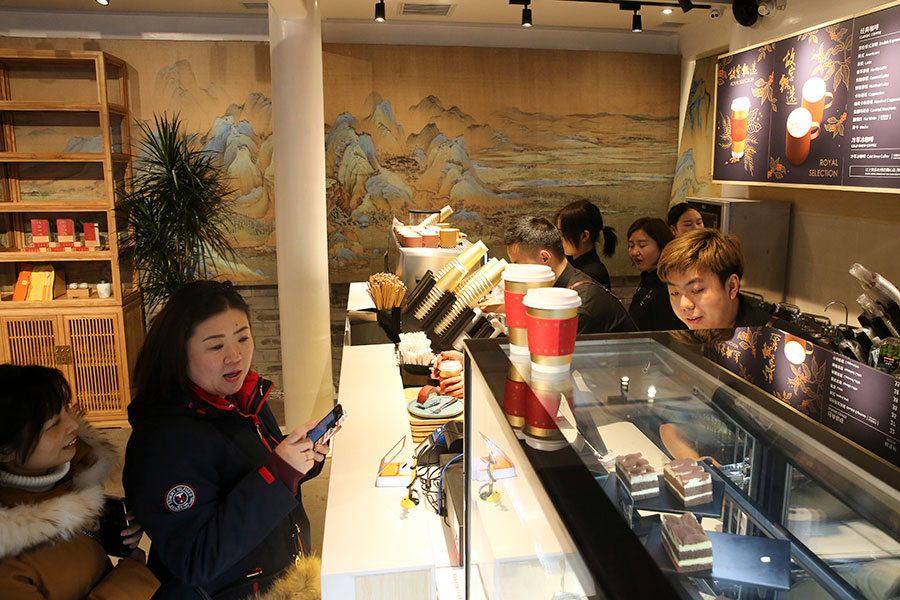
The Palace Museum opened a coffee shop for the modern-day guests of Chinese emperors over the weekend-the Corner Tower Cafe-and it quickly became a hot spot for visitors, bringing traditional cultural heritage closer to the younger generation. The cafe serves more than 30 kinds of coffee, tea and other drinks-priced between 22 and 45 yuan-for 40 guests at a time. Visitors don’t have to buy tickets for the museum to enter the cafe. Officials said a restaurant, also called Corner Tower, will open soon near the museum entrance. This move is slightly controversial. Some years ago, Starbucks was not allowed to open an outlet in the Palace Museum, because ‘a coffee shop does not fit into that historic ambiance’.

Lots of cash but little time

RTDs and instant products are driving coffee’s ascendency, perhaps because, as we are informed often, the Chinese are becoming increasingly cash rich and time poor. While this is clearly a marketer’s dream statement, largely designed to flatter consumers into believing the hype, it is also reflective of the coffee market. Chinese don’t have time any more to learn to brew real coffee. It’s just quicker and easier to empty a three-in-one sachet and add water or open a bottle. For consumers, it takes too long to grind the beans and brew the coffee. People like things that are mixed already. However, this is more by culture than necessity. Ever since Nestlé opened up China’s pre-mixed powder market with Nestea relatively recently, consumers have got in the habit of keeping things simple. According to Damin’s Wang, instant coffee volumes have been growing slowly, with an increase in consumption that is nowhere near as fast as is being found in coffee shops. “[Malaysian brand] Old Town White Coffee has played a big part in pushing instant coffee to China. Before that, there was only one real choice over the past few years, and that was Nestlé. Now we have many more brands, both good and bad,” says Wang. It’s safe to say that tea is not currently under any threat from the rise of the coffee granule, and its market is still growing. Indeed, China is forecast to account for half of all global growth in tea demand through to 2017, according to Rabobank, and tastes are changing among traditionalists too. Wang, whose company also supplies tea to trade customers, says ice tea has been the packaged segment leader, though its prominence is slipping. “The most popular tea drink is ice tea, though this in in decline because unsweetened or zero-calorie teas are on the rise as people become more aware of health issues,” he says. “Traditional tea drinking continues to increase, though. And now young people have the opportunity to choose what they need, be it packaged tea, three-in-one coffee or traditional China tea. “Coffee needs about 10 more years to grow before it becomes a big market in China.”

Expensive tastes

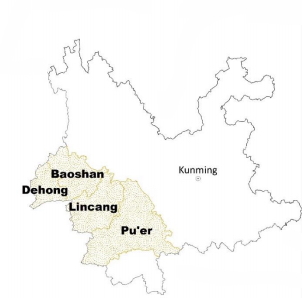
While coffee is a staple everyday purchase for most office workers in the UK, it is considered a premium product in China and is a luxury out of reach of most average workers. In Starbucks, a medium latte is RMB 30. Starbucks has come under fire by state media in China for their high prices, especially as the cost of doing business is generally considered to be cheaper in China. The average monthly wage in Shanghai is RMB 5891, less than a third of the average wage in London, making a RMB 30RMB cup of coffee a luxury most can’t afford. However, a high price is considered a sign of quality in China. The more expensive the better. There is still this concept in China, and Starbucks and Costa realise this. They want to brand themselves as premium chains, that’s why they price slightly higher in China. Most of the coffee on sale in coffee outlets in China comes from imported beans. However, China is also growing as a producer of coffee, with the majority grown in Yunnan province in southern China. You can read more about that in my special post on coffee and tea in Pu’er.
From 2017, several new coffee shop chains have popped up in China. Most of them position themselves in the higher end of the business. A good example of this type of coffee shops is Greybox Coffee that likes to set up shop in business districts in major cities. Japanese niche coffee shop Doutor has also set up shop in China, in a joint venture with a local partner TANSH Global Food Group which runs the Shanghai Min and Maison De L’Hui restaurants. With a 65% stake in the venture, Shanghai-based TANSH facilitates Doutor’s mainland operations.

   

China has also started to export coffee. In 2017, China exported $237 million of coffee beans. As of June of 2019, China has exported around 1.4 million 60-kilogram bags of green coffee beans. Export of green coffee beans shows a stable growth, as quality is improving.

Coffee exchange

The Shanghai Free Trade Zone has just established a Coffee Exchange Centre to boost the China trade for what is the oldest intercontinentally traded commodity in the world. It is not compulsory for companies to trade in the center, but those which do will benefit from Free Trade Zone’s duty-free and foreign exchange policies. By the end of 2015, both companies and individual customers will be able to buy coffee beans on the center’s website. The new center is projected to conduct transactions worth RMB 120 billion by 2018, and aims to overtake Singapore as Asia’s largest coffee exchange.

Nostalgic coffee

Besides the wide array of international and domestic coffee chains that are popping up in China’s major cities, some coffee places of the old days are being revived. A recent example is White Horse Coffee, a coffee shop established in the Jewish quarter of Shanghai, when a large number of Jewish refugees settled there in the 1930s. Hongkou district’s government decided to rebuild the “White Horse Coffee” as part of Shanghai Jewish Refugees Museum’s extended exhibitions. The new “White Horse Coffee” will be located opposite the Shanghai Jewish Refugees Museum. The design and decoration of the new “White Horse Coffee” will stay as close to the original as possible to provide a glimpse into the life of Jewish refugees of that period.

Ethnic coffee

A Tibet-inspired coffee shop, Charu, has recently opened in Chengdu (Sichuan). The place is spacious, outfitted with aged wood panels, edgy houseplants, and dangling Edison-style bulbs. It’s staffed by young people and the couches are upholstered in different shades of blue—the sort of patterns you would expect from a swanky Malibu patio by the beach. The word charu refers to the toggle that links yaks together, according to Tsehua, one of the owners. It connects the tents and the yaks together. Like the charu, this cafe to connect people together.

Tsehua comes from a family of nomadic herders from Hongyuan County in the Amdo Region of Tibet, located in modern-day Sichuan. They live in black tents fashioned from yak hair and rotate around the grasslands according to the seasons.
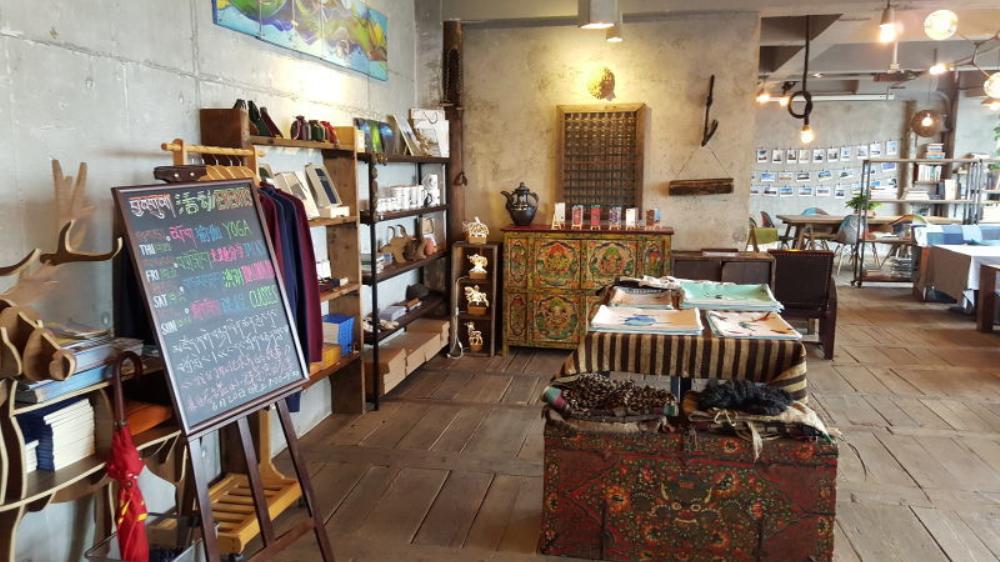
CharuCoffee

Charu has a beverage menu of yak-based drinks—among which is yak milk coffee, decorated with the cafe’s logo. The milk is brought in weekly, sent overnight from Tsehua’s nomadic village of Hongyuan. There’s yogurt, which is made in the same place, and as an option, it can be supplemented with highland barley and raisins. The menu also features a juice squeezed from sea buckthorn, a berry from the Himalayas that tastes like a cross between a mango and an orange.

It is this type of new hip spaces that multinationals like Haagen-Dazs find it hard to compete with recently. The ice cream maker has started cooperating with Illy in China. Its outlets can now also function as alternative for the crowded coffee shops.

Coffee as metaphor

Coffee has now become so popular, that the word is gradually transforming into a symbol for a modern leisurely lifestyle. A traditional Chinese medicine (TCM) store in Hangzhou (Zhejiang) has developed ‘herbal coffee‘ to wrap that traditional product in a modern package.

Coffee as flavouring

As coffee is growing more and more popular, many Chinese producers of foods and beverages are developing coffee flavoured varieties of their products. A good example in an earlier post is: coffee flavoured plums.

Snack producer Sanquan (Zhengzhou, Henan) has launched a coffee-flavoured zongzi in 2018.

One of my personal favourites is affogato, one or two scoops of basic vanilla icecream soaked in strong espresso. I first found it in China in some häagen-dazs outlets, but was not impressed by it, mainly because the coffee wasn’t strong enough. I was pleasantly surprised to find a decent affogato in a new (not yet opened) hotel at the north end of Wangfujing Street in Beijing during in September 2018.

Chinese investment in Argentina

A Chinese investor based in China’s northernmost city Harbin (Heilongjiang) is investigating the possibilities of investing in a 400 hectares coffee farm in Argentina, in cooperation with a local overseas Chinese partner. The coffee is to be roasted in Harbin, using technology imported from Brazil. I will keep you informed about the developments of this project. The Harbin region currently consumes about 60 mt of coffee beans per year.

Chains going abroad

Chinese coffee chains are also venturing abroad. In 2015, Mellower led China’s premium coffee to go international, becoming the first Chinese premium coffee chain brand to expand into overseas markets. In March 2023, Luckin Coffee expanded to Singapore with nine outlets strategically located in the core business districts. In 2023, Cotti Coffee opened its first store in Jakarta, , following the launch of its outlet in Seoul, South Korea. At the beginning of 2023, Cotti Coffee announced its goal of opening 10,000 stores in three years. Remarkably, within nine short months since its first store opened, they have already launched 5,500 stores worldwide, averaging over 500 new stores per month. targeting tech-savvy youth. They successfully penetrated the American Asian e-commerce platform Yami. Saturnbird coffee, Tasogare, and Yongpu, embraced a digital-first marketing approach. They successfully penetrated American Asian e-commerce platforms like Yami and Weee!

R&D

A study by the Kunming Institute of Botany, Chinese Academy of Sciences, published in 2026, showed that fungi can be used to enhance the flavour of coffee. A research team established a microbial repository containing 655 endophytic fungal strains from five Yunnan Arabica cultivars across three maturity stages and selected six representative strains that could make coffee more flavourful. The standout strain, Talaromyces funiculosus KQ2, used as a fermentation agent, can raise the sensory score by 1.5 points, exceeding the specialty coffee threshold of 80 points, while imparting distinctive vanilla-cinnamon notes. Metabolomic analysis also showed a 17.11 percent increase in sucrose content.

More than coffee

Coffee has now become such an important item in the lives of more and more Chinese that domestic coffee companies have started looking at expanding their activities to related products. Hogood Coffee (Yunnan) announced the development of a healthier alternative for vegetable fat, the main ingredient for coffee creamers, based on walnut protein.

Peter Peverelli is active in and with China since 1975 and regularly travels to the remotest corners that vast nation.
Fish paste – from offal to Chinese haute cuisine

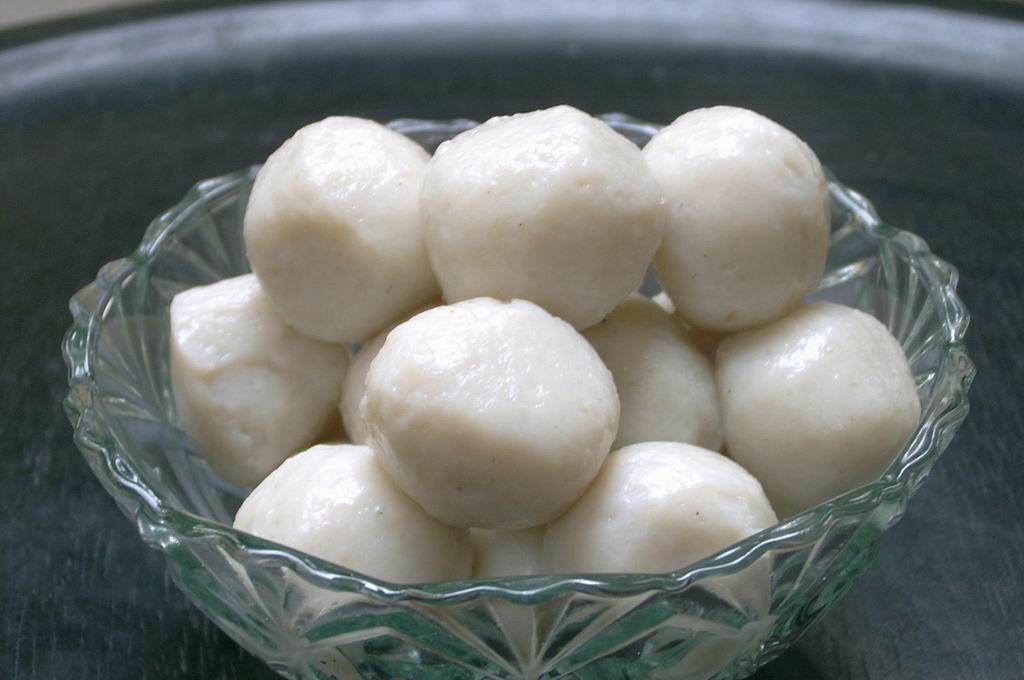
Fish paste is a good example of a Chinese food ingredient that is widely used, but disproportionally little known. The best known product made from fish paste is the fish ball, shown in the picture, that is an indispensable part of the southern Chinese hot pot. However, it can be used in many more dishes of which I will introduce a few examples later in this post.

FishBalls

Fish paste used to be made at home by chopping a piece of fish by hand. For beginner, try to get a small size fish (approx. 600g) as it is easy to handle. Mackerel is popular material for fish paste. Choose one with some dots on the skin.

  • Remove head and all the internal organs. Clean the fish and pat dry. Slice both side of the fish, making sure that the flesh does not contain any bones;
  • Use a spoon to scrape the flesh, including the flesh that may still be on the bones; Chinese do not like to waste any food;
  • Prepare 1 tsp salt;
  • Sprinkle 2/3 tsp salt and dash of white pepper powder on the flesh;
  • Add water to the remaining 1/3 tsp salt;
  • Use the back of the knife to chop the flesh evenly; remove (pieces of) bones that you may spot in the flesh;
  • Add the salted water during the chopping process. A little bit at a time. You will find that the flesh will become sticky and make the chopping getting harder.

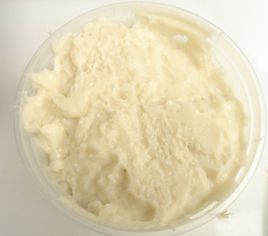
This gives a basic paste that can be placed in a suitable container to ferment for a number of days. The natural enzymes in the flesh will break down part of the protein to give the past a strong, almost pungent, fishy smell. As this picture shows, it is hardly recognisable as something made from fihs.

FishPaste

Fish paste like this can be prepared in larger quantity and frozen in portions big enough for one dish.

Dishes

For making fish balls, starch is added to the fish paste, after which you can make balls in a similar way as you are used to make meat balls for your soup.

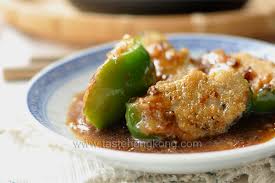
The same starchy fish paste can be used to stuff pieces of bell pepper or bean curd, to prepare ‘stuffed pepper’ (see picture) or ‘stuffed bean curd’, famous dishes of Cantonese cuisine.

StuffedPepper

Instead of fish balls, you can make fish sausages, still using more or less the same stuff.

Industrial production

The industrial production of fish paste is big business. The 2023 output of fish paste products in China is estimated at 1,466,400 mt. Virtually all offal of the processing of any aquatic product can be used to make fish paste. In this respect, you might conclude that the production of fish paste in China is analogous to the production of pulverised chicken meat that is used to make products like chicken mcnuggets. Your first reaction when you learn about the details may be ‘yuck’, but it makes sense to reduce waste to a minimum. It can add valuable protein to any food.

The stages of the industrial process are

  • heading and gutting;
  • separating;
  • washing and rinsing;
  • refining;
  • dewatering;
  • mixing;
  • filling;
  • freezing;
  • packing;
  • storage and delivery.

This is industry has become big enough to make it worth the effort for machine makers to develop dedicated equipment for the production of fish paste.

The industrial recipes include a number of ingredients for protecting the paste against frost damage (e.g. sucrose, egg white, sorbitol), texturisers (calcium salts, hydrocolloids) or humectants (phosphates), and of course various flavours.

Ingredients

Apart from from fish, main additional ingredients of fish paste are:

  • (Modified) starch; fish meat contains 72-80% water. Starch or modified starch is needed to bind some of that water to improve the texture of the fish paste. An ingredient particularly mentioned in the Chinese literature is low cross-linking esterified starch.
  • Vegetable protein/egg white; this improves the elastic properties of fish paste.
  • Oil/fat; to improve the flavour and organoleptic properties.
  • Gelatine; to get smooth jelly-like past.
  • Sugars; Sugars have a number of effect on fish paste. One is that it removes some of the fishy flavour that is too strong for many Chinese. Insiders recommend sorbitol as the most effective in this category.

Innovation and haute cuisine

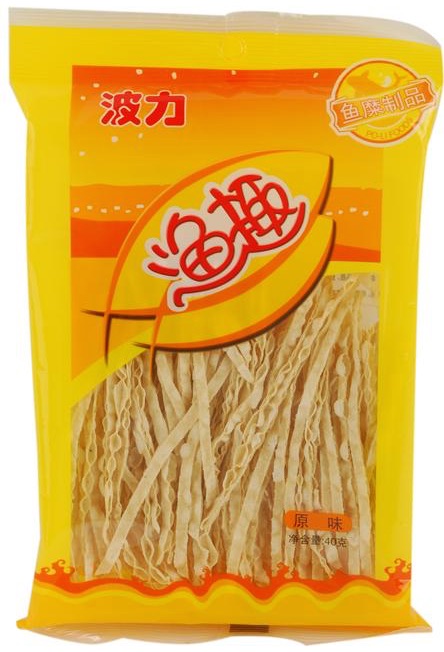
These new processes enable the development of a growing range new products like fish noodles, shrimp cake, fish beancurd, fish strips (look like noodles, but mainly consist of fish paste, unlike the fish noodles that are noodles flavoured with fish paste), fish cubes, fish ham (no pork used!), fish sausages, fish filling for dumplings, or fish aspic.

Boli brand fish strips come in two flavours: natural and spicy.

Boli

Nutritional value:

Item per 100 gr
Energy (kcal) 323.85
Hydrocarbons (gr) 57.00
Fat (gr) 2.75
Protein (gr) 16.75

Ingredients as indicated on the label:

Fish paste, starch, sugar, salt, pepper, potassium sorbate.

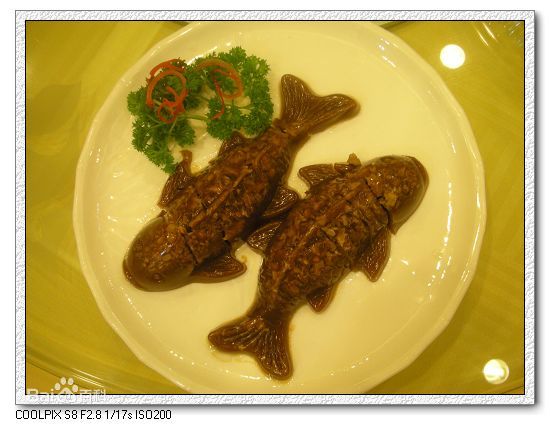
Fish aspic includes hydrolysis of the proteins using the enzyme neutral protease. As the picture shows, this ingredient extracted from fish can then presented again in the form of a fish. This is the ultimate goal of haute cuisine Chinese style: creating an improved form of the original raw material. A good place to taste it is Beijing’s Duyichu Restaurant.

FishAspic

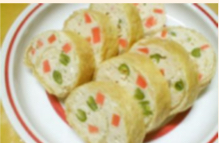
Another interesting variety is mixing fish paste with small cubes of vegetables or mushrooms of various colours, shape that into a large sausage shape and wrap it in a sheet of fried beancurd. After boiling, you can serve slices of this sausage as a fancy fish paté.

I am sure that more ‘fishy’ products will appear in China in the near future and I will keep you abreast about those developments by updating this post.

Fish paste forum

Fish paste is becoming such an important ingredient, that this year a special International Forum will be organised around it in Xiamen (May 19 – 20, 2016). Topics discussed will include applications like surimi.

Peter Peverelli is active in and with China since 1975 and regularly travels to the remotest corners of that vast nation.
Chinese desserts

Experts estimate that the value of the Chinese chicken dessert market will rise to RMB 109.1 billion in 2024

Dessert is not served at Chinese meals in the same way as in Western countries. Generally there is no separate part of a meal that is reserved for eating sweet dishes. Banquets typically end with a plate of assorted fruits. However, China is home to many dessert-like foods, either as part of a meal or as a snack.

Bing

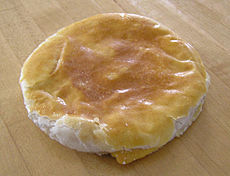
Bing refers to a large and varied group of baked wheat flour based pastries. They are either similar to the short-pastry crust of western cuisine or flaky like puff pastry, the latter of which is often known as su. The preferred fat used for bing is lard. One of the more commonly known are the moon cake (yuebing), and wife cake (laopobing (second picture); sometimes translated as sweetheart cake), pastry with a thin crust of flaky pastry, and a filling of winter melon, almond paste, and sesame, spiced with five spice powder. An interesting combination of Chinese and Western ingredients is the deep fried mantou, served with sweetened condensed milk (first picture).

FriedMantou Wifecake

Tang

Chinese candies and sweets, called tang, Chinese for ‘sugar’, are usually made with cane sugar, malt sugar, and honey. These sweets often consists of nuts or fruits that are mixed into syrup. Dragon’s beard candy (longxutang) is a traditional example (first picture), and White Rabbit Milk Candy a modern variety.

Sugar coating of various fruits can also be regarded as part of this category of Chinese sweets or desserts. The traditional favourite fruit here is the hawthorn. Hawthorns are a member of the rose family and the red berries are the size of a large, round, rosehip. Eaten raw they are incredibly sour and quite astringent, but rolled in oil then confectioner’s sugar and left to dry gives the crunchy, sour hawthorns a crisp sweet white crust (bingtang shanzha; second picture). In northern China, street vendors sell glazed hawthorns (tanghulu, literally: ‘sugar calabash’; third picture), made by dipping skewered hawthorns in melted sugar.

Longxutang

BTSZ  THL

McDonalds China has picked up the tanghulu and combined it with its McFlurry concept making a Tanghulu McFlurry.

Guo/gao

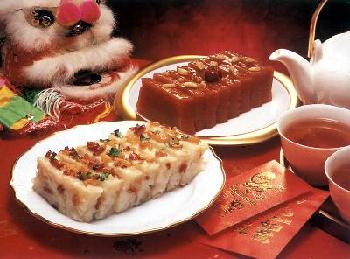
Gao or guo are soft glutinous snacks that are typically steamed and may be made from glutinous or normal rice. Some are made from sweet potato or yam; see e.g. the separate post on Sweet Potato & Yam Pastry These rice based snacks have a wide variety of textures and can be chewy, jelly-like, fluffy or rather firm. Various types of gao include Niangaoa popular type of rice cake, which can be served as a sticky treat or a pudding, flavored with red bean paste or rosewater (first picture), baitanggao, and tangyuan.

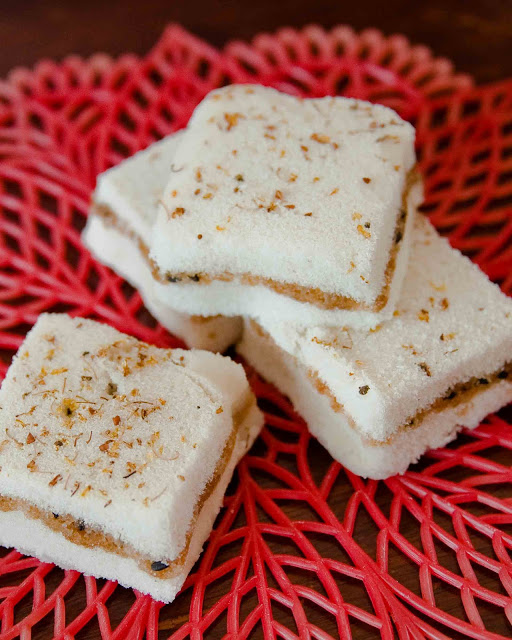
Guihuagao, or sweet osmanthus cake (second picture), is a more delicate variety in this category. Made in a very traditional way, the two layers of steamed white unsweetened ‘cake’ sandwich a sweet red bean paste and black sesame seed filling, with the osmanthus flowers adding a gentle honey scent.

Niangao  Osmanthus

Ice

Shaved ice desserts with sweet condiments and syrup is common eaten as a dessert in China. Ice cream is also commonly available throughout China, and Chinese are getting more and more inventive in creating

Baobing

Jellies

Chinese jellies are known as dong. Many jelly desserts are traditionally set with agar and are flavored with fruits, though gelatin based jellies are also common in contemporary desserts. Some Chinese jellies, such as the grass jelly (liangfen) set by themselves. Grass jelly is a jelly that is made by boiling the stalks of a mint-like plant in potassium carbonate and letting it cool to room temperature. It has a slightly bitter taste and is often mixed with soy milk. Jellies sometimes have medicinal properties. Another famous variety is Almond Beancurd (xingren doufu) Almond tofu is a common and popular Chinese dessert in hot summer. It can be considered as the Chinese version of panna cotta. It is also referred to almond jelly. The recipe differs slightly from places in China, but the common ingredients are all similar: almond, sugar, and agar.

elaine

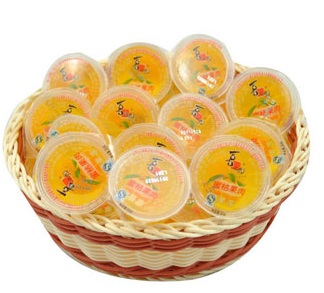
Traditional jelly has become a big money maker as a treat, in the form of fruit jelly (guodong) packed in small plastic cups. The value of this market was RMB 25 billion in 2018. The picture shows tangerine flavoured jelly with the following ingredients.

Sugar, tangerine pulp, konjac, additives (carrageenan, calcium lactate, citric acid, sodium citrate, potassium chlorate, food flavour, sodium cyclamate, potassium sorbate, b-carotene, tartrazine, sunset yellow)

FrJelly

Soups

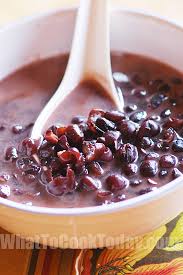
Chinese dessert soups (tang ‘soup’ or hu ‘broth’) typically consist of sweet and usually hot soups and custards. Some of these soups are made with restorative properties in mind, in concordance with traditional Chinese medicine. A very common example is red bean soup (hongdoutang).

RedBeanSoup

Modern desserts

Modern desserts, in particular dairy based desserts like yoghurt or pudding, are widely available in China in a broad range of flavours and textures. See, e.g., my post on ‘old yoghurt‘ earlier in this blog. Babao porridge is sometimes served as a dessert as well.

Puding

Peter Peverelli is active in and with China since 1975 and regularly travels to the remotest corners of that vast nation.
The Power of Geographic Branding in Food Industries

Food brands inspired by the name of their home region is easy to grasp. When a local product starts being promoted elsewhere, branding it with the name of a famous city or region of origin can help push the brand name quicker than when a completely new brand name is forged.

Some of those brand names become so common, that the average consumer gradually forgets that it is a geographic name. Good examples are Worcester sauce or Dijon mustard.

The reversed situation, regions being named after their most famous food or drink, is much rarer.

Chinese local governments, in particular cities, have discovered the power of local foods in increasing the (inter)national awareness of their home region.

Tea city

PuerTeacity

In an earlier post, I introduced how Pu’er tea has been so important for its home region in Yunnan province, that the central city in that region decided to change its name from Simao to Pu’er. The text on the stele in the picture says ‘China’s city of tea’.

Spiritual airport

MaotaiAirport

The Wuliangye Group, the producer of Chinese most famous type of baijiu, made headlines a few years ago by proposing to change the name of the airport of its home town of Yibin to Wuliangye Airport. This has so far remained an idea.

Its competitor Maotai Group in Guizhou has been more successful. Renhuai county will soon open its Maotai Airport. The picture shows the ceremony celebrating the start of the construction.

Let’s hope that the pilots departing from it will not sample too much of this local specialty.

This post is still relatively short, but I intend to add examples as they occur.

Eurasia Consult Food knows the Chinese food industry since 1985. Follow us on Twitter.

Eurasia Consult Consulting can help you embed your business in Chinese society.

Peter Peverelli is active in and with China since 1975 and regularly travels to the remotest corners of that vast nation.
 

Reviving China’s Traditional Food Brands

We are experiencing a moment in time in which the Chinese are looking back at the nation’s long history with more appreciation for traditional values and things Chinese to be proud of. This includes a number of old famous food brands (laozihao in Chinese) that have (almost) gone lost in during the years of rapid economic growth. Of the 2000 traditional brands in China, about 27% are food and beverage businesses, according to a research report from Beijing Technology and Business University.

Several of the Beijing-based brands used to enjoy national fame — Yili, Sanyuan, Beibingyang, Liubiju, and Wangzhihe. Curiously enough these old Beijing brands still have large numbers of loyal customers but also mirror the development of typical State-owned enterprises in the capital. A number of famous old brands based in other regions of China are being revived as well. The national government has started to protect those brands with a system of certification.

Beibingyang

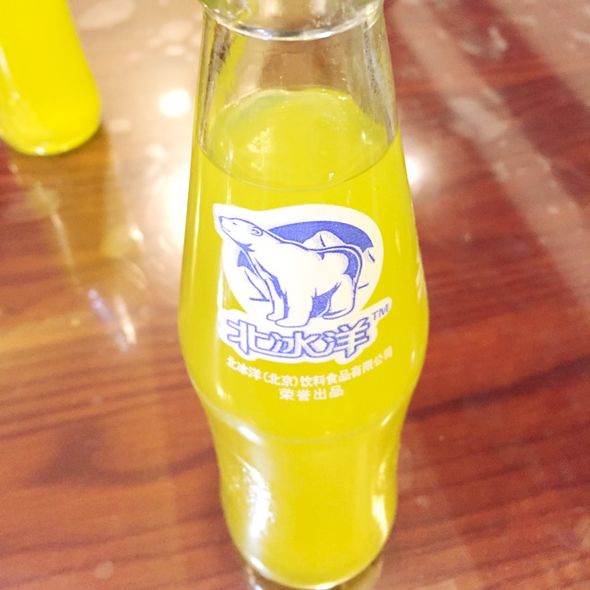
The Beibingyang Beverage Co’s soda water, for example, can be seen in snack bars and small restaurants in the city where it is quite popular, with demand always far outstripping supply on hot summer days, according to Ma Chunying, Party head of Beijing Yiqing Holdings Ltd, a Beijing-based food manufacturer, who added, “Beibingyang Beverage grew out of an ice plant that started in 1936, so it’s nearly 80 years old.”

BBYsoda

Beibingyang (Northern Ice Sea) used to be China’s top brand soft drink, but disappeared 15 years ago, when it proved unable to reposition itself in the world dominated by Coca Cola and the likes. Yili announced its return in 2011.

Yiqing literally means ‘First light’ and is an abbreviation of the Beijing First Light Industry Corp., a management vehicle of the part of the industry that used to be operated by the Beijing Bureau of Ligh Industry, which in turn was the local branch of the Ministry of Light Industry. This ministry was demoted to the China Light Industry Association and the former ministry’s local branches were reorganised into holding companies that managed the individual companies. ‘First’ refers the lighter types of industry like food.

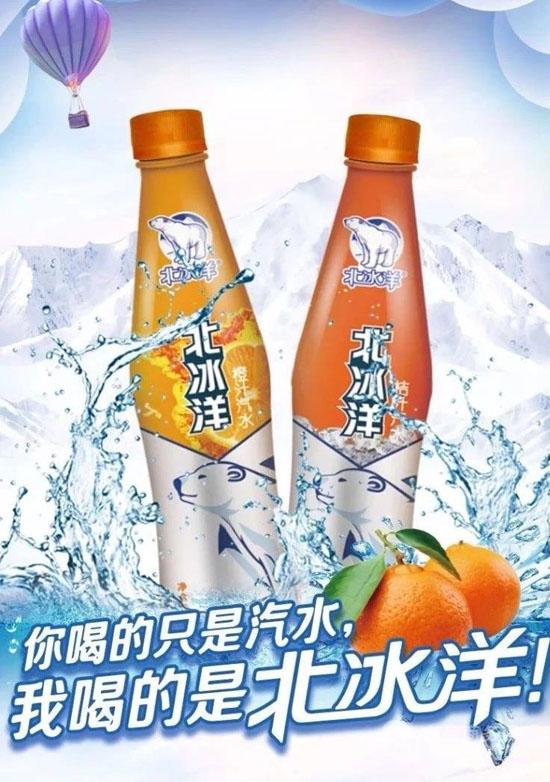
Beibingyang is performing well. The company has filed a turnover of RMB 600 mln for 2017. It has also launched a type of peanut-based protein beverage of its own, under the Beibingyang brand. It has also started to pack its soda in PET bottles mid 2018 (see pictures).

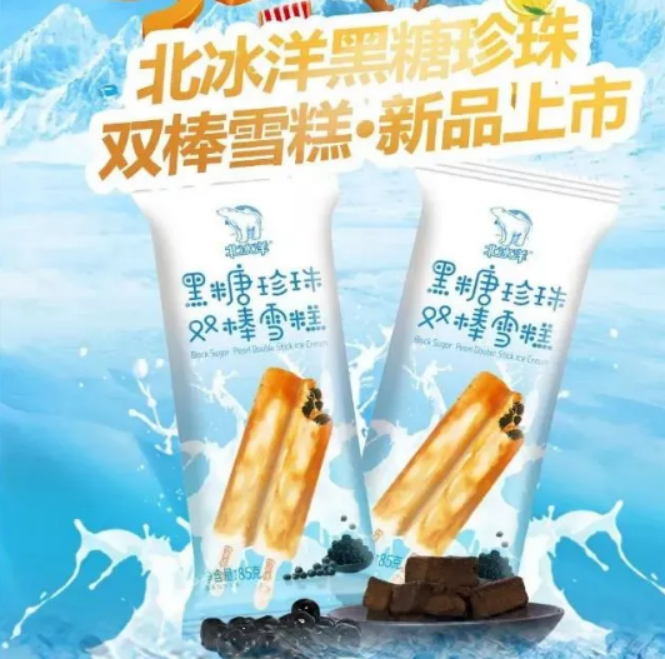
Based on its initial success, Beibingyang launched its first ice cream popsicle, Brow Sugar Pearl Double Stick ice cream, in the summer of 2020.

For me personally, reading the brand name Beibingyang alone brings back my own memories of my year in China in 1975-76.

Yimin ice cream

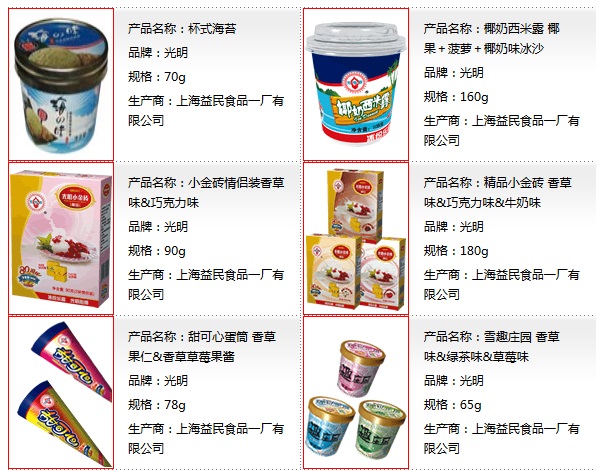
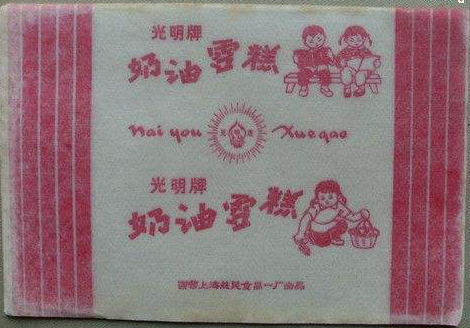
The resurrection of Shanghai Yimin No 1 Food Factory, one of China’s oldest ice cream makers, is creative: the brand chose a new durian flavoured sundae to announce its comeback. Yimin’s vanilla ice cream has some history to it. Now the brick-shaped dessert sells at RMB 8 yuan apiece. Back in its heyday in the 1950s, its price was RMB 0.25. Its popularity continued through the 1980s and 1990s. Its size and shape resembled a soap bar (see photo above). And consumers would dip it in soda water, mix it with cookies and fruits, or even allow it to melt so they could use the fluid as a dressing on fruit salad. Those were the days when air conditioners and refrigerators were still few and far between at homes. At its peak, Yimin’s vanilla ice cream commanded nearly 80% of the local market. But then, the ubiquitous imported ice cream brands mauled the 95-year-old firm’s offerings. Let’ watch and see if the new flavour can help Yimin recoup some of that old market share.

Moqi

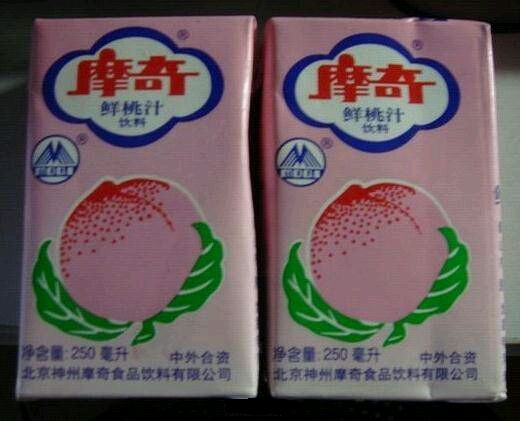
Moqi Peach Drink is not even a very old brand. Launched in 1984, and booming by 1992, the brand faded away before the end of the century. It grew a dull and old-fashioned image and was no match for the ‘modern’ international soft drinks. However, Moqi was relaunched on February 5, 2018.

Yili

Yili bread (not to be mixed up with Yili, China’s top dairy company), another Yiqing Holding brand, especially the type filled with jam, was known in practically every household in Beijing in the early 1960s and ’70s, and, Ma adds, “This bread keeps the traditional flavor and texture of dozens of years ago and which is still popular, and along with Beibingyang soda water, in the words of one customer “still brings back childhood memories”. In fact, reading the brand name Beibingyang brings back my own memories of my year in China in 1975-76.

YiliBread

These sentiments for old brands fit in with the current trend in China to go back to traditional Chinese values and respect the good things of Chinese culture. Protecting a number of national brands is another distinctive trait of the current Chinese government, as I indicated in the post on infant formulae.

An employee of Yili bread, Zhang Chunlin, explains why it still tastes good after so many years of development by saying that the company insists on using the traditional fermentation method, which produces the particular flavor and nutritional benefits and that the food safety is a major concern for Yili and Beibingyang, which claim to have strict production standards for raw materials and processing. Yili bread does not have any food additives or trans-fat, which can increase the risk of disease.

Sanyuan

When it comes to food security, no one feels stronger about it than Sanyuan, according to a company spokesman, which is a Beijing Sanyuan Foods Co brand and one of China’s leading dairy producers. Sanyuan started life as the Pingjiao State Farms Administration office in 1949, the year of the founding of the PRC; another government agency turned company.

SYmilk

China’s diary business was badly hurt by the 2008 scandal in which several giant Chinese companies were found to be adding melamine, a chemical that can cause kidney and other damage, to their food, while Sanyuan’s products, a relatively smaller operation, proved to be safe. Since then, the government has imposed tighter quality controls on the industry, and has tried to restore consumer confidence. Sanyuan acquired most of the assets of Sanlu, China’s largest dairy company until it got bankrupt as a consequence of the melamine incident.

In a spot inspection, in 2011, China shut down 426 dairy producers and told another 107 to suspend operations until they made improvements. Then, in 2014, the Beijing government gave RMB 10.8 mln to the Sanyuan Group to develop safer, healthier infant milk powder.

One Sanyuan Foods manager said that in addition to about 30 tests for heavy metals, pesticide residue and chemical additives, the company has advanced testing facilities for antibiotics and somatic cells.

They also have a complete industrial chain, from cow breeding, feeding, and processing, to sales and cold chain transport to after-sale service and use information technology and intelligent systems to identify the cows and calculate the amount of exercise and, in processing everything is automated.

Five Star Beer

Established in 1915, Five Start was one of China’s oldest beer brands, but when it failed to redefine itself in the new competitive environment, it was finally taken over by Tsingtao in 2000. The new owners discontinued the brand. In September 2015, Tsingtao announced that it will revive the Five Star brand, for the time being concentrating its marketing in Beijing and the Northeast.

china-five-star-lager

Wangzhihe

Wangzhihe, of the Wangzhihe Group, a subsidiary of Beijing’s Ershang Group, goes back to 1669, so it has a long history with fermented bean curd. The parent group owns dozens of national brands with long histories, including Liubiju sauce and pickles, and Yueshengzhai pickled beef and mutton.

WZHlogo

The literal meaning of Ershang is ‘Second Commerce’. Like Yiqing, it is a management vehicle for the state owned enterprises under the former hierarchy of the Ministry of Internal Commerce. That ministry merged with the Ministry of Foreign Economic Relations & Trade into the current Ministry of Commerce. And again, the companies involved were distributed over a number of holdings.

Wang Jiahuai, GM of the Wangzhihe Group, says, “It takes at least 100 days for the furu (fermented tofu) while the natto (Japanese soy food) ferments in about one week. There is a wide gap in texture, fermentation and nutrition between Chinese furu and the Japanese natto.”

Wangzhihe’s furu got national recognition as a cultural heritage item, in June, 2008, Wang added, so, it gives all its suppliers an evaluation and certification before letting them work. They are mostly in the northeastern provinces of Jilin, Liaoning and Heilongjiang, which have high-quality soya beans.

In denying a rumor that furu contained nitrite, a food additive that can cause cancer if taken in excessive amounts, he said, “Wangzhihe uses a biologic method to ferment furu, and it won’t harm your health,” then went on to explain, “People get used to eating furu as a side dish and do not know much about its nutrition and cultural connotations so, a major mission of our company is to develop the traditional processing and do more research on microbial fermentation and nutrition.”

Liubiju

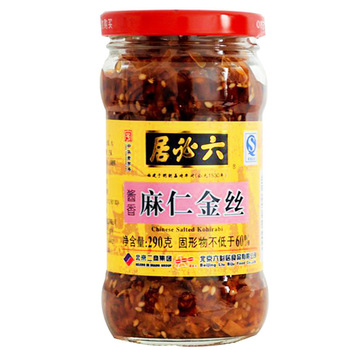
Liubiju Pickle is “China’s Time-honored Brand”, enjoying a history of over 400 years. It was originally created in 1530 A.D. as a small store bu brothers surnamed Zhao in Xishe Village, (Linfen, Shanxi). Later, it specially dealt with pickle business. The name Liubiju was taken from the motto coined by the shop’s founder and means “House of Six Musts,” referring to prime raw materials, choice ingredients, the best yeast, pure water, proper curing, and flavorful pickles.

LBJsample

The pickles in Liubiju have carefully-chosen materials and strict processing procedures. Natural saucing method is adopted and abided by strictly. All materials come from fixed places. For example, soybeans are purchased from Majuqiao of Fengrun (Hebei) and Yongle Store of Tongzhou (Beijing), and the wheat flour are from Laishui (Hebei) and. cucumber from Daxing (Beijing).

In 1988 all the sauce and pickle makers in Beijing, including Liubiju, merged to establish the Beijing Pickles Company, later renamed the Liubiju Food Company.

Tianfu Cola

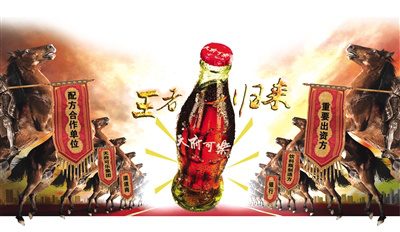
The Chinese cola brand Tianfu, that in 1991 was good for 80% of the Chinese cola market, will be relaunched around the Spring Festival of 2016. Back in 1980s and 1990s, the Chongqing-based company was the largest soft drink maker in China with a strong hold of 70% of the soft drink market. Tianfu Cola was sold beyond China and started to gain market recognition in Russia and America. In 1994, the company set up a joint venture with American cola producer Pepsi, which was not successful. By 2005, Tianfu Cola’s market share had plummeted to 1%. The company blamed the failure to the decision to cut the production of Tianfu Cola to make way for the production of Pepsi-Cola. In 2006, the company sold its stake in the joint venture to Pepsi. However, Pepsi refused to give back Tianfu’s production right. In 2010, Tianfu took Pepsi to court accusing the US firm of stealing the secret recipe for its beverage, with success. Tianfu will still use its natural traditional Chinese medicine herbal recipe to produce the drink, which was developed in cooperation with the Sichuan Research Institute for Chinese Medicine.

Tianfu

Yimin 1

In Shanghai, Yimin No 1 Food Factory is trying to regain its earlier leading position with a new high-end ice cream. Founded in 1913, Yimin No 1 Food Factory is one of the first ice cream makers in China. Originally a conglomerate that produced beverages, canned foods and snacks, the company later made ice cream and sold it under the brand “Bright” during the 1950s (Bright became one of China’s leading dairy companies). At its peak, Bright accounted for 80% of ice cream sold across the country. By the early 1990s, the company produced 15,000 mt of ice cream every year, 18 times the amount when it was started four decades ago. But with the aggressive expansion of foreign brands in the late 1990s, the brand fell down the pecking order in the market. Its main consumers today are middle-aged consumers looking for a slice of nostalgia. In 2017, the company recorded RMB 200 mln of sales across its product categories, up 10% from the previous year. However, a low profit margin and a dissipating market share, especially in areas outside Shanghai where people are less attached to the history of the brand, remain big concerns for the company. Yimin is hoping that a new polar bear logo for their high-end offering could eventually become a prominent IP like characters from Disney, in turn drawing more young people to try their product which is available in three flavours — vanilla, cheese and strawberry yoghurt.

Adapting to modern demands

Most of these time-honoured brands stick to traditional methods, but also try to improve through modern technologies, which they consider inevitable if they hope to meet the demands of customers beyond Beijing, change is necessary.

Wangzhihe says it has more tailored marketing strategies for different parts of China and products that cater to local tastes, with Wang pointing out that the people of northern China prefer the red furu while southerners like the white better.

Yiqing Holdings says it has been trying to adjust to meet market demands and, in 2011, opened its first store in the Yili chain in Beijing, and in doing so got to know more about the market and got customer feedback. In the past, businesses such as supermarkets and snack bars just went to the plant themselves to get the goods and the company just stood by, passively waiting for buyers, something that was really out of step with the times.

Ma explains, “There are 65 chain stores in all and that is expected to reach 100 by the end of this year,” while Li Qi, the president of Yiqing Holding, in commenting on their development, says they consider the development of the Beijing-Tianjin-Hebei region as a business opportunity for their brand strategy.

The company was also a sponsor of last year’s Asia-Pacific Economic Cooperation meetings in Beijing and its sponsored products cover food and beverages and sponsoring such grand international event was a good way to become known globally.

Other regions in China will undoubtedly have similar clusters of old trusted brands produced by new style state owned enterprises that are no longer directly operated by the government, but still closely monitored and protected by it. I will report on these regions in the near future.

Old brands introduced in previous posts

A number of earlier posts in this blog introduce other old famous brands. I will list them here, with links to the relevant posts.

Peter Peverelli is active in and with China since 1975 and regularly travels to the remotest corners of that vast nation.
The Rise of Individual Food Products in China

Chinese demographers estimate that China will have 92 mln singles in 2021

Yili Dairy, China’s top dairy brand (and second food brand in 2014), based in the capital of Inner Mongolia, Huhhot, has launched remarkable marketing campaigns for some of its popular products. Mengniu, located in the same city, has followed suit.

Oat milk

Breakfast milk is; another member of the expanding Chinese family of formulated dairy products. Yili has entered this market with Oat Milk.

The phenomenon breakfast milk is a product of the increasing of the pace of life in China. From the beginning of the Chinese nation to very recent times, three hot meals a day were sacred in China. Gobbling down a sandwich on your way to work, a familiar sight in my home region, would abhor any Chinese. That thing with the sandwich is still rare in China, but the quick ready-made breakfast is emerging.

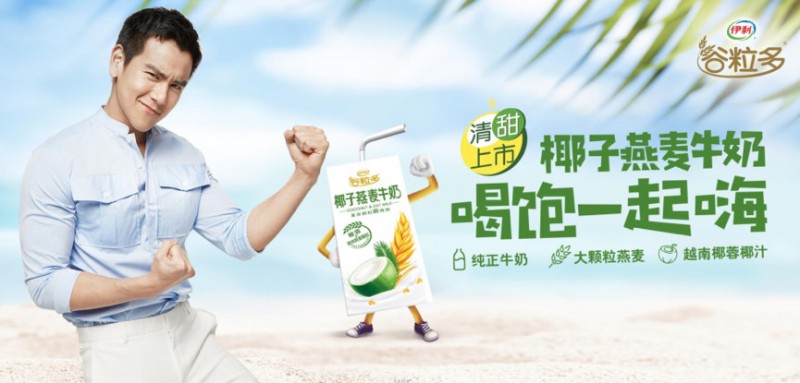
The ad for Oat Milk shows Taiwanese singer Eddy Peng drinking (well, at least one end of the straw is in his mouth and the other in a carton of Oat Milk) striking a masculine pose. The text introduces him as a nanshen ‘male god’. Although Chinese women are just as attracted to males like this as their sisters in any other part of the world, such direct sexual remarks are rather un-Chinese. And I am not talking about post 1949 China. Han Chinese are usually rather reserved about this type of emotions.

Eddy

The text adds that male gods are busy chasing their ideals, but impeded by the hardship of work. I have translated the Chinese word ouxiang ‘icon’ here as ideal. It alludes that Peng is the male icon of many Chinese men, but also an object of worship for most women.

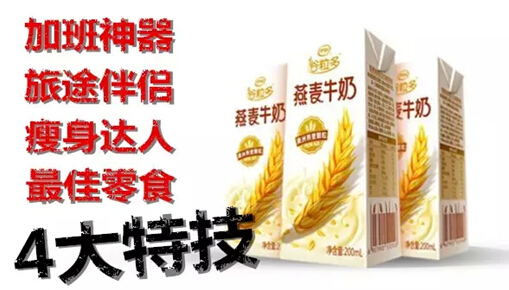
The Oat Milk slogan is: four special functions:

OatMilk

Overtime Miracle

Travel Mate

Slimming Success

Ideal Snack

Overtime has entered China already a while ago. China is one of the few nations the constitution of which includes the right to rest for all citizens. However, overtime now seems to be more normal than in many Western countries. What Yili seems to be suggesting is that its Oat Milk can be used to replace the meal that a proper employer would provide to staff members who agree to overtime. A carton of milk with chunks of oat floating in it, that you can consume while continuing to work, would until recently never be accepted. Now, the marketers of Yili seem to believe that this suggestion will no longer elicit protests.

The Chinese term lütu banlü has been coined after kafei banlü Coffee Mate. However, the latter is a powder that is much easier (and again quicker) to use than liquid coffee creamer. Oat Milk is a liquid that you are advised through this ad to carry with you while travelling. A quick bite/sip on the road. Once more, this suggested use is a replacement of the meal that Chinese travellers would usually not be willing to skip. Chinese travellers board a train heavily packed, not with clothes, but food and drinks to consume while chatting with their companions and enjoying the landscape.

Both functions seem to indicate that the pace of life is accelerating in China. One of the cultural rituals affect most strongly by this development is that of eating three warm meals a day.

The oat fibre in Oat Milk is said to help keeping your waist slim. That by itself would not be much more than an empty promise, but the picture of a man Eddy Peng makes it real. Drink Yili Oat Milk and look like Eddy Peng.

The word ‘snack’ in my translation of the final term refers to the Chinese concept of lingshi. It literally means ‘fragmentary food’, food that you can eat any time between meals. When you look at the scope of what is regarded as lingshi by Chinese it seems to be basically identical to xiuxian shipinleisure food’, about which I have devoted an entire post in this blog. Lingshi then seems to be a more colloquial term, while xiuxian shipin is used in a more commercial context. Why it is called ideal seems obvious: as you are snacking anyway, you might as well do it on healthy food. However, I wonder if people would be willing to pack a relatively heavy carton of beverage instead of that pack of melon seeds, preserved plums or other traditional snacks.

Regardless whether Yili’s Oat Milk will be a success or a failure, its ad already is making history.

So, what’s in it? Here is the ingredients list:

Fresh milk, water, crystal sugar, oat grains, oat meal, Vit. A, Vit. D3, iron (fe edta), zinc, food additives (microcrystalline cellulose, CMC, gellan gum, carrageenan, monoglyceride,sucrose ester, sodium bicarbonate), food flavour.

So it is not completely natural, but we would not have expected it to be to begin with.

In the course of 2018, Yili has launched another oat milk, this time flavoured with coconut, marketed under the Guliduo (‘Lots of Cereals’) brand. It is said be made of Vietnamese coconut, carefully selected milk and Australian oat.

You Yoghurt

Yili has hired the services of another Tainwanese star, Jack Chou, to advertise for one of its yoghurt ranges: You Yoghurt (you means ‘best’). Jack Chou is shown sitting in a director’s chair, shouting ‘I want You’. The scene is derived from the TV program Voice of China.

YiliYouAd

Note that the makers of this ad assume that the intended audience have a command of English sound enough to recognise the pun. The deeper reference to the old American military posters telling young American men that ‘Uncle Sam wants you’ will escape the attention of most of them, though.

Expressing love through French fries

Early 2020, McDonald’s contracted the young superstar Jackson Yee, another male young god, not as their icon, but as their ‘spokesperson (daiyanren)’ for its advertisements. Af first sight, it seemed like yet another good looking young guy trying to sell food. However, some of the ads are quite funny, although I’m not sure if they were designed to be funny. My favourite is the ad for Mickey D’s famous French fries, which includes the slogan: ‘every single fry tastes of love‘.

Winter Olympics

Yili is one of the first Chinese food companies to respond to Beijing’s winning of the Winter Olympics in 2022. The company has launched the following commercial:

YiliOlymp

The text reads: ‘I have a seven-year appointment with the Olympic Games‘. And again we see the emerging individualism in this frame. The lonely icehockey player, instead of a team and the use of ‘I’ instead of ‘we’.

It is fascinating to see how a traditional state owned enterprise is able to reinvent itself to fit into the 21st Century. According to the Rabobank survey, Yili now ranks among the world’s 20 largest dairy companies.

Yoghurt icecream

Mengniu, China’s second largest dairy company, has recently launched one of China’s first yoghurt icecreams, marketed under the Dilan brand. The company started the promotion campaign with handing out samples for free to white collar workers in Beijing’s major commercial buildings. Dilan’s ads also indicate that the product is geared to that market segment: the individualist young professionals focused on their careers.

DailanYoghIce

Ambrosial

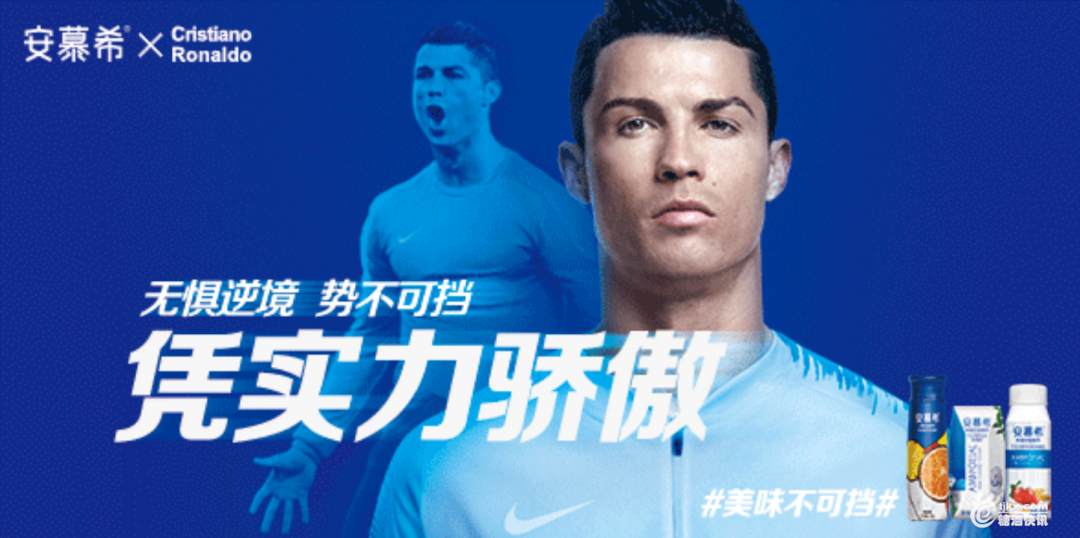
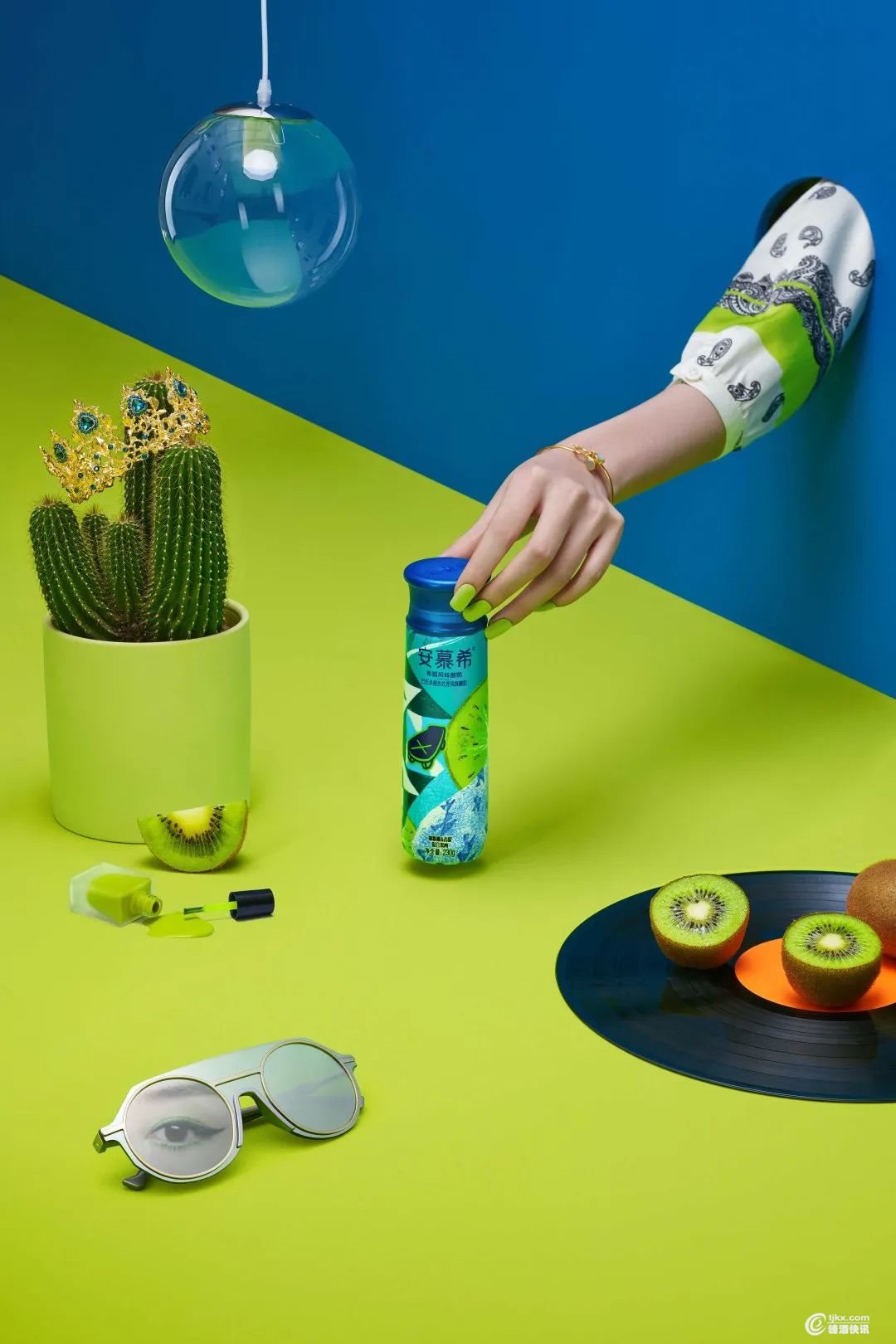
Yili’s has launched another innovative marketing campaign for its latest range of formulated dairy products, marketed under the brand name Ambrosial, in early 2020. This product’s ads can be divided in three types. The first is linking the brand with famous athletes, singers or movie stars.

The second type tries to link the brand to several symbols of modern life.

The third is more abstract, linking the brand to a number of goods pointing at good taste and healthy living and a human arm grasping a bottle of Ambrosial.

Ingredients:

Fresh milk, crystal sugar, whey protein powder, addives (acetylated distarch phosphate, pectin, agar, diacetyl tartaric acid ester of mono(di)glycerides, gellan, food flavours), lactobacillus bulgaricus, streptococcus thermophilus.

Single-portion milk

Here we see a trend towards individualisation expressed in the packaging as well. Some Chinese hate milk, a few like it, and many drink a glass a day for its healthy image. If there is only one milk drinker in a household of, say, four, milk can easily spoil before finishing your 1 litre bottle or UHT pack. Xiajin (Ningxia) has launched a 243 ml bottle of milk to solve this problem in 2019. It is interesting to note that it is not one of the top dairy processors like Yili, Mengniu or Bright that first launch milk in individual portions, but Xiajin, that has been a good second tier dairy company for several decades.

Tea for one

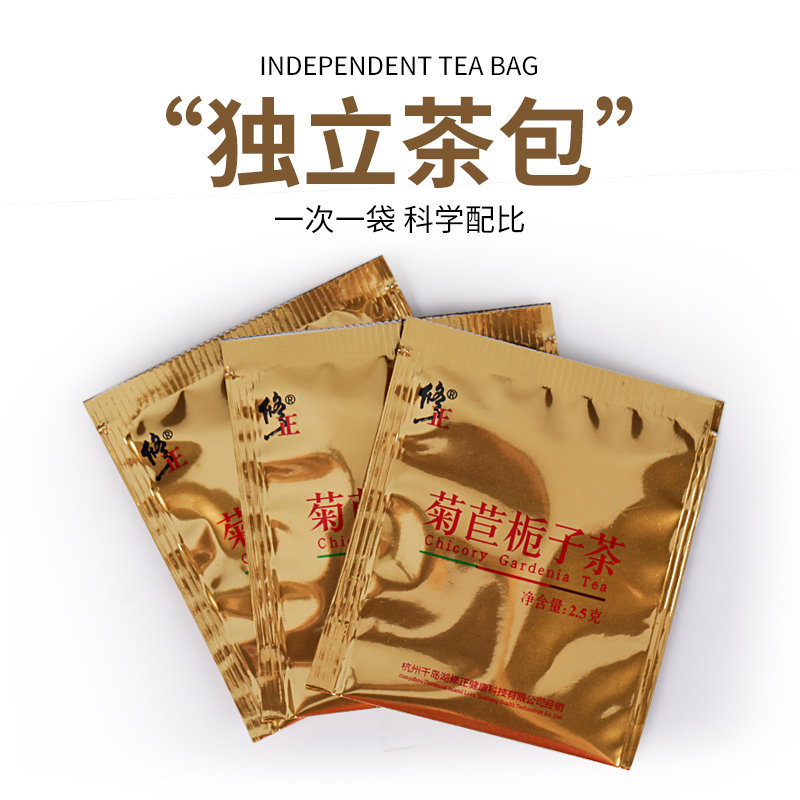
A group of friends chatting for hours around a table with not much more than a pot of tea and a tray of melon seeds is still a very common sight in China. However, the first brand of tea presented in small bags for a single cup has appeared on the market. The term ‘independent’ in ad for this Chicory and Gardenia Tea by Qiandaohu (Hangzhou, Zhejiang) leaves nothing to the imagination.

Male vs Female

Yet another product of Yili is a lactic acid beverage branded Changyi that is marketed as being beneficial to the ‘male spirit’ (nanshen). Most of Yili’s new ads introduced above use male bodies as icons for position various dairy products. This product takes this trend one step further by directly referring to the male spirit.

Changyi

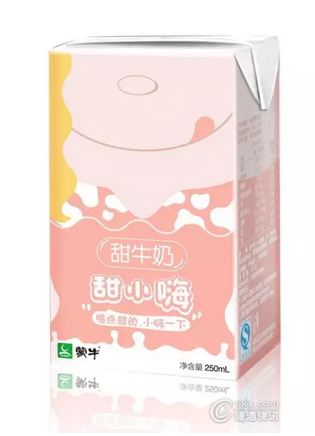
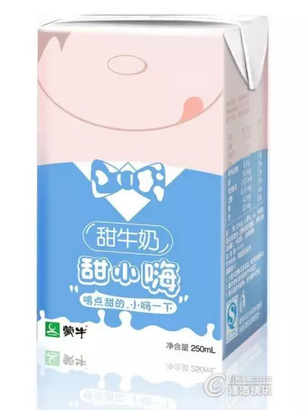
Mengniu has launched a sweetened milk, Tianxiaohai, that comes in separate female (pink) and male (blue) packagings

MnFemPack  MnMalePack

However, the ingredients are exactly the same; no gender-related formulation.

Fresh milk (>= 80%), sugar, additives (sucrose ester, monoglyceride, carrageenan), flavour

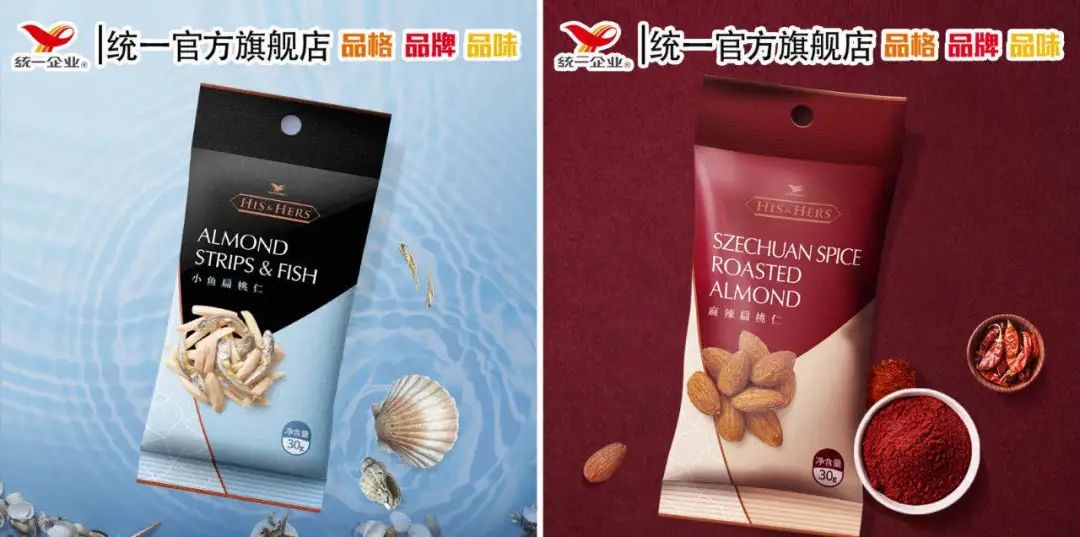
Uni-president has launched a series of flavoured consisting of two flavours in 2020. The packaging of both includes the phrase ‘his & hers’. However, although it is not indicated which flavour is his and which hers, one pack is blue and the other red, consistent with the cross-cultural mainstream bias that ‘blue is for boys’ and ‘pink is for girls’.

No sharing with others

Specialists in national culture all agree that Chinese culture is collectivist, placing the group’s interests above that of the individual. This trait of Chinese culture has left a huge mark on the Chinese practice of eating and drinking, in which sharing is a key concept. A Chinese meal is typically eaten around a round table with all dishes placed in the middle, for all participants to share. An now, in 2016, Yili launches this ad.

YiliWangpai

The ad is for Weikezi Chocolate Milk and the boy is saying: ‘Weikezi is delicious, no way I’m going to share it with you’. That statement sounds outrageously un-Chinese. So, is this a sign that young Chinese are becoming more individualist, or is this ad perhaps meant to provoke? I am sure it will make more than few Chinese eyebrows rise.

The ultimate individualisation: one person hot pot

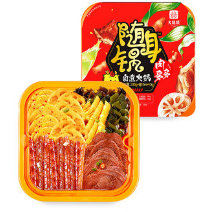
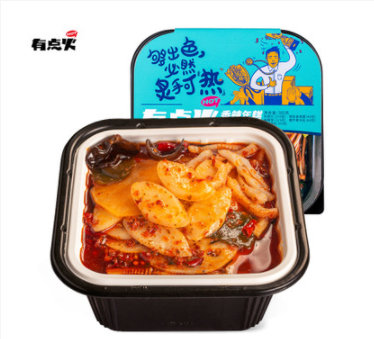
Hot pot is a hot item in China. Nothing beats a group of people around a table throwing chunks of meat, vegetables, bean curd, mushrooms, or virtually any other fresh ingredient in a pot with boiling water and fishing them up when they are cooked. Hot pot is the ultimate communitarian food for a communitarian nation like the Chinese. Even a European fondue is hard to imagine to enjoy on your own, right? Well, be prepared to see this fact shattered by exactly those extremely communitarian Chinese. The past year has witnessed the launching of a number of one-person instant hot pots.

On the outside they look like a big instant noodle cups. Inside you will find a variety of ingredients, like the classic hot pot. Just heat it in the microwave, open it, and enjoy . . . on your own. Some brands are even packed in self-heating packagings. Squeezing the pack will create a chemical reaction that will heat up your hot pot, so you even lose the microwave. I have collated pictures of a couple of the instant hot pots currently on the market. How does it taste? Probably like most instant foods. Is it fun? Not more than eating instant noodles, or instant congee, certainly not as fun as enjoying hot pot with a group of friends or your relatives.


Single dog noodles

Early 2018, entrepreneur Zeng Ruilu founded Single Dog, a company producing potato crisps and similar snacks in single portions, geared to the growing group single Chinese. This company launched a range of single portions instant noodles in 2019. Smart readers will say: ‘aren’t all instant noodles made for one person to eat?’. You are right, of course, but Single Noodles (Danshenliang) still caught on. While Chinese singles used to be single for specific reasons (like a shy nature), more and more Chinese remain single for a while by choice. Those people like to confirm this by snacking on food that is specially made for them.

Peter Peverelli is active in and with China since 1975 and regularly travels to the remotest corners of that vast nation.
Understanding ‘Artificial’ in Chinese Culture

In Chinese culture, artificial has a more positive connotation than in Western culture. We tend to regard anything artificial as less that ‘the real thing’. Chinese on the other hand perceive creating a good to perfect copy of the real thing as a skill and the product of that skill as something that has added value over the copied object.

This cultural difference is very visible in the different ways Chinese and Westerners deal with landscape. Many Westerners have their favourite spot of unadulterated nature that they frequently visit to recuperate. When Chinese find such a spot, they like to embellish it, to make it even more beautiful. You can accentuate a hill by adding a few metres of soil, dig a little lake, build a wooden bridge over a brook.

The Chinese word for ‘artificial’ is renzao (man-made). Man’s interference with nature makes it more renqi. This literally means ‘people spirited’ and refers to the cozy ambiance that you create, when people get together. In other words, a human hand will make nature more human.

In Chinese cuisine, and later carried on in the Chinese food industry, this positive perception of artificial has led to a large number of artificial versions of natural foods and ingredients.

For this post I have selected artificial jelly fish an example. Even the natural jelly fish is not something you will find on many menus of Western restaurants, let alone an artificial version.

My source for this post states that artificial jelly fish is novel food that can compare in look and quality with natural jelly fish. It adds that regular consumption can lower the glycemic level, and can prevent heart diseases and obesity. Wonderful!

While most industrially produced jelly fish starts from sodium alginate, this recipe uses seaweed as raw material. The seaweed is steeped in sufficient water and treated with sulphuric acid to take away the calcium and soaked in a sodium carbonate solution. The acidity of the filtrate of the resulting liquid is then lowered to 7.5 – 8 using diluted sulphuric acid.

The basic recipe of artificial jelly fish is:

580 gr of the processed seaweed; 20 gr gelatin; 90 gr calcium chlorate; 5 gr sodium hydroxide; 200 gr salt; 5 gr MSG; 100 gr water.

First solve the gelatin in 100 ml water and stir in the treated seaweed; leave for 6 hrs. Stir again and add the sodium hydroxide until pH 10.

Solve the calcium chlorate in water using a 1:5 ratio, and then add the solution to 450 ml of water. Poor 400 ml of the liquid on an enamel plate and wait until it sets into a sheet of 2 – 3 mm. Repeat that until all liquid is finished.

The sheets are seasoned with salt and MSG and left for 3 days. Then the product can be cut into shapes, most typically shreds, like the natural jelly fish. Sodium benzoate can be used as preservative.

Jelly fish is usually eaten as a cold appetiser. Some vinegar, chili and chopped spring onions can be added.

JellyFish

It is difficult to assess if the cost price for this product is lower than that of the real thing. This also applies to the balance of nature. We do not need to hunt jelly fish, but we are still harvesting seaweed. However, seaweed can be grown in coastal water, just as we grow wheat in soil, while jelly fish is hard to herd like some of the fish we like to eat.

This product is definitely high in dietary fibre, even though some less agreeable chemicals are needed to get it on our table.

I think that the real bonus for the creators of this recipe (and a long list of other recipes, including those for artificial chicken, honey, grapes, and shrimps) is that they derive pleasure from the very fact that they are able to create all this artificial food that is like the real thing . . . and a little bit more.

Peter Peverelli is active in and with China since 1975 and regularly travels to the remotest corners of that vast nation.
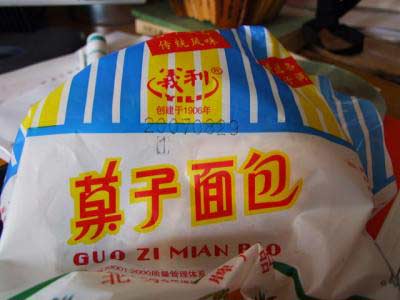
Guoba: A Culinary Treasure from China’s Rich Cuisine

Many of mankind’s finest delicacies have been discovered by accident; sometimes literally. Cheese has probably been discovered when milk had been stored in a calf’s stomach sufficiently long enough for the rennet in the stomach to produce curds.

Problems cooks, professional or at home, often meet when preparing starchy foods in a frying pan is that part of it sticks at the bottom of the pan, forming a relatively hard layer that proves tough to get rid up. Scrubbing it is the only solution.

However, as long as the stuff that is stuck at the bottom is not too black and burnt, it can actually be very tasty. The physical-chemical reaction produces a whole range of aromachemicals that please the taste buds and the nose (though perhaps less so the eyes).

A waiter in a Spanish restaurant in Rotterdam once told me that the rice stuck at the bottom of the pan is the part they like best of their national food paella.

Pan is guo in Chinese and to stick ba. The phrase ba guo, getting stuck to the pan, is a negative cooking term. However, Chinese have also developed a liking for rice fried that way, and those two words turned around, guoba, have become the designation of a tasty snack.

Guoba as a dish

Guoba is a form of rice that is actually scorched or hard cooked to change its colour and texture. Guoba is popular in many forms of Chinese cuisine, particularly in Sichuan cooking. It is known by many names in different areas of China and surrounding countries, and may even be found worldwide in areas where Chinese cuisine is presented and appreciated.

GBnatural

Initially, guoba was made by burning or heavily cooking rice to the bottom of a wok or pot. When the cook took out the rice, the leftover rice was used in various dishes. Later, demand for this sort of rice dish led to the commercial preparation of blocks of this crisped rice.

Any kind of Chinese dish can be served with guoba. Some common forms of this scorched rice food include sweet and sour dishes, as well as other international Chinese favorites like lo mein, chow mein, or other dishes. The usual choices of meat, seafood, and vegetable elements like tofu and bean curd apply to many guoba dishes.

One thing that guoba offers to cooks is the chance to include a different kind of presentation based on the shape and texture of the rice. Cooks can serve the guoba, with heavy sauces or other elements, in blocks, or crumble the rice onto the plate. The scorched rice stands up to all sorts of innovative culinary uses, which makes it popular in many restaurant kitchens, especially where innovative aesthetic presentation is a part of the culinary strategy.

Another form of this food is a “sizzling rice soup” that has become common in some parts of the world. This is not the usual form of the food, so some cooks, even authentically Chinese ones, may not be aware of the use of scorched rice in this particular soup. The general use of the scorched rice in a thinner soup or broth is another way that the rice can be served for a contrasting taste experience.

Snack

Regular readers of my blog will already have noticed that Chinese are masters in re-creating modern snack food (or in their own terminology: leisure food) from traditional dishes. This is also the case with guoba.

Already in the 1980s, Chinese snack makers launched small squares of guoba with various flavours as the Chinese alternative to the Western potato crisps. When I was stationed in China for my company, we regularly served guoba with the aperitifs when entertaining Dutch or other international guests. The all loved them. The pioneer was Sun Brand that ranked 9 in popularity in 2025.

ShGuoba

The first picture shows a package of guoba produced by Xishilai Food (Shanghai) and come in: chili, beef, five spices and BBQ flavours. The ingredients listed:

Rice, maize, vegetable oil, salt, crystal sugar, MSG, spices, additives (food flavours, rising agent, antioxidant).

GBerge

The alternative is onion-flavoured guoba produced by Sha’erge (Crazy Brother) from Dongguan (Guangdong). It has black rice as one of its ingredients, which is advertised as ‘black pearls’ or ‘the king of rice’, due to its nutritional qualities. The producer claims that this product contains vitamins A and B as well as calcium, potassium and magnesium. Ingredients:

Rice, black rice, refined vegetable oil, soybeans, starch, eggs, shortening, refined pork fat, salt, MSG, onion spices.

It had been relatively quiet on the guoba scene in terms of new developments. However, Wolong Shenchu (Divine Cook) from Hunan province launched a new type of guoba in 2018: Wolong Guoba. This brand ranked 4 in 2025.

The crackers look more slick than the first products and they are marketed in a high-end position, as if it is a very traditiional Chinese product. The ingredients list:

Rice, vegetable oil, chili, Sichuan pepper, spics, salt

This is definitely a healthier formulation that has cut on fat and MSG.

A rising star in this market is Shuijun, established in 2014 by a very young entrepreneur Zhang Yulong (then 26 years old). He had studied at the Nanjing Auronautics University, where he was trained to be an interior decorator. However, he decided to open a restaurant and while learning about the catering business, he invented Shuijun guoba aided by a couple of friends and co-entrepreneurs. The Shuijun range of guoba includes varous meat and seafood flavours. Shuijun ranke 6 in 2025.

Guoba as market for flavour mixes

Some flavour houses have already discovered the guoba industry as a separate market segment and have develop special seasoning mixes for guoba. Beijing-based Shanwei Puda Food supplies 4 types: five spices, beef, BBQ and cumin. The ingredients list provided for the cumin mix is as follows.

salt, sugar, MSG, spices, cumin powder, food additives (not specified)

The manufacturer advises a dosage rate of 4% -6% of the weight of the end product.

Innovation: peanut guoba

Guoba has already developed as a generic type of snack in the Chinese food industry. The concept is now further stretched to guoba made from other raw materials than the traditional. Zhenyuantong (Huzhou, Zhejiang) has launched a peanut guoba. The ingredients list reads as follows:

White sesame seeds, peanuts, maltose syrup, flour, vegetable oil, coconut meat, coconut milk powder, salt.

PeanutGuoba

The company also produces: melon seed guoba:

Melon seeds, crystal sugar, flour, vegetable oil, salt.

and:

White sesame seeds, crystal sugar, flour, vegetable oil, chili oil, salt.

Haochijia has developed a type of instant noodles based on guoba packed in a cardboard cup. Add boiling water, wait a while, and you can enjoy guoba as it is served in a restaurant.

We are eagerly awaiting the following product to add to this post!

Clean guoba

Concepts like Clean Label have also reached China and started to get serious around 2022. However, the Chinese interpretation of ‘clean’ seems to be broader or lest strict than the Western. Here is an example of a crispy guoba from Eurasia Consult’s database that is advertised as ‘zero additives’ site in China.

Product: Sticky Rice Guoba

Ingredients:

Sticky rice, vegetable oil, starch, salt.

Peter Peverelli is active in and with China since 1975 and regularly travels to the remotest corners of that vast nation.

Exploring Chinese Train Food Culture

Trains are a vital means of transportation in China. Although domestic air travel is as common in China as in the US nowadays, the Chinese government keeps investing huge amounts of money in updating the railroad system and new trains. China already has the world’s largest high speed rail system.

Heavily packed

Chinese train travelers are usually heavily packed. However, at least half the load they carry onto the train is not their actual luggage, but food, and drinks. Entire loaves of bread and hole packs of sausages, cartons of hard boiled eggs and instant noodles, obviously, baskets with apples, and other fruits; and tea.

The tea comes in the form dried leaves. You bring your own mug as well and as soon as you have settled in, you place your mug with a handful of tea leaves on the small table in each compartment. Every Chinese train comes with a number of boilers. A train attendant will pass by about every half hour with a thermos flask with boiling water to fill your mug, again and again. If that is still not enough to satisfy your thirst, you can go to the boiler yourself to fill your mug, or perhaps your own small vacuum flask. One helping of tea leaves is usually enough to get you through the day.

After settling in on their seats or berths, and after getting their first infusion of tea, the next collective activity of Chinese train travelers is unpacking. No, not their pyjamas or playing cards, or whatever they could use for entertainment, but food. In no time, the small tables almost collapse under the heavy load of ham sausages, eggs, water melons, fried chickens, biscuits, tangerines. Every food you can name is there, as well as a few items you may not be able to name.

One of the Mongolian's cabins. Smelly mongolian food strewn about. Gross.

All that eating is bound to create waste: sausage skins, eggshells, watermelon seeds, and skins, chicken bones. A lot of that ends up on the floor. However, the train attendants will take care of that as well. After a round with the thermos flasks, they soon return with their brooms, to sweep the leftovers of their hungry guests to a waste bin at the end of each wagon. It takes getting used to for the beginning Western train traveler in China.

Train food

All this long distance train travelling has affected the Chinese food industry. I dedicated an earlier post in this blog to ‘leisure food’, a typical Chinese food category. Of course, these foods are consumed in all means of transportation, but trains certainly have the edge.

Instant noodles have risen to top position. They are cheap, convenient and tasty. As all trains in China provide hot water, instant noodles have become the most popular hot food on a train, because they can be made anytime.

While instant noodles are the typical staple foods during long haul train rides in China, snack food in small packs are the ideal dishes to add some flavour to the relatively bland noodles. Beef jerky, various parts of the duck, steamed chicken feet, dried bean curd, any nut or seed you can think of, pickled vegetables like zhacai, as long as it comes in a palm-size pack, it works for train travelers.

TrainFoodVar

If soaking noodles in hot water is too time consuming for you, you can opt for a liquid staple. Canned porridge in China usually contains nuts, dried fruits and grains, and is sweet flavoured. Young passengers will like it and adults can take it as dessert.

The second favourite activity of Chinese train travelers is sleeping. A full belly makes you sleepy. However, the refreshing activity of tea can be a spoilsport here. A good alternative for train travelers who want to kill a few hours by sleeping is beer. You will find a few cans of beer in the luggage of many Chinese train passengers. And when your last can is empty, you can usually buy more in the dining carriage.

Other moments to replenish your food and drink stock are the stops at stations. Trains will stop for a few up to ten minutes, which usually gives you just enough time to buy a few cans of beer, some freshly steamed buns (mantou), or a bag of peanuts.

Frui for sale on the platform

Dining carriage

Spending such a long time in a restricted space, is bound to become tedious sooner or later. You can chat with your travel companions, but the moment will come that you have exhausted all topics you may want to discuss. You can play cards, read, listen to music, but it all will become repetitive.

There are three peak events to look forward to on long Chinese train rides: breakfast, lunch, and dinner. This is not because they are such a culinary tour de force. Neither is it because you are hungry. You have spent most of the time that you are awake eating, and there are few opportunities to burn calories. Still, few people skip a meal, simply because meals are served in the diner, so you finally have an occasion to walk and get some exercise. And you can sit on a chair, instead of a berth, or one of the small fold out chairs in the corridors.

TrainDiner

A typical train meal consists of a bowl of lukewarm rice and a couple of greasy dishes. You usually get more flavour from the foods that you brought yourself than from what you get served in the diner. However, with the modernisation of the Chinese railway system towards the world’s largest high speed train network, the production of train food is also updated. The following picture shows a cold-chain packed meal produced by the Beijing Railway Service Company, with an expiry time of 72 hours.

RailFoodBox

The following video gives an impression about how train meals are served in China.

To summarise: eating and drinking on Chinese trains is not a haut cuisine experience, but it is one of the best occasions to experience a symphony of all aspects of Chinese food and culture.

High speed trains driving change

As of late july 2018, 27 high-speed train stations are providing a pilot food-on-demand service to passengers, who can pre-order food from a selection of the outlets at the stations. The service serves as an apt response to the meal box monopoly. Complaints about the expensive, tasteless meal boxes offered on high-speed trains are not rare, and many passengers prefer to take instant noodles with them or else not eat at all while traveling by train. So the takeouts-on-demand that can be ordered via China Railway Corp’s website or its app two hours before the train is scheduled to arrive at a selected station could be a savior to those hungry travelers who have no interest in the meal boxes. The pre-order service costs as much as that offered by popular food delivery apps like Eleme, except the delivery fee is around RMB 8, which is slightly higher than in cities.

High speed trains continue to change the relationship between trains and food in China. The top season is undoubtedly the period before and after Chinese New Year, when migrant workers in big cities are returning home to celebrate China’s main festival with their close relatives. A dining carriage director with the China Railway Nanchang Group recalls the changes during the past few decades. In the early 1980s, flavoured peanuts and lard cakes were among the very few snacks sold on trains, and they were highly sought-after. Trolleys were introduced in the 1990s and it became a booming business thanks to the large volumes of passengers. One trolley could sell RMB 10,000 worth of goods during one train trip, though most passengers still favoured cheap snacks. Now Starbucks coffee and Haagen-Dazs ice cream sold on high-speed trains are also welcomed by passengers, though their prices are much higher than traditional snacks like melon seeds. Bottled mineral water is also best-seller, at least on slower trains, and passengers are willing to dig deeper into their wallets for better brands. Water priced at  RMB 5 sells better than the RMB 2 ones.

Special train meals

Some Chinese railway authorities have started looking at Japanese companies specialising in train food. These are packed easy to heat meals that can be offered to train travellers, much like airplane food, but slightly simpler in terms of logistics. The following photo shows how a railway-related company in Qingdao (Shandong) is preparing train dishes.

Peter Peverelli is active in and with China since 1975 and regularly travels to the remotest corners of that vast nation.

Crab Roe Flavoured Seed Kernels – a fine example of Chinese food engineering

While celebrating Chinese New Year where it should be celebrated: in China, a saw a friend nibbling on a product that I had never seen before. As a Chinese food blogger, I had to taste it and study the packaging. The list of ingredients was impressive.

Crab Roe Flavoured Seed Kernels (fried type)

Anhui Zhanshi Food Co., Ltd.

Ingredients: sun flower seed kernels, vegetable oil, glutinous rice powder, corn starch, modified starch, salt, crystal sugar, crab roe seasoning (glucose, shrimp powder, squid powder, crab roe powder, soy sauce powder, MSG, dextrin, yeast extract, spices), food additives: ammonium bicarbonate, citric acid, tert-butylhydroquinone (TBHQ), aspartame, disodium 5’-ribonucleotide, food flavour

Nutrition information

Energy

2120 kj

Protein

13.6 g

Fat

29.1 g

Carbohydrates

46.7

Sodium

860 mg

IMG_20150219_102750

This blog combines a number of story lines. Chinese food and culture is obvious a leading theme. Frequently recurring themes include: adapting traditional Chinese foods and beverage to the age of modern mass production and consumption, novel foods Chinese style, fusion foods and drinks combining Chinese and Western concepts.

If we compare these story lines with warps in weaving, than the wefts are a number of technical issues related to those topics. A major weft is the use of additives to reach the goals of the food technologists. To adapt the recipe of a traditional food for economic scale industrial production, additives are often needed to retain the traditional flavour, colour and texture of the food. This is obviously not a typically Chinese problem, but it appears to be more prominent in China.

Chinese are demanding consumers when it comes to traditional foods. Where many Westerners would settle for a generic sandwich to still an upcoming pang of hunger while on the run to an appointment or waiting for our plane at the gate of the airport, Chinese would prefer a steaming bowl of noodles, spiced to perfection, with condiments, succulent chunks of meat, and topped with a pinch of chopped spring onions. Who is going to cook that for you? Just try to imagine one of those noodle vendors that you can see on almost any Chinese street corner setting up shop in an airport!

So this is why Chinese supermarkets have such an astonishing number of different types of instant noodles on their shelves. You open a pack, place the dried noodles in a bowl, tear open the bag with dry seasoning and poor it over the noodles, open the additional pack with wet seasoning past, dried beef, or dehydrated vegetables and add it all to the noodles. Then infuse it with boiling water and let it all soak for a few minutes. Now you are ready to eat. And yes, this cannot compare with the noodles you regular get from Boss Wang who runs a mobile noodle cookery near the subway station, but it is better than a bland cold sandwich.

Modern instant noodles are gems of modern-day Chinese food engineering. No time or effort, or ingredient, is spared to re-create the experience of road side noodles.

These same drivers motivate Chinese food technologists in inventing new traditional foods like the product that has lent its name to the title of this post.

Chinese love to nibble on seeds. Melon seeds, sunflower seeds, pine seeds, all kinds of nuts, form an important subgroup of the typical Chinese food category of leisure food, that has been the topic of an earlier post in this blog.

EatingMelonSeeds

The seeds are often flavoured to give the product of a certain manufacturer a less generic touch. So you can buy ‘cream flavoured melon seeds’, or ‘garlic flavoured peanuts’.

The product I want to introduce here, however, has taken the process of creating a unique nibbling experience to a new level.

The main raw material are the kernels sunflower seeds. The hulls have been removed by the manufacturer. Actually, Chinese like to do that themselves using their teeth, but in this case it would be hard to add the flavoured coating to the hulls, so the manufacturer has taken the risk of invoking criticism and removed the hulls in the plant. Indeed, the Chinese friend who showed me this product was a little disappointed that she had been deprived of the pleasure of chewing on a seed and spit out the hull.

The kernels are fried in vegetable oil. The manufacturer does not specify the type of oil used.

Most of the other ingredients are used for the crab flavoured coating. We see a number of flours and starches for the coating material. The follows a list of ingredient in the compound ‘crab roe seasoning’. The term that I translate here with ‘crab roe’ is xiehuang, which refers to all edible parts of the crab other than the meat. Interestingly, shrimp and squid powder are apparently needed to enhance the flavour of the crab, like lemon juice can intensify the flavour of strawberries. A whole army of taste enhancers is called upon to make the crab flavour even more prominent. Most of these are well known. Soy sauce powder is typically Chinese product that is obtained by spicing up and drying soy sauce.

The way to indicate the ingredients of the compound ‘crab roe seasoning’ using brackets is part of the labelling regulations. It is likely that Zhanshi Food is buying the compound from a flavour company, so not blending it in house. The flavour houses are such a major group of food ingredients in China, that the annual Food Ingredients China (FIC) trade fair has set up a dedicated hall for flavour suppliers.

The single food additives are indicate by the word ‘food additives’ followed by a colon and the list of additives. This shows, e.g., that glutinous rice powder is an ingredient, but not recognised as an additive.

The use of TBHQ as an antioxidant is interesting, because it has not been very popular in China lately.

So, what is the final verdict about the total eating experience of these seeds? They are tiny morsels of coated kernels. You take out a few, put them in your mouth and chew on them. They are definitely crunchy and have a distinct seafood flavour, although I would probably not have been able guess that it was ‘crab’ without seeing the pack. The small pack is finished quickly, especially because the hulls have already been removed.

Perhaps it could be served by airlines to accompany the pre-dinner drinks. My KLM has been serving almonds for as long as I can remember, so this could be an interesting alternative. However, the ingredients list of these kernels is considerably longer than that of KLM’s almonds. The question is do we want stuff like TBHQ or nucleotides to accompany our drink, regarding how low the dosage rate? I will leave the answer to my readers.

Peter Peverelli is active in and with China since 1975 and regularly travels to the remotest corners of that vast nation.