It’s well known that China is the biggest coffee market in the world. And if you’ve been following this blog, you might recall my stories about new coffee experiences in China, like coffee cocktails, ready-to-drink coffee and dirty coffee.
During my recent trips, I met even more coffee innovators, so I thought I’d share some of the latest trends in a new blog post.
Coffee and tea: a perfect pair
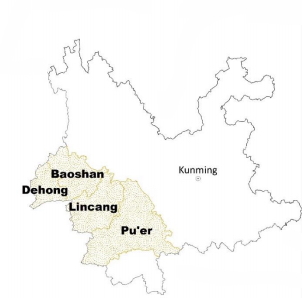
Even though coffee is becoming super popular in China, it’s not really replacing tea as the national drink. Tea is still the top choice. But to be more accurate, coffee is just becoming a new kind of tea in Chinese tea culture. The Pu’er region in Yunnan province was the first place I saw coffee and tea blending together.
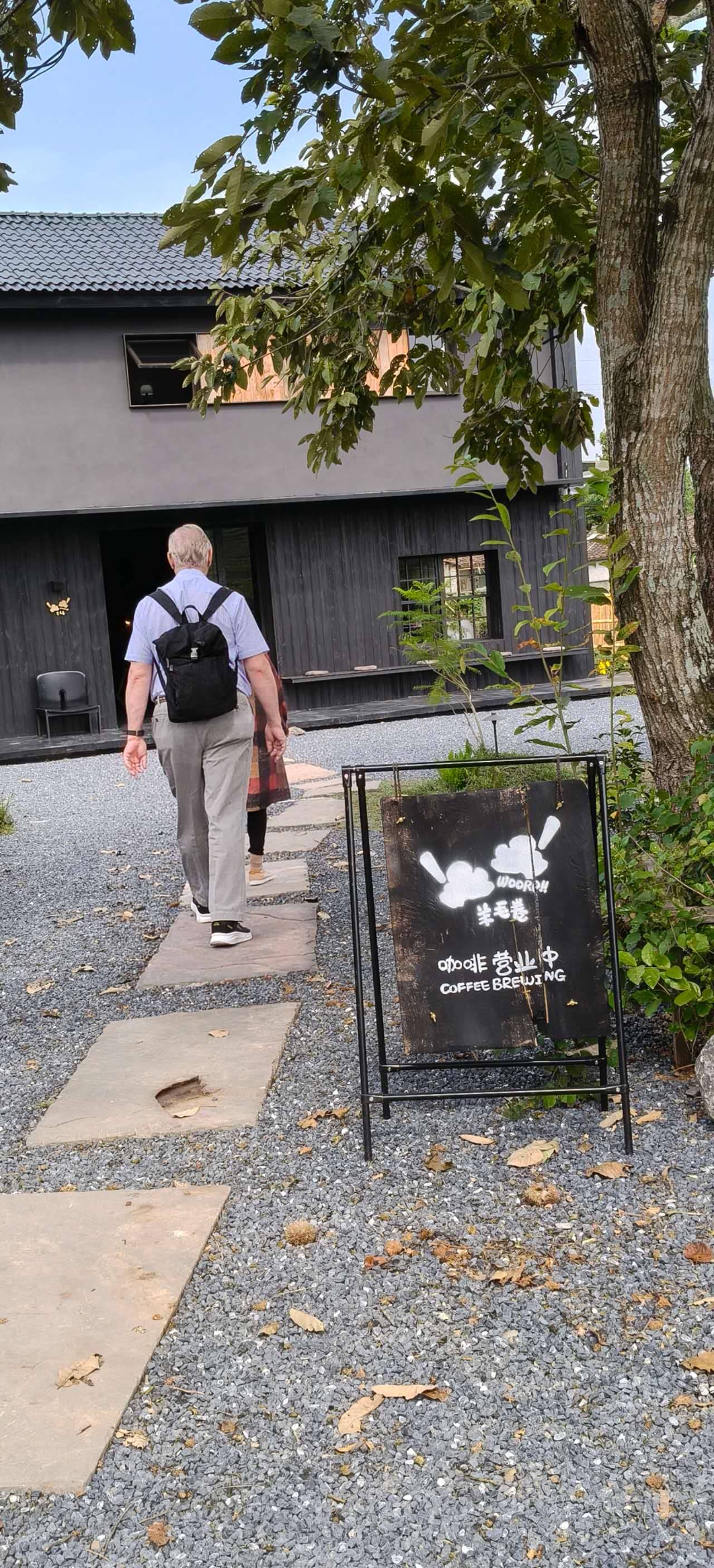
In October 2025, we took a tour around Jingdezhen, China’s ceramics capital in Jiangxi province. This area is also famous for its tea. But we had a really interesting coffee experience in a small village called Hanxi, where an entrepreneur had opened a fancy coffee shop right in the middle of the tea fields.
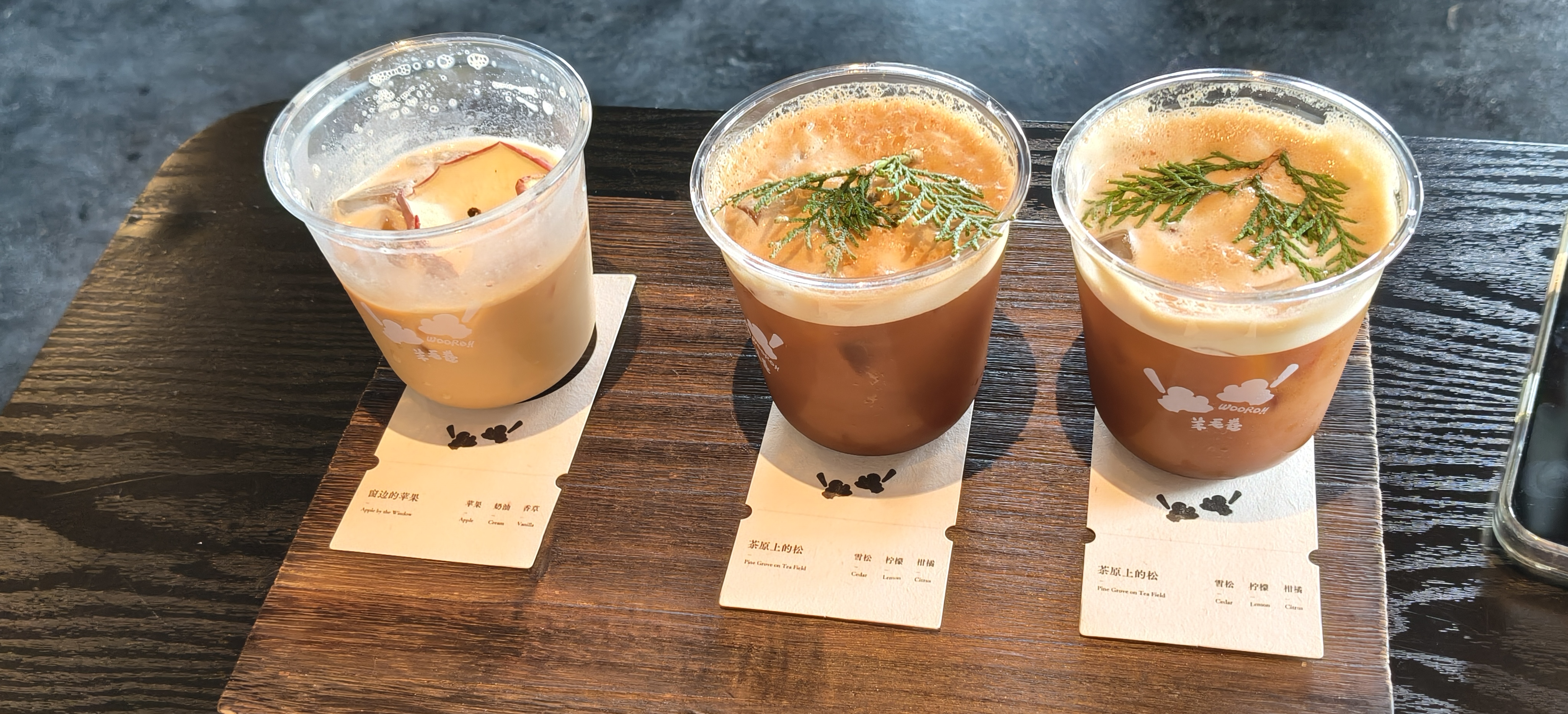
Besides the usual coffee drinks like espresso and americano, they also made coffee mixes with tea and other ingredients. We tried two special drinks: Apple by the Window and Pine Grove in Tea Field. They weren’t quite to our taste. They tasted mostly like coffee, but the tea flavour was hard to spot. The apple in the first one didn’t really go well with the coffee. The pastries were good, and the view of the endless tea fields was amazing. We chatted with the manager, who told us they’re planning to make even more variations and might even add Chinese wines. She had just come back from a trip to the wine region of Ningxia.
Coffee and wine: a bold combination
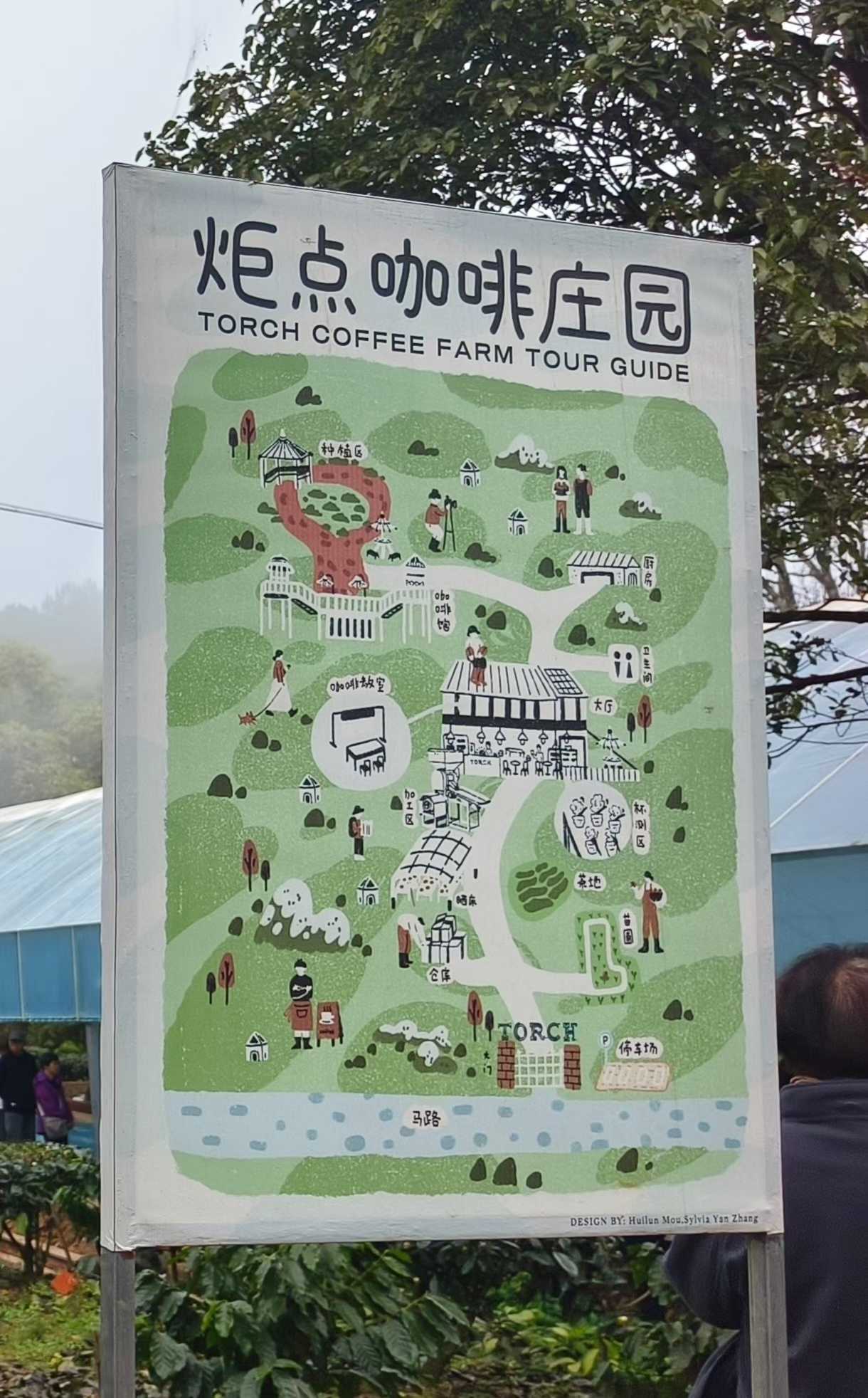
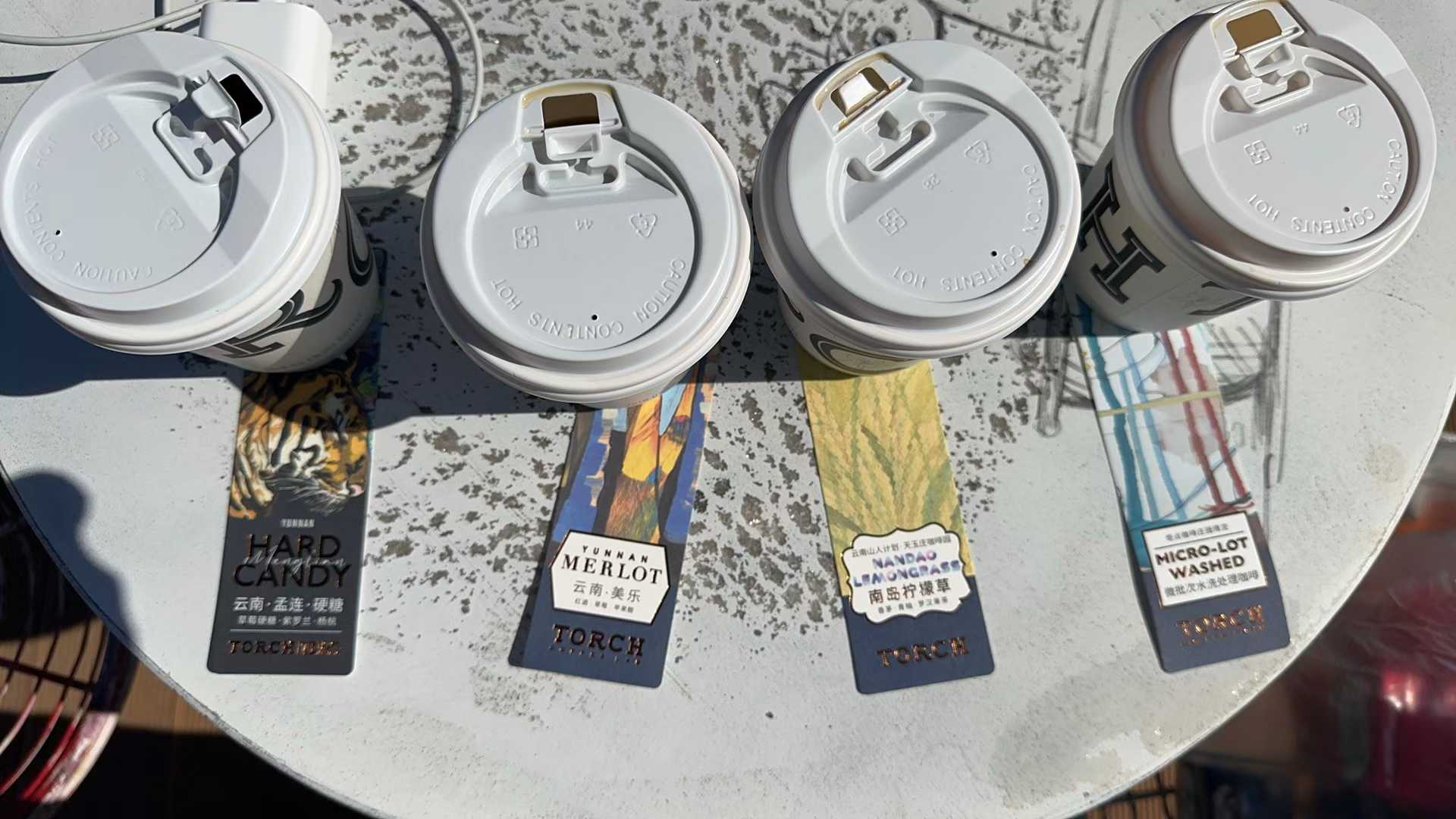
I came across this on Chinese social media about a visit to the Torch Coffee Farm in Pu’er, Yunnan. Torch Farm is experimenting with different coffee bean varieties, like roasting methods, to create unique flavours. The illustration shows some of their coffees during a tasting session, which is part of the tour. To me, the Merlot variety stands out the most. Torch Farm people compare coffee flavour variations to wine grapes. Interestingly, Pu’er has a sister city relationship with Libourne in the Bordeaux region of France. This was because tea experts in Pu’er noticed similar differences between tea and wine grapes.
These are fascinating developments that blend food science, business and culture. I’m sure I’ll be back soon with another post on this topic.
Picles and coffee: a peculiar couple
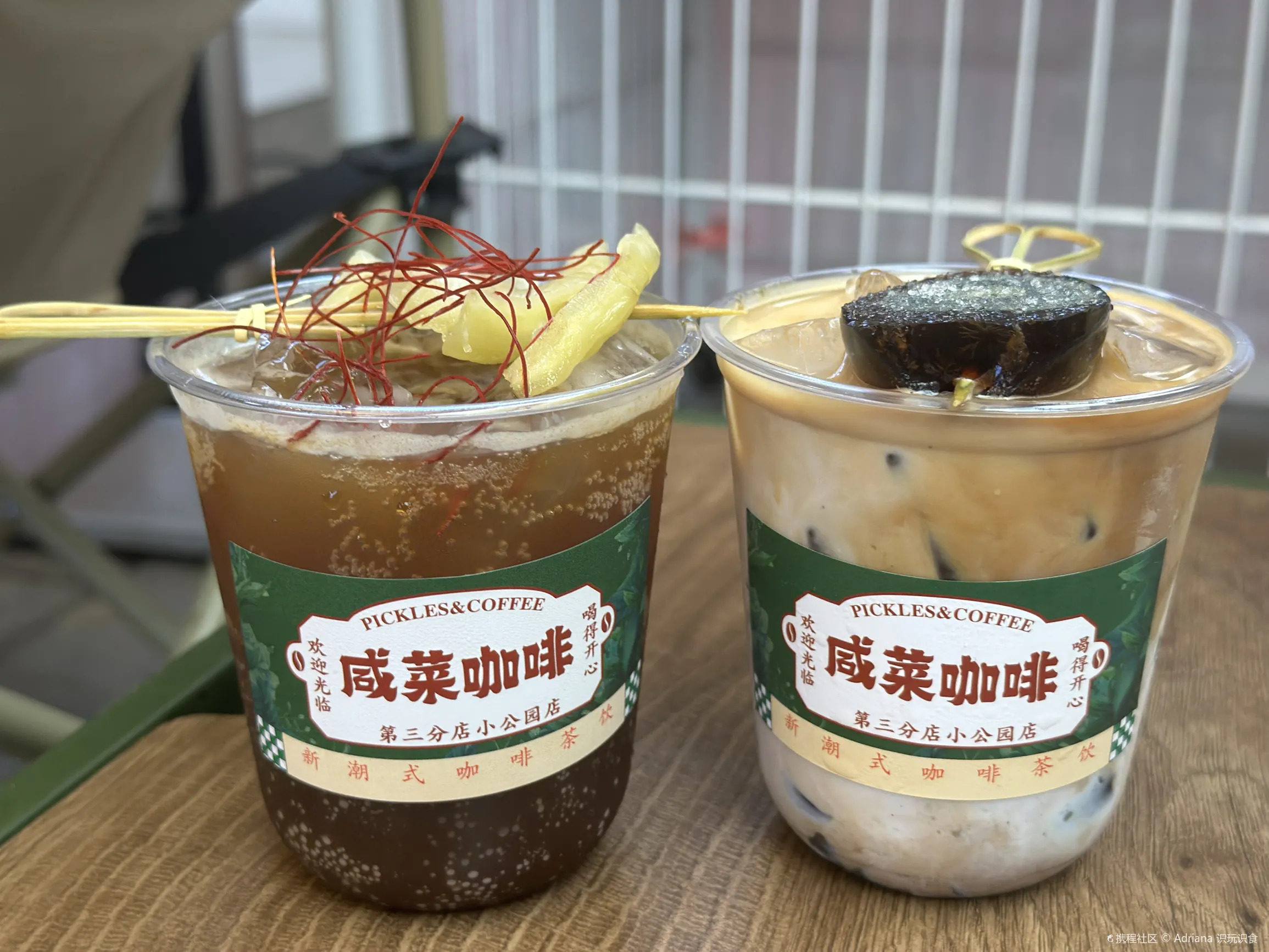
A company in Shantou (Guangdong) has launched an extremely funky drink, combining coffee (milk) tea and several other ingredients including pickled vegetables, in 2024. This concoction redefines the expression ‘an acquired taste’. However, a sales point was reported in Beijing in February 2026. So, apparently has developed a certain clientele.
An international coffee exhibition was held in Pu’er, Yunnan province, on January 5 – 7. Pu’er is the central town in Yunnan’s coffee production region, that is good for 95% of China’s coffee production; the remainder being produced in Hainan. In 2022, Yunnan’s total coffee bean output was 113,600 mt That year, Yunnan exported 8,700 mt of beans.
International
In that respect, Pu’er is the natural venue for an international coffee fair in China. However, the town is not the easiest place to reach for international exhibitors or buyers. That was probably the reason that, although it was an international fair, the number of foreign stands was limited. Only the stands of Mexico and Uganda had foreign persons on the stand. The other non-Chinese stands were manned by local people. As for visitors, I only spotted one other foreign visitor apart from myself.
Exhibitors
As Eurasia Consult specialises in food and beverage, I will not allot space in this post on machinery or services. However, the number of exhibitors was remarkably high. It seems that we can divide Chinese suppliers of coffee in two types: coffee companies comparable to the big international suppliers and a large number of small companies. The former purchase beans from farmers and process it into a number of standardised products. The latter are farms that have started processing their own beans into specialty products, and/or have added tourist facilities like a visitor centre or even a hotel, so tourists can stay at the farm for a complete coffee experience.
Coffee
A visit to a coffee fair inevitably leads to a high caffein intake. At a certain moment, it becomes hard to savour the flavour of another cup offered to you however hospitably. Still, the average quality was good. The range of flavours was impressive. Chinese coffee processors have reached the level of maturity in which various houses have developed a distinct flavour that you can like or dislike as a consumer. Most people offering coffee at the stands were familiar with expressions like ‘dark roast’ vs ‘medium roast’. Also, most coffee offered was prepared freshly in a percolator, to extract maximum flavour.
Innovative products
Coffee (beans, grinds, instant) was not the only product exhibited at this fair. A number of exhibitors was offering a broad range of derived products:
In several earlier blogs, I reported that coffee consumption in China is soaring, to the point that we can speak of a coffee culture. This trend has been developing constantly and now I feel comfortable to announce that a uniquely Chinese coffee culture is in place. This culture is affected by a number of recent trends: the nationalist trend and the punk-diet of the growing group of young single professionals.
Guochao – or the ‘national trend’; A trend that currently affects virtually every aspect of Chinese society is guochao, or the ‘national trend’, which encompasses a renewed interest in traditional Chinese culture (both material and immaterial). The economic reforms of the late 20th century made many (then) young Chinese turn their back on traditions, seeking new solutions in the present and in the western world. This is now changing. The shift can be partly linked to the enormous advancement of Chinese science and technology. Chinese now have a lot to be proud of. Recent anti-Chinese sentiments in the West are another driver of this trend. The national trend is noticeable in several aspects, including on packaging and the use of traditional Chinese symbols.
Pengke yangsheng – the ‘punk diet’ A trend that has appeared among the same post-90/post-2000 consumer segment is pengke yangsheng, or the ‘punk diet’. These consumers tend to work late, often until after midnight. They smoke less than their parents, but eat irregularly, with a preference for snacks and sweets, that can be eaten in front of your PC. However, these consumers also want to stay fit and healthy. They frequent the gym, but also try to get nutrition from convenience foods enriched with nutrients. These can be vitamins and minerals, but also extracts from traditional Chinese medicinal (TCM) herbs.
As for the nationalist trend, China’s home grown coffee is gaining market share in its home market. ‘Imported coffee’ is no longer automatically perceived as superior to the domestic bean. Another guochao development is that China’s leading TCM pharmacy, Tongrentang, has established a coffee shop concept in which you can order coffee enriched with various TCM herbs.
The influence of the punk diet trend is much stronger. It has led to coining the concept of ‘dirty coffee’. Dirty coffee is a relatively new type of coffee made by pouring hot espresso over extremely cold milk. It’s become popular in Asian countries including China, Japan, South Korea, and Thailand. In China, the expression is evolving to adding lots of ingredients that you would not normally associate with coffee. This trend is undoubtedly also informed by the immensely popular milk tea of which young Chinese can consume several litres per day. Luckin Coffee was the first to introduce the term dirty coffee.
Various other chains quickly followed suit. The following photo shows two dirty coffees from the fancy chain Vista Coffee.
Vist Coffee’s dirty coffees with odd colours
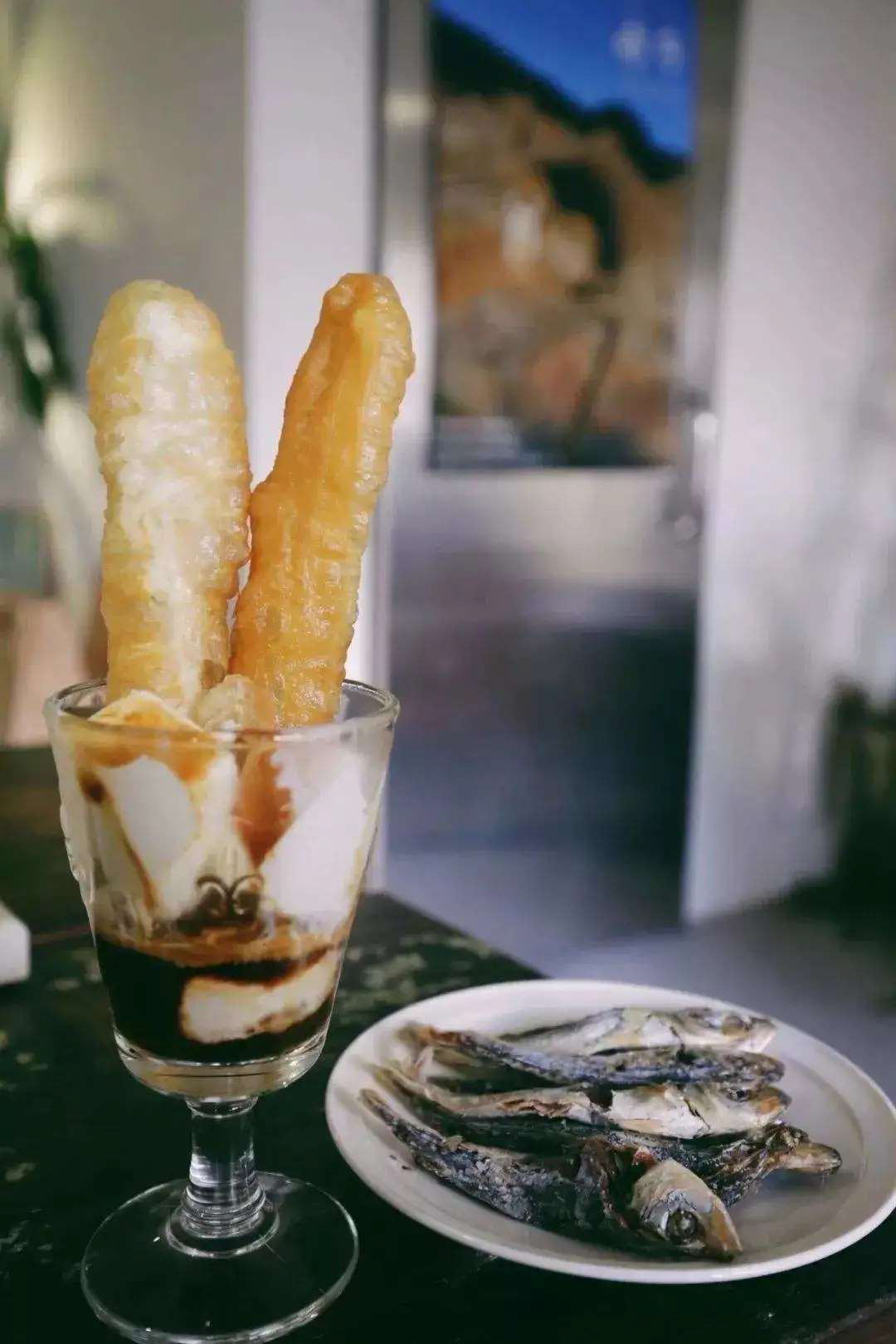
The ‘dirtiest’ picture that I have come across sofar is also provided by Vista: coffee with two youtiao (fried dough sticks) stuck into it. To make the dirty impression complete, they have added a plate of fish as well. Youtiao is a traditional food, so this picture also reflects the nationalist trend. Why would you only drink tea with your dim sum?
The developments proceed rapidly, so this blog is a little messy, which suits the dirty image of the products I am introducing here. I will keep you up to date as usual.
KFC
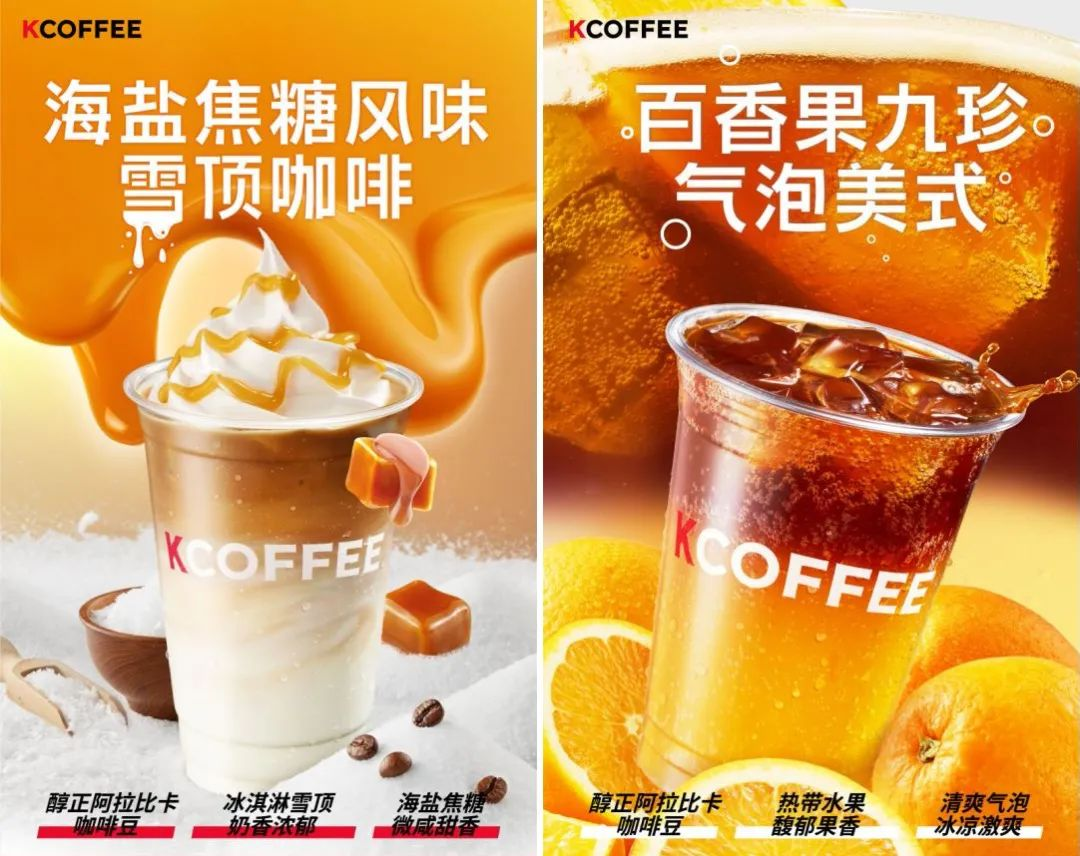
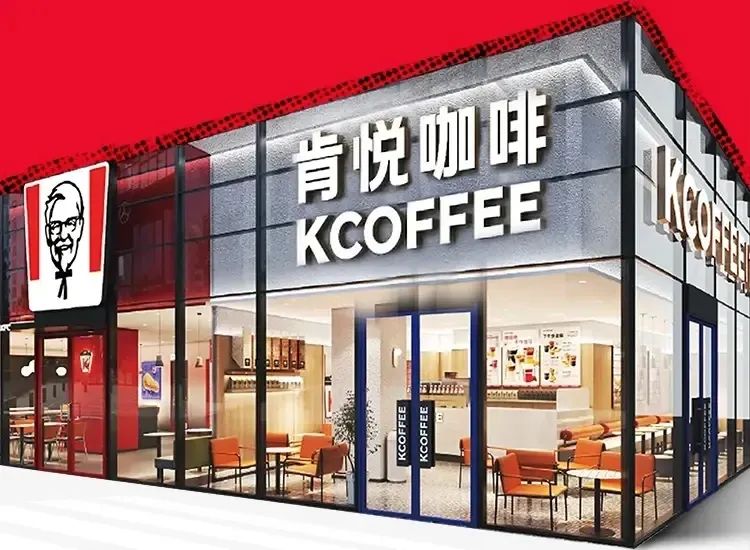
Multinationals have also noticed this trend. KFC launched its KCCoffee in China in 2023. Products on offer include sea salt caramel and passion fruit.
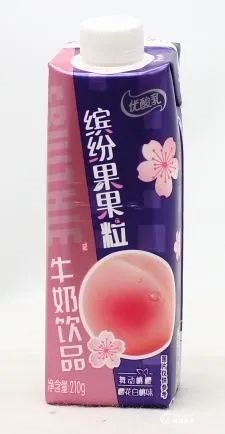
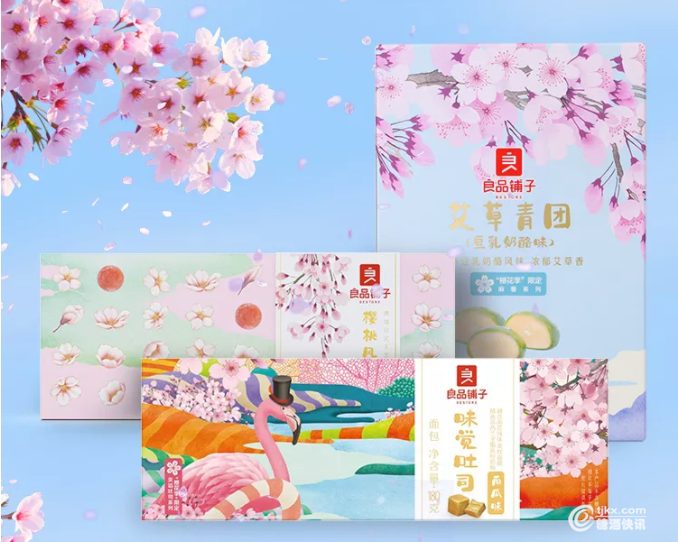
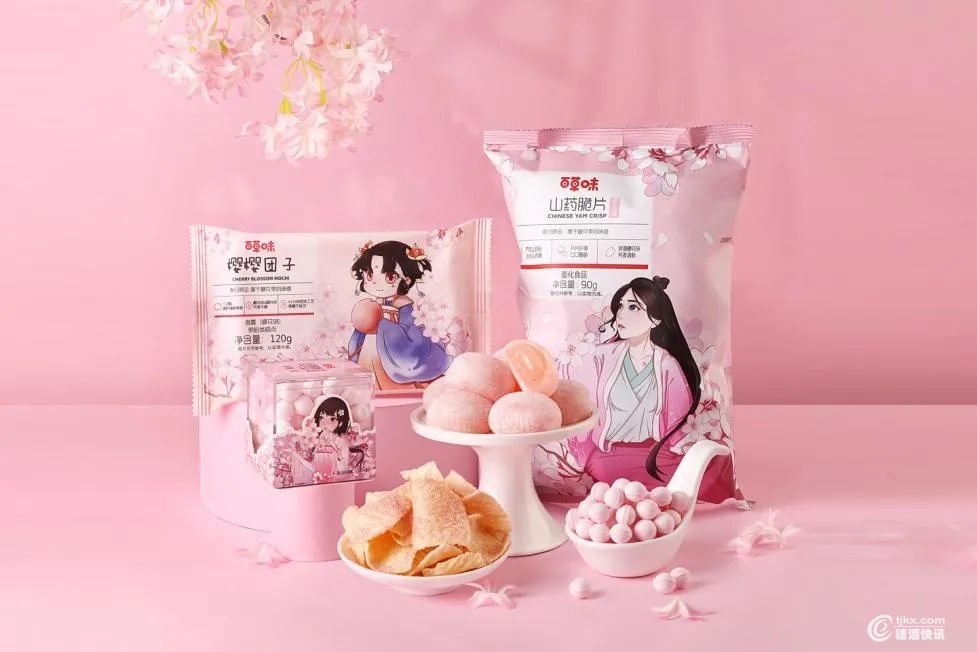
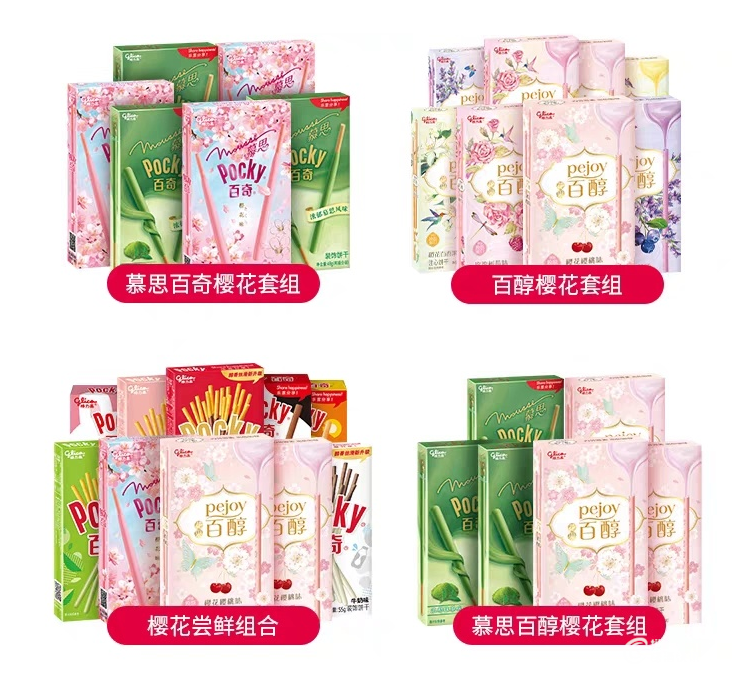
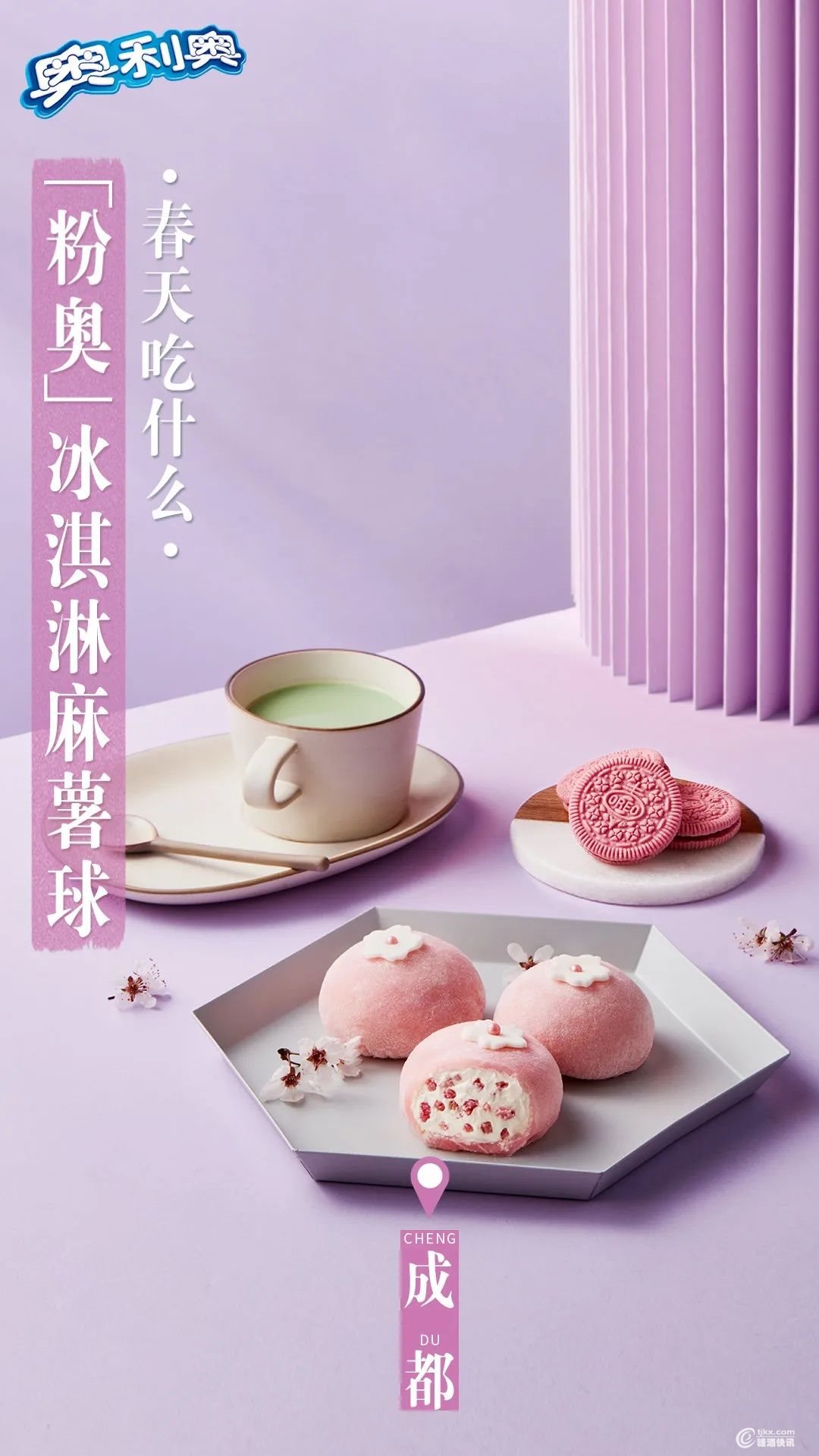
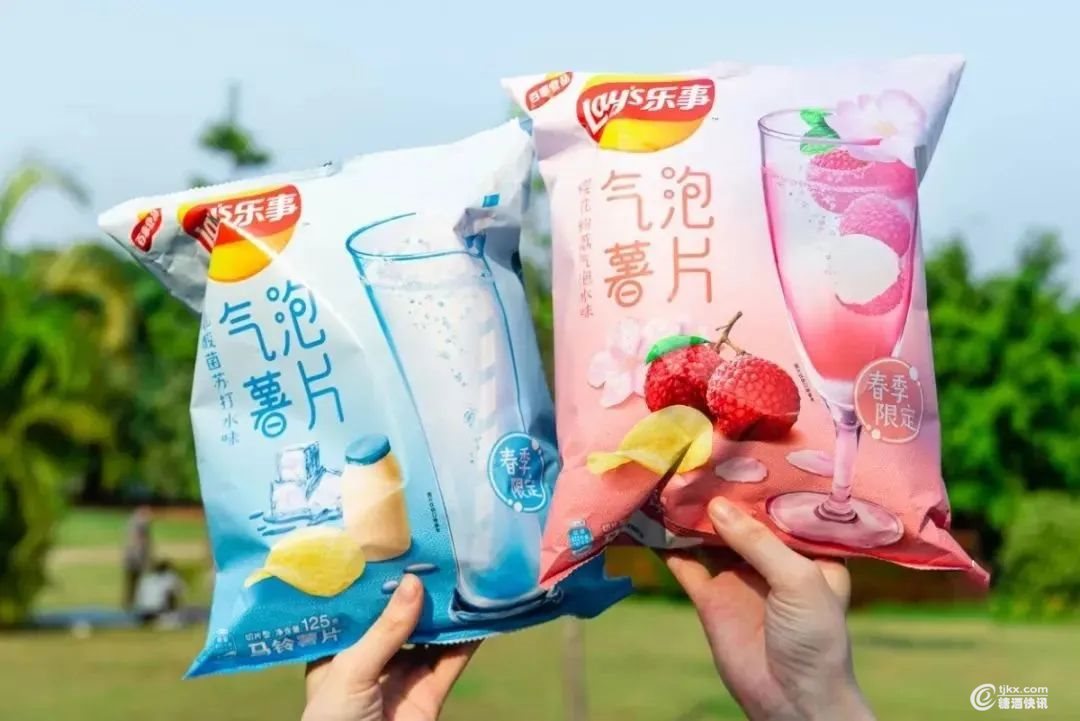
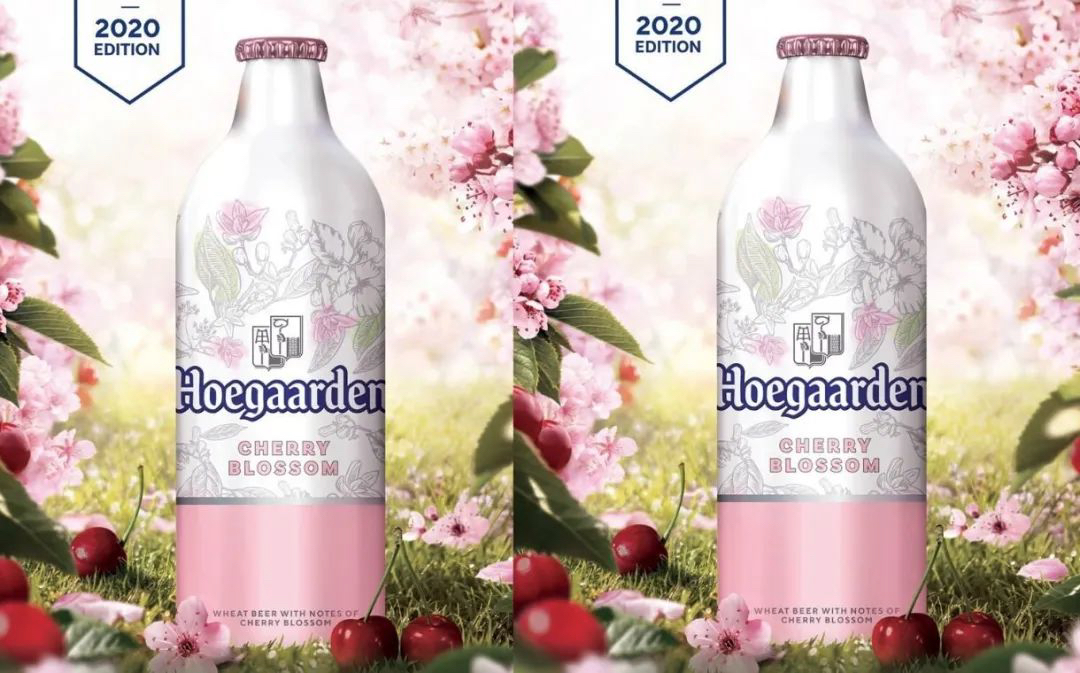
Spring has arrived in a world that is still in the grip of the COVID-19 epidemic. However, the epidemic is clearly on its retreat in China and the nation’s food and beverage suppliers are celebrating this with an outburst of pink-coloured products. This blog does not require a lot of explanation; the pictures speak for themselves. Moreover, this post is a good overview of China’s most popular foods and drinks at this moment.
The scale of China’s coffee industry has reached RMB 265.4 billion yuan in 2023. The per capita coffee consumption has reached 16.74 cups in 2023, almost double the figure of 9 cups in 2016. (2024 market survey)
Once upon a time every non-Chinese, when asked about the favourite drink of the Chinese, would answer: tea. Foreigners brought coffee with them and introduced that brew to their Chinese friends and business relations. As a result, a number of Chinese in major port cities, where the foreigners were typically concentrated, acquired a taste for that brew as well. Today, tea is still the leader by a massive margin, though coffee is charging forward in leaps and bounds. Manager Wang of Damin Food (Zhangzhou, Fujian), a manufacturer of instant teas and coffees, still remembers that when he was at university in Zhangzhou, there were at most 10 coffee shops in the entire city. When he moved back a couple of years ago, there was one street alone with 10 coffee houses. That’s how things are changing, and we are starting to see real growth outside the metro cities. A trend towards coffee culture has developed over the last half-decade largely through the influence of cosmopolitan Beijing and Shanghai, the drivers of Chinese fashion. Now, the coffee shop has become a common and popular place that many people of moderate income can afford going to. The following table shows the value of the Chinese coffee market in the period 2020 – 2024.
However, the annual consumption amount per capita in China in 2024 was only 9 cups, far behind 300 cups for Japan and Korea, and the world average of 240 cups. This is due to the fact that coffee consumption is large in the cities, but still small to non-existent in the countryside. There is room for an annual increase rate of 15-20% for the coming years. Young white-collar workers in cities like Beijing and Shanghai consume 100 to 150 cups of coffee annually. Coffee drinking has added many new expressions to the Chinese language.
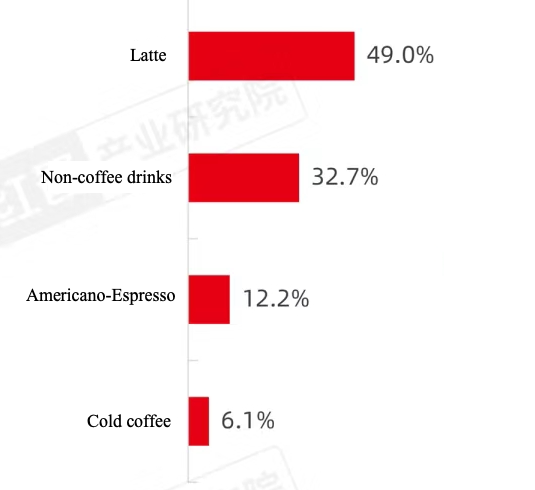
The following table shows the different types of coffee and the degree in which Chinese consumers ordered it in coffee chains in September 2024
China’s oldest domestic instant coffee
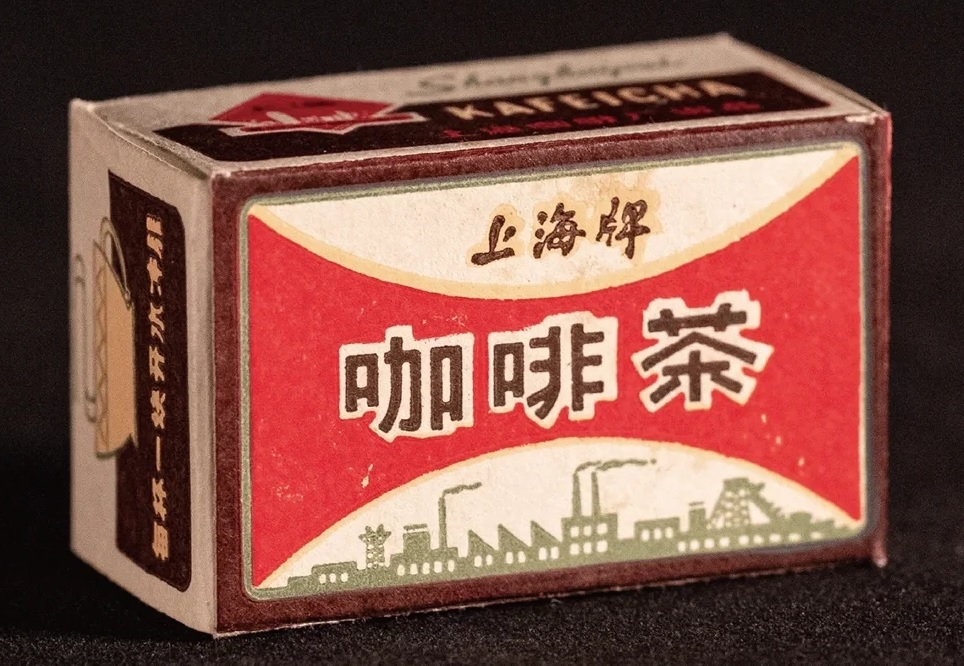
In 1935, Zhang Baocun founded the Desheng Coffee Shop on Shanghai’s Jiang’an Temple Road (currently: Nanjing West Road). The company was renamed State Operated Shanghai Coffee Factory in 1959. After the founding of the PRC, private enterprises were gradually reorganised from ‘private-public joint operation’ to ‘state operated’. This renaming indicates that the company had reached that final stage. A year later, the company started producing a kind of instant coffee, ground coffee beans and sugar pressed into blocks. You only needed to poor boiling water over it to get a cup of coffee. Because the general public was not used to coffee drinking, the product was named: kafeicha, literally ‘coffee tea’.
Vietnam major source
Vietnamese coffee beans accounted for 49% of those imported by China in 2017. However, other coffee exporting nations like Colombia and Brazil have all set up promotion offices in China. Chinese coffee imports grew by 16% year-on-year in 2017, compared with about 2% in the United States, the world’s largest coffee consumer. The following table shows the import and export figures of coffee beans in the period 2019 – 2023.
Surprise from Ethiopia
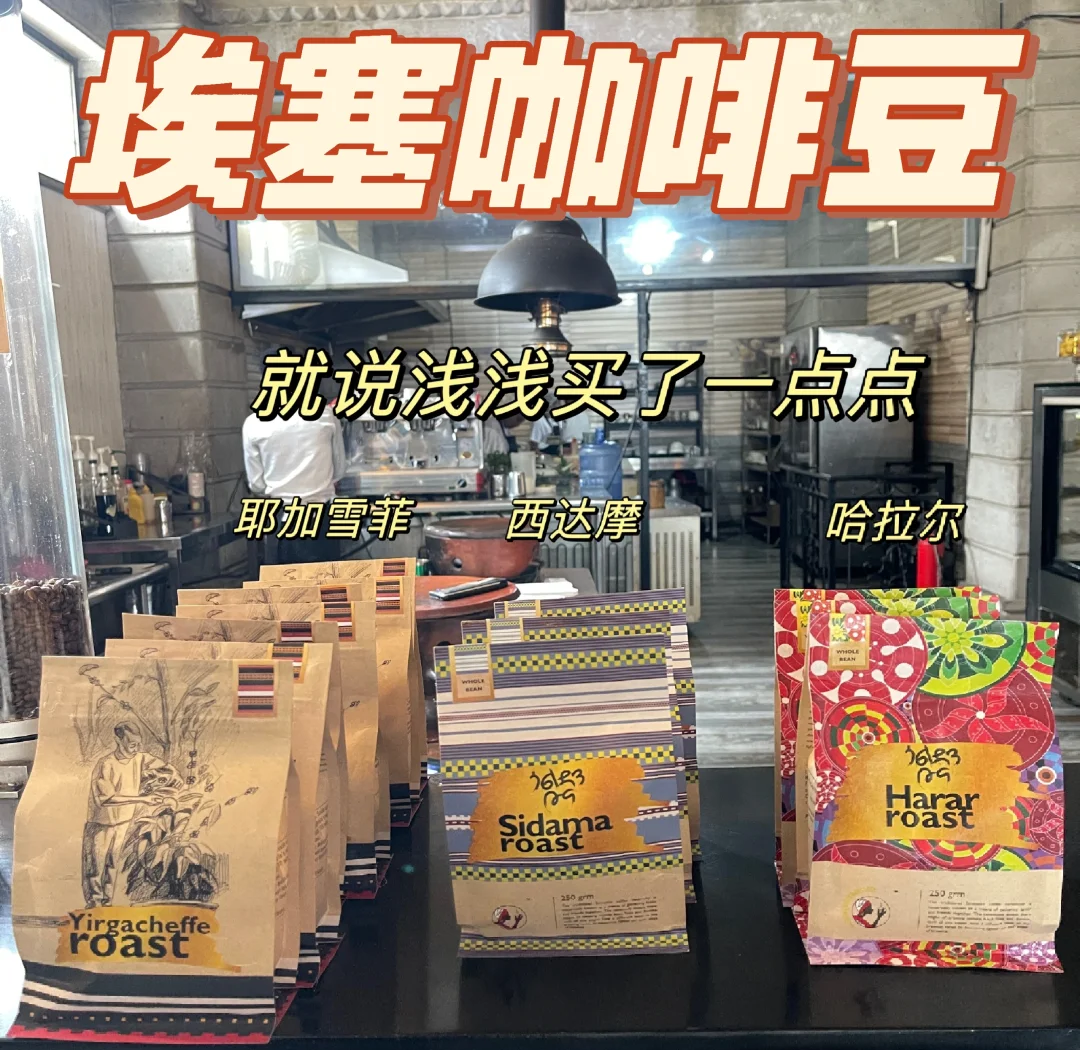
The China (Puyang) Ethiopia Coffee Industry Demonstration Park, which imports raw coffee beans from Ethiopia, has established a complete production chain in 2020, from roasting and extraction to freeze-drying and packaging. With an annual output of 1000 mt of freeze-dried coffee powder, the park can supply around 500 mln cups of coffee each year. Their products have also reached international markets, with exports to countries like Australia and Malaysia.
Market on the rise
China’s currently low average rate of coffee consumption, in tandem with its status as the most populous nation on earth, add up to real market potential, especially as sales of ready-to-drink (RTD) coffee products are soaring. Research carried out earlier this year shows that thus far the most significant strides have occurred in the instant coffee market, which reached over US 1 billion in retail sales in 2012. However, since 2011, RTD coffee has consistently boasted the strongest volume growth of any Chinese beverage category. The RTD coffee segment growth of 22%. Fresh coffee, though, remains a niche product. Its demand, due largely to its convenience, is mostly from recent adopters who tend to be unfamiliar with fresh coffee preparation methods and who often lack the appliances needed to make it. In terms of flavour, instant coffee’s ability to be packaged as a mix with sweeter and other additives appeals to the Chinese palate, which generally prefers milder, milkier coffee to the stronger, acid profiles often evoked by fresh coffee. Indeed, the most popular type of instant coffee in China, which accounted for 52% of the segment’s sales in 2012, are three-in-one mixes that include a mix of instant coffee, creamer and sweetener. Nestlé’s Nescafé is the dominant player in both instant and RTD markets, accounting in 2012 for half of the entire RTD market, and just shy of three-quarters of the instant market. While the brand has a global instant share of 46%, its strength in China is unsurprising, though the strength of its RTD sales in the country is very different to its global weight of just 3% share.
Foreign trade
The following tables show the development of China’s coffee-related imports and exports.
The competing forces
According to analysts, currently, on China’s coffee shop market, there are three distinct competing forces: Chinese domestic, European and American, and Korean and Japanese. They are engaging in different strategies to strengthen themselves. For instance, Sculpting in Time is trying to take the advantage of e-commerce. In December 2014, it established a professional coffee website, Hello Coffee, where visitors can see all relevant information about coffee making and consumption. Hello Coffee says it is China’s first B2C coffee website. Starbucks places more emphasis on fast coffee serving in the shop. It also takes measures to encourage consumption outside of the coffee shop. Mid 2018, Starbucks is present in 147 Chinese cities with a total of 3362 outlets, including 7 cities with 100+ outlets. Shanghai is the largest with 663 stores. Starbucks has announced that it intends to run 6000 outlets by 2022. Costa Coffee, a British multinational, plans to open 900 more stores in China by 2020, which will give it 1344 shops in the country.
Starbucks China has in 2024 lost its dominant position in the on-premises coffee market in China as local coffee rivals have emerged. Starbucks’ brand share in the specialty coffee and tea shops category in China dropped from its peak of 41% in 2017 to 14% in 2024.
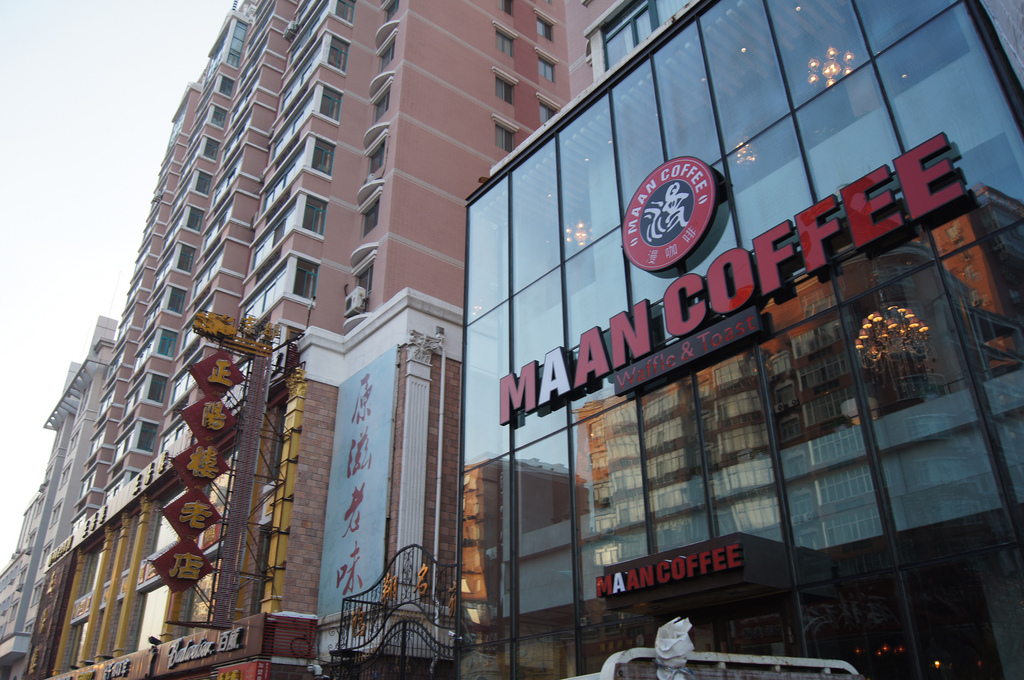
Korean coffee shops are dedicated to business alliance. What is more, Korean coffee shops, such as Caffe Bene, Maan Coffee and Zoo Coffee, have entered China’s market. However, this business alliance mode does not seem to work smoothly. In the course of 2015, Caffe Bene started to show cash flow problems and soon the Chinese mother company stopped injecting further capital in the venture. You can still see several Caffe Bene outlets operating in Beijing, but shops in other cities have closed down one after another. Insiders believe that the chain will disappear complete during the first months of 2016. Zoo Coffee is also reporting problems in developing the Chinese market. The management has decided to quit the franchising system and only operate wholly owned outlets. It has also stated that it wants to alter its ‘Korean’ image to avoid Zoo Coffee running in the same problems as Caffe Bene.
Founded in 2019, Nowwa Coffee opened its first store in Shanghai and operated over 1800 stores across 150 Chinese cities in 2025 – making it the sixth largest operator.
McDonalds already operated a chain of McCafés in China and KFC joined its competitor in 2024 by opening a coffee chain of its own: KCcoffee.
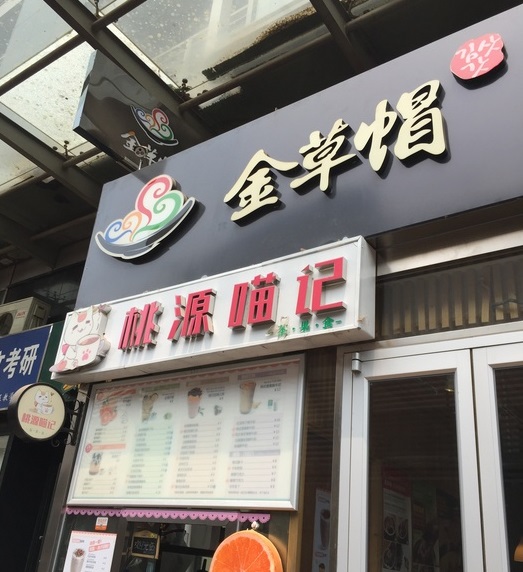
Industry insiders believe that chain coffee shops should be prepared to face the challenges from fast-food restaurants and convenience stores as well as milk tea stores. According to these analysts, coffee shops should focus on their unique service rather than size, since consumers might stay there for a long time, thus increasing their operating costs. Also, they suggest coffee shops host some activities in order to boost their business and advertise themselves. Actually, there is also a third force emerging in this market: the private coffee shop. It needs a lot of courage, but there are single Chinese coffee entrepreneurs who do not want to tie themselves to one of the big names and set up their own, often single-store, coffee shop. One of my favourites is Taoyuan Miaoji, located in an alley opposite the main gate of the University of International Business and Economics (UIBE). It is an ideal spot for a quiet talk with friends.
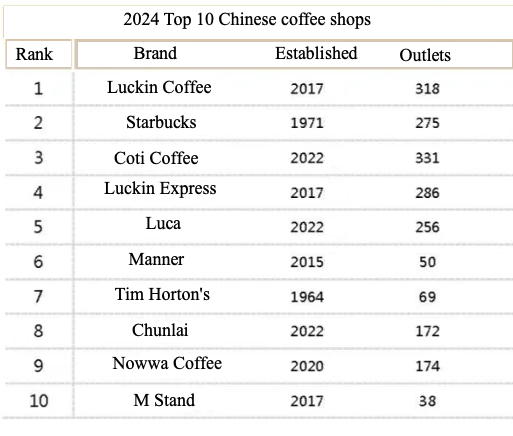
The following table shows the Top 10 coffee shops as per end of 2024.
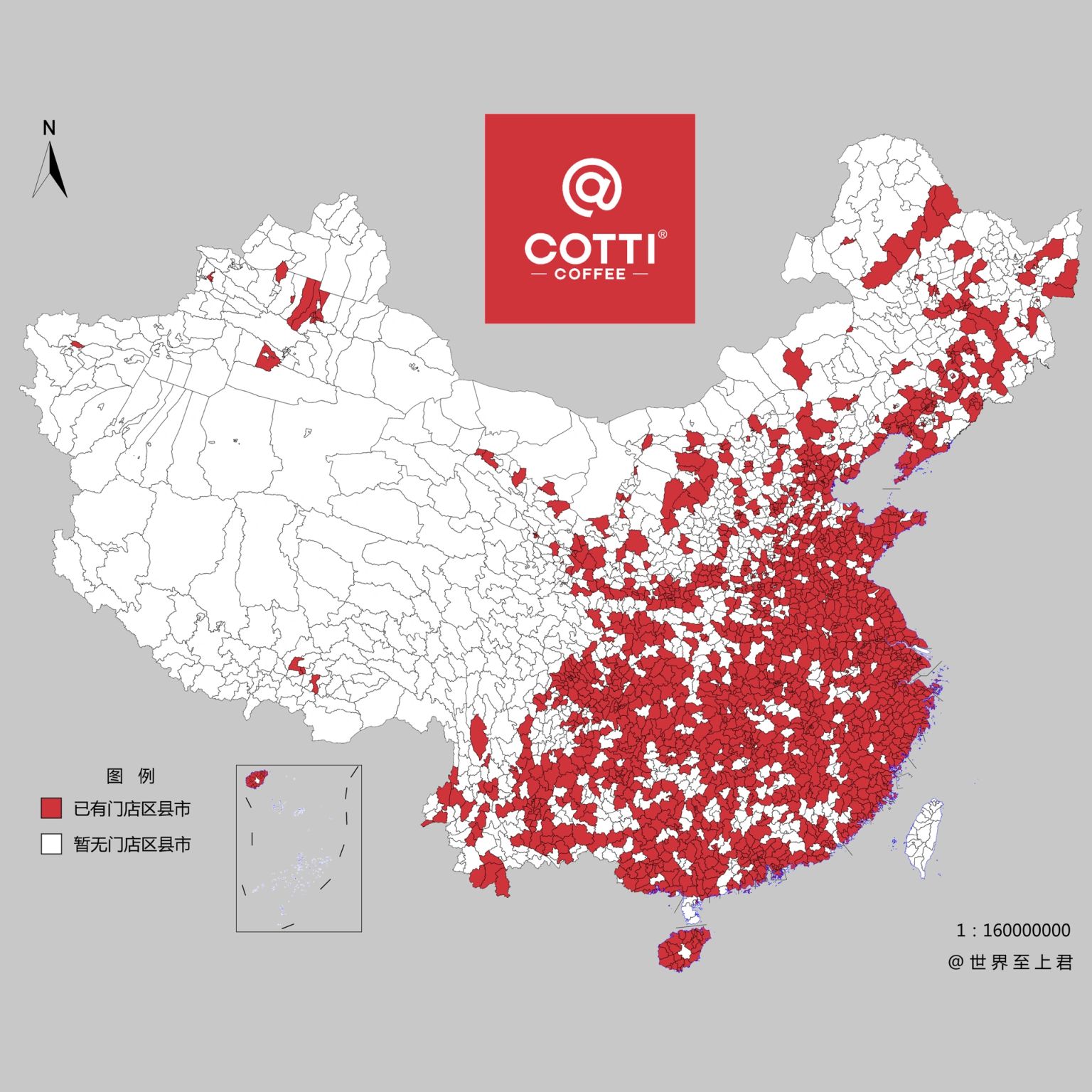
Here are some maps showing the distribution of major chains in 2024
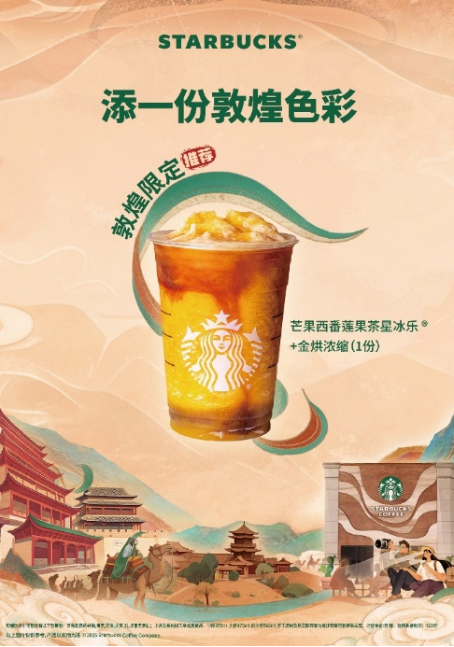
It is clear that coffee chains were still mainly distributed in the eastern half to one third of the country. However, the development of these and other chains has been fast and is still going on. Starbucks’ distribution shows very few outlets in Gansu province yet in 2024. However, a year later, the company started to cooperate with Dunhuang, China’s most famous caves with Buddhist frescoes, incorporating Buddhist imaging in its advertising. The top text says: ‘Adding some Dunhuang flavour’. The mango passionfruit coffee in the picture is, according to the ad, restricted to the Dunhuang scenic area. A nice cultural gesture, but that restriction may limit its commercial effect.
Categories
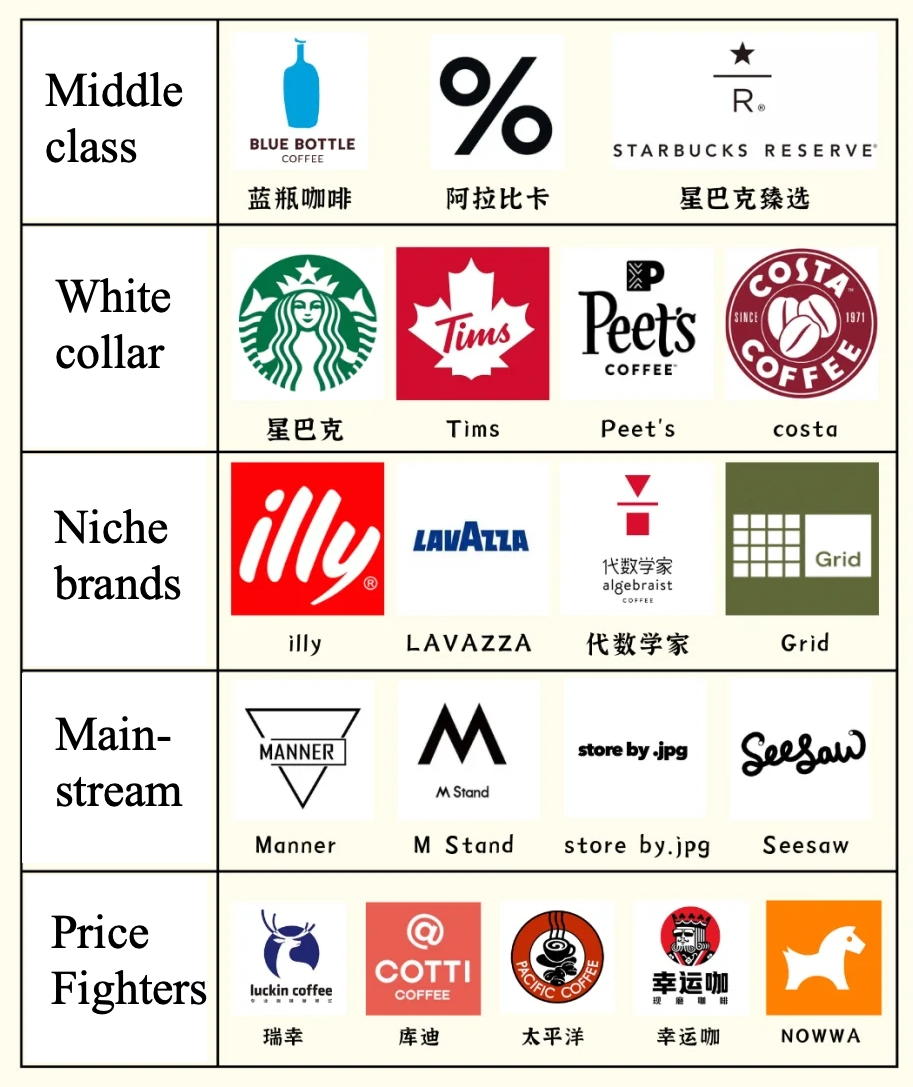
The following diagram shows the coffee chains operating in 2024, arranged in five different categories.
Starbucks as measure for development
The site Dudihui is a blog consisting of infographics about Beijing. A blog posted mid 2018 compares the size and development of the various districts of Beijing. One of the dimensions in that infographic is the number of Starbucks outlets in the district. It is shown in the following picture.
It is the strongest sign of the symbolic value of coffee shops on present day China. An interesting detail is that the Chaoyang Distr. with its foreign embassies and CBD has more coffee shops that the university district Haidian.
Starbucks’ business in China got into trouble in 2024, when Luckin Coffee finally reached its primary goal: more outlets in China than Starbucks (see below). The ever growing number of domestic chains also proved a major challenge.
The German connection: from Hannover to Changde
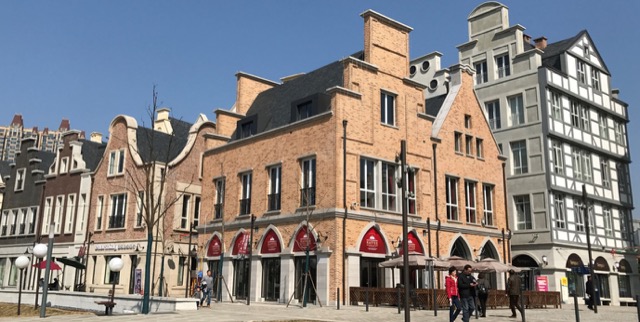
Coffee is often associated with Italy, but Germany has played an outsized role in its history too. The paper filter was invented by a Dresden housewife, and the city of Emmerich am Rhein was home to one of the first automated drum roaster. Now, there’s another reason to turn to Deutschland for your java fix, with the arrival of Hanover Coffee in China. Founded by Andreas Berndt in 2011, the former marketing man opened the first premium coffee bar and bean shop in Hanover, which has since grown to supply private customers, high-class hotels, restaurants, companies, and cafés in Germany with over 30 different types of coffee beans. Last year, Berndt’s sons, Fabian and Flemming, came out to China to set up their first overseas branch. Now operating out of a roastery in Changde, Hunan province, where a ‘German Town’ has been erected (the photo shows the roastering plant in that town). They use a the medium roast, also known as a Vienna roast, which is not too light or dark. The coffee beans are roasted at around 190 degrees Celsius, or as low as possible, to preserve the full aroma. They use a Probat drum roaster from Germany. Their green beans are checked in Germany before they’re shipped to China and checked again.
Luckin Coffee – playing the nationalist card . . . with ups and downs
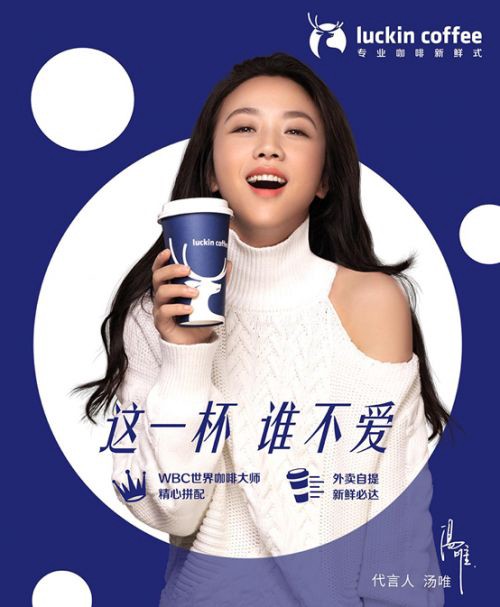
The nationalist trend in Chinese politics is also entering the fierce competition in the coffee market. Newcomer Luckin (Ruixin) Coffee, with its HQ in the coastal city of Xiamen, opened 525 stores in the first four months of 2018. It has wooed more than 1.3 million customers and created an internet frenzy by challenging coffee giant Starbucks. With investment of more than RMB 1 billion from Lu Zhengyao, CEO of car rental company Ucar Inc, and other founding members, Luckin Coffee aims to grab some of Starbucks’ market share with a combination of delivery services, lower prices and smaller-sized stores-a brand strategy it calls Any Moment. Qian Zhiya, CEO and founder of Luckin Coffee, and previously an executive at UCar, said the goal is to offer Chinese consumers an alternative to Starbucks. “The market will not only have Starbucks. Every country has their own coffee brand,” Qian said. Luckin Coffee said their secret ingredient for creating “a decent cup of coffee” is their select Arabica coffee beans, world-leading coffee machines and professional baristas. Of its stores already in operation, 294 are brick-and-mortar cafes between 30 to 50 square meters in size. Some 231 receive delivery orders only. Qian said, in the future the delivery kitchens will comprise less than 15% of the total. Luckin is also using high tech to distinguish itself.
Luckin Coffee even started to involve the courts in its competition with Starbucks in May 2018. Luckin accused Starbucks of monopolistic activities, because it prohibits owners of properties in which it has set up shop to also sell space to competitors. This case will be hard to win for Luckin, as I can name numerous locations in various cities in China where Costa Coffee or Pacific Coffee have opened outlets very close to a Starbucks shop.
Luckin Coffee announced on July 11, 2018 that it had raised USD 200 million in a fundraising round that values the company at USD 1 billion. Investors are said to include Singapore sovereign wealth fund GIC. The company intends to open another 2500 outlets in 2019.
Lucking Coffee got listed on the Nasdaq Stock Exchanges in 2019. It priced its initial public offering at $17 per share. However, in March 2020, the company came out with an announcement that its COO Liu Jian fabricated more than USD 310 mln worth of transactions in 2019, almost half of the company’s roughly $732 million in sales of that year. The NASDAQ decided to oust Luckin in June 2020.
Following this down period, Luckin then entered its second period of aggressive expansion. Luckin’s financial results for 2022 showed the full extent of its recovery: Revenue exceeded USD10 billion for the first time, and the company turned a profit for the first time in its history. According to Luckin’s earnings report for the first quarter of 2023, net profits have increased 27 times year-on-year. It has opened a new store on average every two hours, including its first foray overseas in Singapore. What was powering Luckin’s recovery was its new strategy of targeting China’s so-called “sinking market” — mostly third- or fourth-tier cities in China. In fact, for the coffee industry, the “sinking market” basically covers second-tier cities and below.
In spite of all the mistakes and mishap, Luckin Coffee surpassed Starbucks China, at least in number of outlets in the course of 2024. Against the background of the US – China trade war, this coffee war between the US-based Starbucks and the domestic street fighter Luckin has gained an interesting political dimension.
One of the original founders of Luckin Coffee, Lu Zhengyao and Qian Zhiya. left the company with a number of employees and established a coffee chain of her own in 2022: Cotti Coffee. Half of Cotti’s core team are former Luckin employees, and pricing and products are also almost identical to Luckin’s. Cotti is even more aggressive in its expansion. While Luckin took 11 months to reach 1000 stores nationwide, Cotti did so in just five months. It took Starbucks 16 years.
More and more
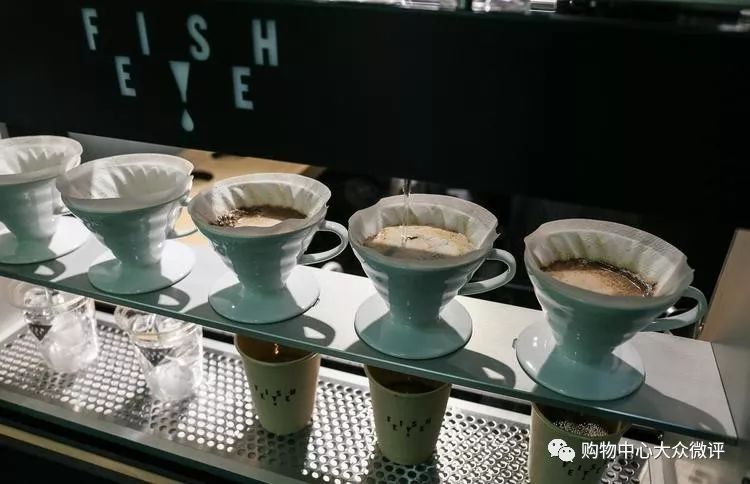
More domestic coffee entrepreneurs are following the example of Lucking Coffee. A newcomer worth watching is Coffee Box. This chain emphasises coffee drinking as a total experience. Coffee Box picks business districts of major cities as the locations for its ‘experience shops’. A more locally concentrated chain is Buzztime Coffee in Shanghai. This chain opens relatively small outlets in areas where restaurants and small shops are concentrated, as a more homely alternative for the more crowded and noisy coffee shops. Shanghai-based Unibrown Coffee (2017), owned by Shanghai Jiajia Electronics, is playing the high-end ‘specialty coffee’ card. Greybox Coffee (2017) and Soloist fall in the same category, but then geared to those who are passionate about coffee. Soloist baristas do not want to be addressed with ‘waiter (fuwuyuan)’ but with ‘coffee master (kafeishi)’, in an effort to link the Chinese term for barista to their own brand. A lesser known newcomer is Beijing-based Coffee08. Minicoffee (Xiaojia) specialises in milk coffees. Uin Coffee positions itself as a high tech coffee maker. ParCoffee is also based in Shanghai, with its most famous coffee cup shaped outlet near Huashi Plaza. The number and speed of new coffee concepts launched in China is so high, that keeping this post up-to-date is a genuine challenge. A catching feature of Fish Eye Coffee (see following photo) is filter coffee; you can watch your brew appear drip by drip.
Uin Coffee (2018) seems to concentrate on high-end office buildings. It als operates coffee vending machines. Coffee Now (2015) is China’s first producer of cups like those of Nespresso. Seesaw Coffee (2017) is once more Shanghai-based, aiming at coffee lovers preferring a quiet elegant ambiance.
Bestar Coffee was launched in Shanghai in 2022, with coffee + artisan ice cream as its distinctive feature.
Lucky Cup, the coffee brand of tea chain Mixue launched in 2017, is known for its ultra-low pricing strategy: a latte for RMB 10 yuan and an Americano for RMB 5. Compared to Starbucks’ and Luckin’s average cost of RMB 40 and 20, respectively, Lucky Cup’s prices are more attractive to younger people in less affluent cities.
Saturn coffee: instant coffee in a cup
Hunan’s provincial capital Changsha is a growing coffee city in China. One typical phenomenon of Changsha is the large number of tiny coffee shops, with only place for 3 – 4 customers at a time. It is also the home of the creator of a new type of instant coffee: Saturn Bird. The company came up with a breakthrough an instant coffee that completely dissolves within a few seconds. No stirring required. It adopted bright, eye-catching (and recyclable) packaging for its coffee pods. Late 2019, Saturnbird Coffee consecutively completed Series A and Series A+ rounds of funding, led by Tiantu Capital, securing RMB tens of millions. FreesFund invested in the preceding round of financing, which was valued at RMB 10 mln.
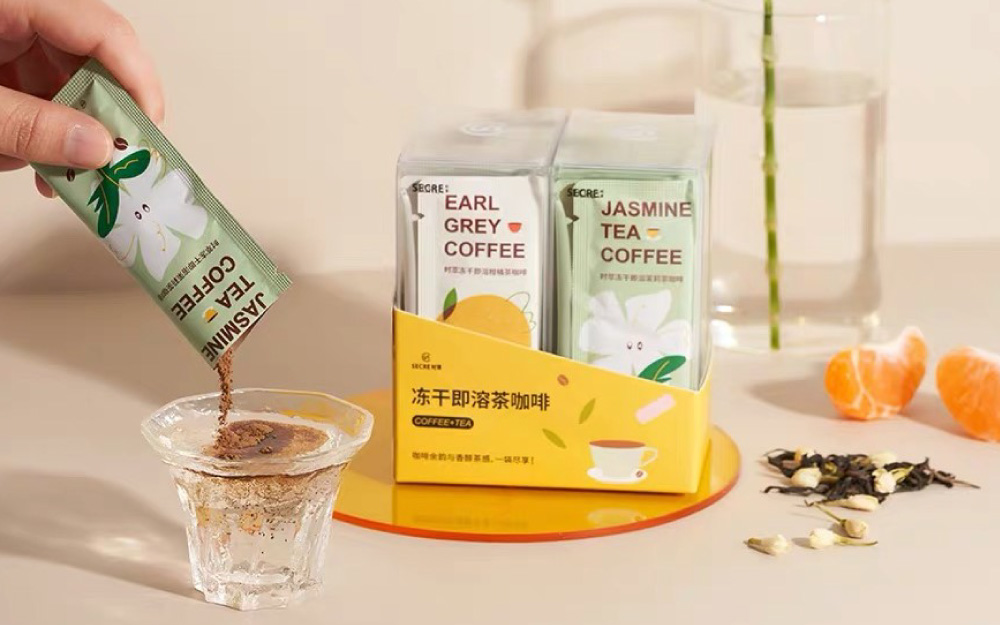
Another domestic brand of instant coffee is Secre Coffee. Secre Coffee was founded by former executives of major coffee businesses and tech firms, including Starbucks and Uber. Its estimated sales reached around RMB 120 mln in 2020. Secre adopts a tea-inspired product strategy and its product range includes Earl Grey Coffee and Jasmin Tea Coffee.
The Chinese coffee scene is also attracting private foreign investors. Read this interesting human interest story about a Canadian coffee grader who started his own coffee shop in the northern port city of Dalian.
The Russians are back
The Russian coffee brand Lebo opened its first coffee shop in China in Harbin in 2021. Harbin had a large Russian community in the decades after the Russian Revolution until the establishment of the PRC.
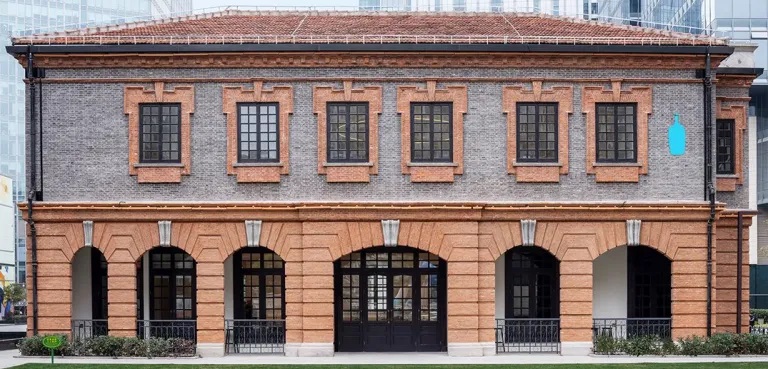
Blue Bottle Coffee’s Debut in Shanghai
Blue Bottle is a coffee roaster and retailer headquartered in California, United States. In 2017, Nestlé acquired around 68% of Blue Bottle Coffee’s stake. By then, the brand had 40 stores worldwide. Five years later, its number of stores has been expanded to 100, and the Shanghai store is the first one that Blue Bottle Coffee opened in the mainland of China. The coffee store opened on February 25, 2022. Some people woke up at 6 am just to get a cup of Blue Bottle coffee, and on average, it took 3 hours for consumers to get in line and enter the store. The company has adapted to the Chinese palate. At the Blue Bottle Coffee Shanghai store, consumers can have local snacks to match the coffee, such as mung bean pastry (lüdougao) and mahua, a kind of fried dough food.
Medicinal coffee
Coffee has become such a lucrative product, that even an old established traditional Chinese pharmacy like Tongrentang has started a medicinal cafe that serves various types of coffee enriched with medicinal herbs.
Fruit-flavoured coffee
Shanghai based S.Engine Coffee launched an orange flavoured coffee (or should we say coffee flavoured orange juice?) in 2021. Chinese love to add fruit flavours to all types of foods and beverages.
Strategic alliances
Strategic alliances are one way for foreign players to get a foothold in the Chinese market. Lavazza is cooperating with the shopping mall chain Parkson in operating a chain called Coffii & Joy.
In 2020, China’s Internet giant Tencent entered into a strategic alliance with Tim Hortons, investing in Tim’s entry into China. Tim plans to open more than 1,500 stores in China within 10 years. Statistics show that 80% of Tims China’s sales come from WeChat applets. Tims and Tencent jointly built the first esports themed coffee shop in China, also opened in Shanghai in November 2020, providing users with a strong social attributes “esports + coffee” life scene. Tims Coffee China CEO Lu Yongchen revealed at the end of 2020 that he has made an overall profit in all its stores. Previously set up shop plan, is expected to be shorter.Tims Coffee currently has nearly 200,000 members and a monthly repurchase rate of 40%.
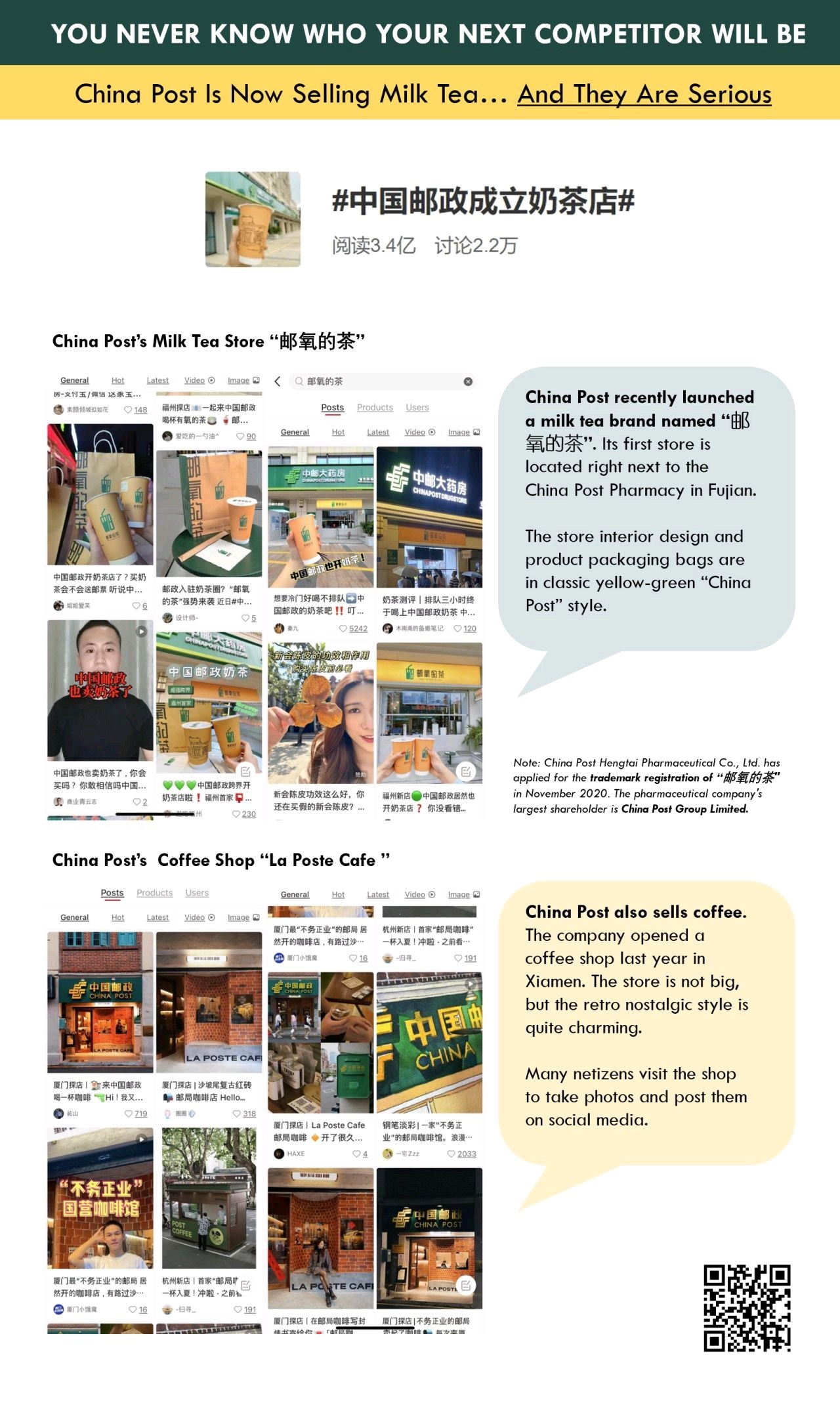
Coffee is now regarded as such a money maker, that the most unexpected parties are venturing to tap this market. China Post got the idea in 2021 that it could use the obsolescent post offices to add or turn them into coffee shops. The first one was opened under the fancy French name La Poste Café.
Coffee on the road
A huge, and still growing, market for coffee in China is: the express way. China’s network of express ways is still growing and so is the number of Chinese going on self-drive holidays. Gas stations along the express ways have turned into full-grown resting areas, often including several restaurants and shops. Coffee is a good way to stay alert behind the wheel, so gas stations have become a place for coffee shops and coffee vending machines.
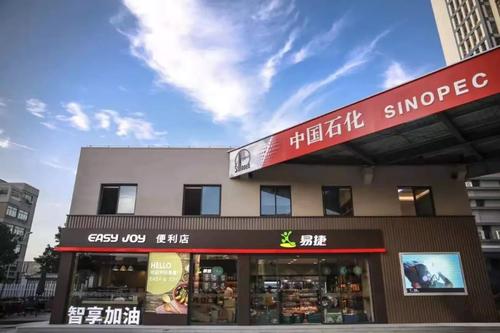
Sinopec, one of China’s top gasoline makers and distributors, has started a coffee brand of its own, called Easy Joy, to complement the services in its own gas stations. To reinforce the ‘gasoline image’ of the chain, it advertises its coffees with octane numbers: ’92 95 08′. On December 22, 2020, Sinopec Easy Joy announced the establishment of a joint venture with the Internet coffee brand “Lian Coffee,” the main gas station convenience store coffee business. On the same day, “Easy Joy coffee” Beijing first store settled in Beijing Longyu Yuquan gas station, officially open for business.
Coffee without baristas
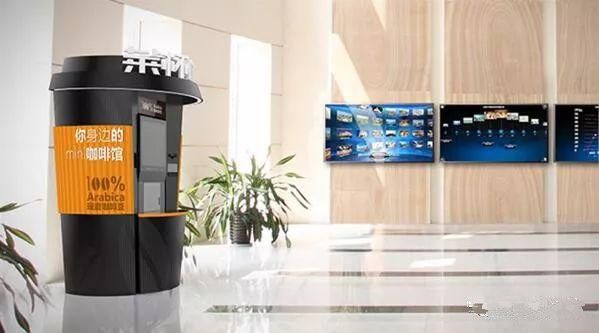
Laibei Kafei (2015), a transliteration of the Chinese expression for ‘give me a cup of coffee’, is China’s first supplier of coffee vending machines. Supermarkets, shopping malls, etc., can place them in suitable locations to provide coffee to their patrons, with all the issues that come with establishing a coffee corner with life baristas.
New coffee shop adds modern flavour to Palace Museum
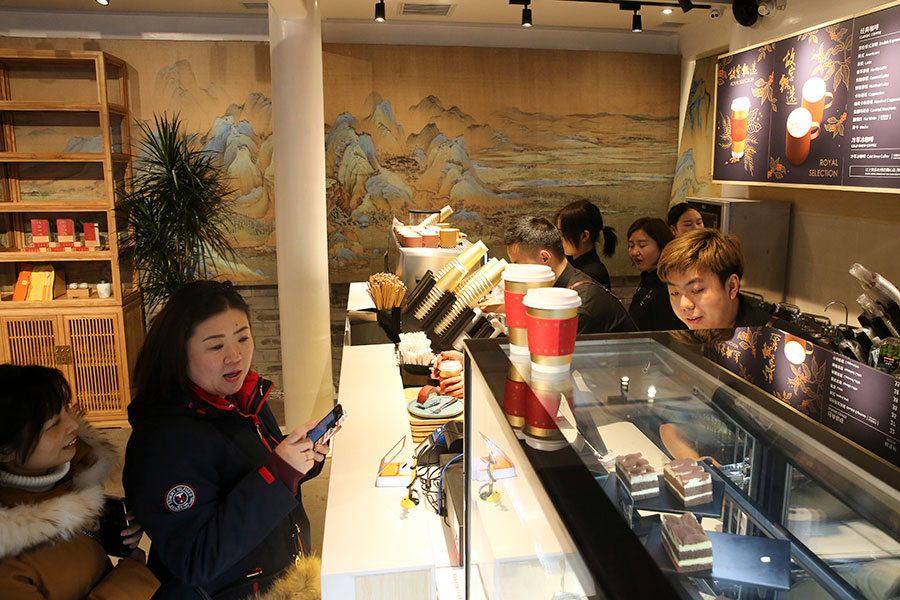
The Palace Museum opened a coffee shop for the modern-day guests of Chinese emperors over the weekend-the Corner Tower Cafe-and it quickly became a hot spot for visitors, bringing traditional cultural heritage closer to the younger generation. The cafe serves more than 30 kinds of coffee, tea and other drinks-priced between 22 and 45 yuan-for 40 guests at a time. Visitors don’t have to buy tickets for the museum to enter the cafe. Officials said a restaurant, also called Corner Tower, will open soon near the museum entrance. This move is slightly controversial. Some years ago, Starbucks was not allowed to open an outlet in the Palace Museum, because ‘a coffee shop does not fit into that historic ambiance’.
Lots of cash but little time
RTDs and instant products are driving coffee’s ascendency, perhaps because, as we are informed often, the Chinese are becoming increasingly cash rich and time poor. While this is clearly a marketer’s dream statement, largely designed to flatter consumers into believing the hype, it is also reflective of the coffee market. Chinese don’t have time any more to learn to brew real coffee. It’s just quicker and easier to empty a three-in-one sachet and add water or open a bottle. For consumers, it takes too long to grind the beans and brew the coffee. People like things that are mixed already. However, this is more by culture than necessity. Ever since Nestlé opened up China’s pre-mixed powder market with Nestea relatively recently, consumers have got in the habit of keeping things simple. According to Damin’s Wang, instant coffee volumes have been growing slowly, with an increase in consumption that is nowhere near as fast as is being found in coffee shops. “[Malaysian brand] Old Town White Coffee has played a big part in pushing instant coffee to China. Before that, there was only one real choice over the past few years, and that was Nestlé. Now we have many more brands, both good and bad,” says Wang. It’s safe to say that tea is not currently under any threat from the rise of the coffee granule, and its market is still growing. Indeed, China is forecast to account for half of all global growth in tea demand through to 2017, according to Rabobank, and tastes are changing among traditionalists too. Wang, whose company also supplies tea to trade customers, says ice tea has been the packaged segment leader, though its prominence is slipping. “The most popular tea drink is ice tea, though this in in decline because unsweetened or zero-calorie teas are on the rise as people become more aware of health issues,” he says. “Traditional tea drinking continues to increase, though. And now young people have the opportunity to choose what they need, be it packaged tea, three-in-one coffee or traditional China tea. “Coffee needs about 10 more years to grow before it becomes a big market in China.”
Expensive tastes
While coffee is a staple everyday purchase for most office workers in the UK, it is considered a premium product in China and is a luxury out of reach of most average workers. In Starbucks, a medium latte is RMB 30. Starbucks has come under fire by state media in China for their high prices, especially as the cost of doing business is generally considered to be cheaper in China. The average monthly wage in Shanghai is RMB 5891, less than a third of the average wage in London, making a RMB 30RMB cup of coffee a luxury most can’t afford. However, a high price is considered a sign of quality in China. The more expensive the better. There is still this concept in China, and Starbucks and Costa realise this. They want to brand themselves as premium chains, that’s why they price slightly higher in China. Most of the coffee on sale in coffee outlets in China comes from imported beans. However, China is also growing as a producer of coffee, with the majority grown in Yunnan province in southern China. You can read more about that in my special post on coffee and tea in Pu’er.
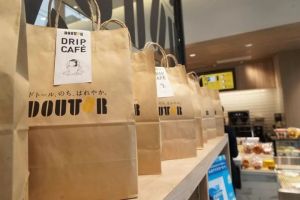
From 2017, several new coffee shop chains have popped up in China. Most of them position themselves in the higher end of the business. A good example of this type of coffee shops is Greybox Coffee that likes to set up shop in business districts in major cities. Japanese niche coffee shop Doutor has also set up shop in China, in a joint venture with a local partner TANSH Global Food Group which runs the Shanghai Min and Maison De L’Hui restaurants. With a 65% stake in the venture, Shanghai-based TANSH facilitates Doutor’s mainland operations.
China has also started to export coffee. In 2017, China exported $237 million of coffee beans. As of June of 2019, China has exported around 1.4 million 60-kilogram bags of green coffee beans. Export of green coffee beans shows a stable growth, as quality is improving.
Coffee exchange
The Shanghai Free Trade Zone has just established a Coffee Exchange Centre to boost the China trade for what is the oldest intercontinentally traded commodity in the world. It is not compulsory for companies to trade in the center, but those which do will benefit from Free Trade Zone’s duty-free and foreign exchange policies. By the end of 2015, both companies and individual customers will be able to buy coffee beans on the center’s website. The new center is projected to conduct transactions worth RMB 120 billion by 2018, and aims to overtake Singapore as Asia’s largest coffee exchange.
Nostalgic coffee
Besides the wide array of international and domestic coffee chains that are popping up in China’s major cities, some coffee places of the old days are being revived. A recent example is White Horse Coffee, a coffee shop established in the Jewish quarter of Shanghai, when a large number of Jewish refugees settled there in the 1930s. Hongkou district’s government decided to rebuild the “White Horse Coffee” as part of Shanghai Jewish Refugees Museum’s extended exhibitions. The new “White Horse Coffee” will be located opposite the Shanghai Jewish Refugees Museum. The design and decoration of the new “White Horse Coffee” will stay as close to the original as possible to provide a glimpse into the life of Jewish refugees of that period.
Ethnic coffee
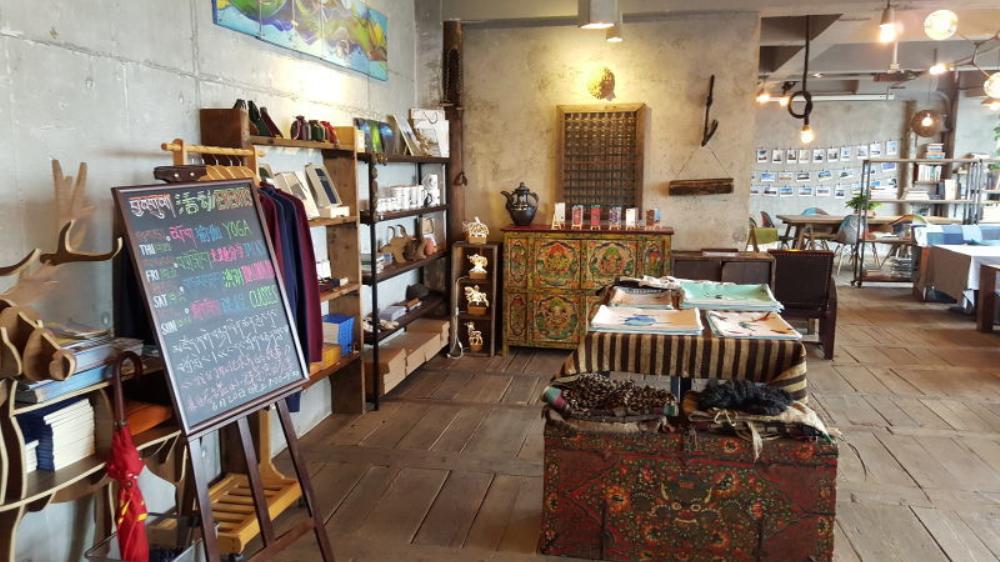
A Tibet-inspired coffee shop, Charu, has recently opened in Chengdu (Sichuan). The place is spacious, outfitted with aged wood panels, edgy houseplants, and dangling Edison-style bulbs. It’s staffed by young people and the couches are upholstered in different shades of blue—the sort of patterns you would expect from a swanky Malibu patio by the beach. The word charu refers to the toggle that links yaks together, according to Tsehua, one of the owners. It connects the tents and the yaks together. Like the charu, this cafe to connect people together.
Tsehua comes from a family of nomadic herders from Hongyuan County in the Amdo Region of Tibet, located in modern-day Sichuan. They live in black tents fashioned from yak hair and rotate around the grasslands according to the seasons.
Charu has a beverage menu of yak-based drinks—among which is yak milk coffee, decorated with the cafe’s logo. The milk is brought in weekly, sent overnight from Tsehua’s nomadic village of Hongyuan. There’s yogurt, which is made in the same place, and as an option, it can be supplemented with highland barley and raisins. The menu also features a juice squeezed from sea buckthorn, a berry from the Himalayas that tastes like a cross between a mango and an orange.
It is this type of new hip spaces that multinationals like Haagen-Dazs find it hard to compete with recently. The ice cream maker has started cooperating with Illy in China. Its outlets can now also function as alternative for the crowded coffee shops.
Coffee as metaphor
Coffee has now become so popular, that the word is gradually transforming into a symbol for a modern leisurely lifestyle. A traditional Chinese medicine (TCM) store in Hangzhou (Zhejiang) has developed ‘herbal coffee‘ to wrap that traditional product in a modern package.
Coffee as flavouring
As coffee is growing more and more popular, many Chinese producers of foods and beverages are developing coffee flavoured varieties of their products. A good example in an earlier post is: coffee flavoured plums.
Snack producer Sanquan (Zhengzhou, Henan) has launched a coffee-flavoured zongzi in 2018.
One of my personal favourites is affogato, one or two scoops of basic vanilla icecream soaked in strong espresso. I first found it in China in some häagen-dazs outlets, but was not impressed by it, mainly because the coffee wasn’t strong enough. I was pleasantly surprised to find a decent affogato in a new (not yet opened) hotel at the north end of Wangfujing Street in Beijing during in September 2018.
Chinese investment in Argentina
A Chinese investor based in China’s northernmost city Harbin (Heilongjiang) is investigating the possibilities of investing in a 400 hectares coffee farm in Argentina, in cooperation with a local overseas Chinese partner. The coffee is to be roasted in Harbin, using technology imported from Brazil. I will keep you informed about the developments of this project. The Harbin region currently consumes about 60 mt of coffee beans per year.
Chains going abroad
Chinese coffee chains are also venturing abroad. In 2015, Mellower led China’s premium coffee to go international, becoming the first Chinese premium coffee chain brand to expand into overseas markets. In March 2023, Luckin Coffee expanded to Singapore with nine outlets strategically located in the core business districts. In 2023, Cotti Coffee opened its first store in Jakarta, , following the launch of its outlet in Seoul, South Korea. At the beginning of 2023, Cotti Coffee announced its goal of opening 10,000 stores in three years. Remarkably, within nine short months since its first store opened, they have already launched 5,500 stores worldwide, averaging over 500 new stores per month. targeting tech-savvy youth. They successfully penetrated the American Asian e-commerce platform Yami. Saturnbird coffee, Tasogare, and Yongpu, embraced a digital-first marketing approach. They successfully penetrated American Asian e-commerce platforms like Yami and Weee!
R&D
A study by the Kunming Institute of Botany, Chinese Academy of Sciences, published in 2026, showed that fungi can be used to enhance the flavour of coffee. A research team established a microbial repository containing 655 endophytic fungal strains from five Yunnan Arabica cultivars across three maturity stages and selected six representative strains that could make coffee more flavourful. The standout strain, Talaromyces funiculosus KQ2, used as a fermentation agent, can raise the sensory score by 1.5 points, exceeding the specialty coffee threshold of 80 points, while imparting distinctive vanilla-cinnamon notes. Metabolomic analysis also showed a 17.11 percent increase in sucrose content.
More than coffee
Coffee has now become such an important item in the lives of more and more Chinese that domestic coffee companies have started looking at expanding their activities to related products. Hogood Coffee (Yunnan) announced the development of a healthier alternative for vegetable fat, the main ingredient for coffee creamers, based on walnut protein.
This is the meaning of the Chinese expression yao shi tong yuan, which indicates that in the traditional Chinese perception food and medicine are substances derived from the same raw materials. There is a strong link (overlap) between pharmaceuticals and food in traditional Chinese thinking about food, nutrition and preventing/curing disease.
The function of many medicinal plants is often referred to as restore (bu) in Chinese. Medicine brings the diseased body in balance again. The various basic flavours are also accredited medicinal functions.
One consequence of this view on food and medicine is the existence of medicinal restaurants in China. You can tell the cook about your ailments, and he will compose a meal with ingredients that address those problems. This is called yaoshan, ‘medicinal meal’, or shiliao, ‘cure through eating’, in Chinese, again a combination of medicine and food.
This part of the Chinese cultural heritage has a strong influence on Chinese policy making. A good example is the Chinese government’s strong attention to promoting public nutrition. While most Western governments believe that promoting fortified foods is misleading the public from a more healthy diet, the Chinese authorities are actively promoting fortified foods. See our special item about that topic.
The national authorities have issued a list of 87 TCM herbs that are allowed as food ingredients.
TCM in food and beverages is very popular in China, as shown by the results of a 2024 market study.
Nutritional beverages
TCM has especially inspired the development of a range of health drinks. I will mention a couple of the most representative here.
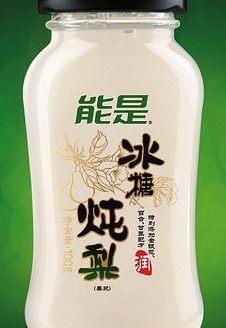
Stewed pear
Cansi’s (Nengshi) “stewed pear with rock sugar is positioned as an ancient folk recipe that has been spread for thousands of years throughout China”. Some of the claims the product makes are to “lubricate lungs” and to “relieve stress”, with pears playing an integral role in traditional Chinese medicine. The product also has TCM ingredients, such as honeysuckle and lily extract.
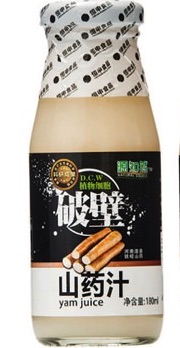
Yam drink
Natural Source’s Wall Breaking Yam Juice earns it name from the technology it uses. With its yam juice processing, it’s claimed that superior technology can break the cell wall to release additional molecules for nutrition value. The result is that when consumed, it increases the absorption rate by 80%. Yam is one of many traditional Chinese medicinal ingredients that are being processed, combined with other flavours and packaged for modern times.
Biscuits and water for stomach problems
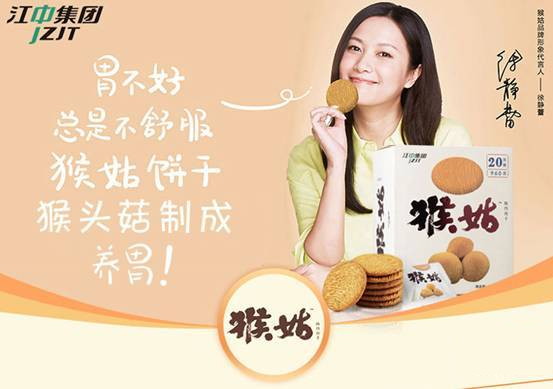
The Jiangzhong Pharmaceutical Group, that became famous for its successful TCM drug against stomach ailments due to indigestion, has launched a biscuit with extracts from the hericium erinaceus fungus in 2015. It is an age old ingredient in Chinese cuisine and an equally old raw material for TCM drugs against problems in the entire digestive tract.
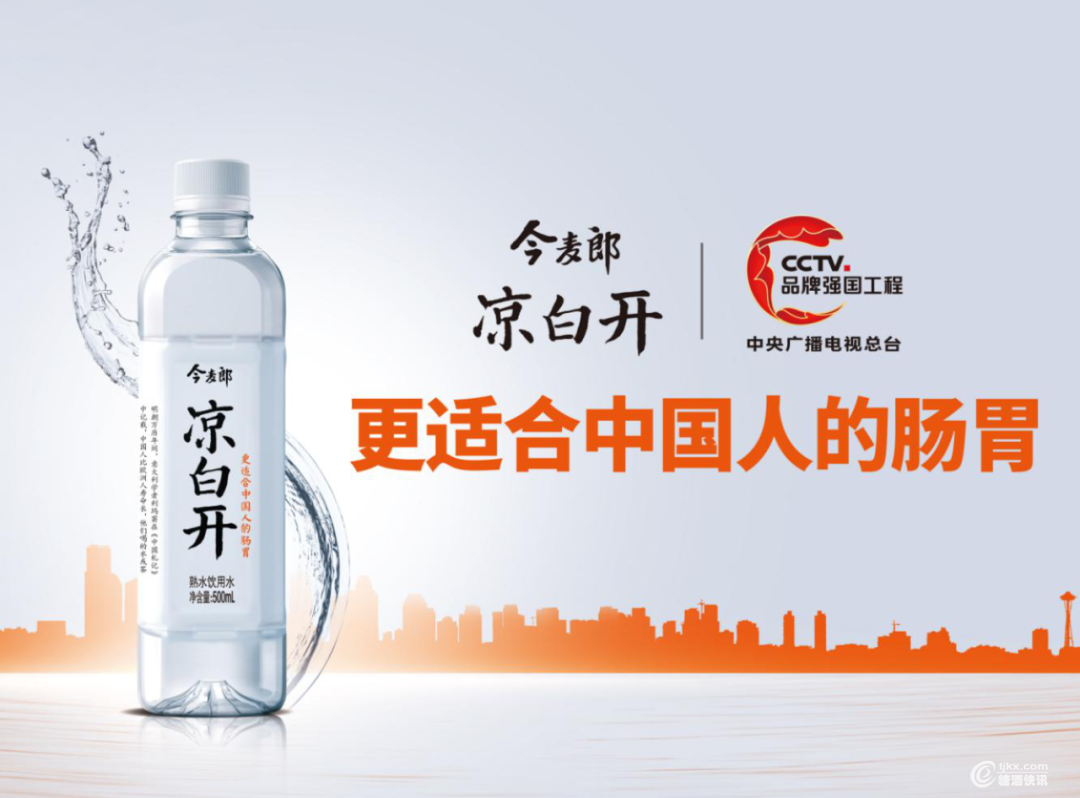
Early 2020, instant noodle maker Jinmailang launched a new type of bottled water that has been pre-boiled. It is marketed under the brand name Liangbaikai. This literally means ‘Cool Clear Boiled’ and has been derived from the Chinese expression ‘cool boiled water’, i.e. boiled water cooled down to an agreeable drinking temperature. According to TCM, such water is much better absorbed by the human body than tap water or other types of bottled water. The ad states that this water ‘is more suitable to the guts and stomachs of the Chinese’.
Military participation
Chinese military researchers are are also developing modern applications for traditional herbs. An interesting item we have spotted in this category is an ‘antiradiation biscuit’, a biscuit with the extracts of five Chinese medicinal ingredients. It has been developed for military use, but has also been made available to the general public. We have not yet found it on any supermarket shelf though.
The Wuhan College of Military Economy has develop a type of biscuit that can increase the body’s oxygen level and alleviate fatigue for 48 hours. The recipe includes a number of herbs from traditional Chinese medicine. Once more, this product has been developed for use by soldiers, but it will also have an interesting market in tourist destinations in high elevations, like Tibet. Problems caused by oxygen deficiency often spoils part of the fun among tourists in such regions.
Herbal coffee
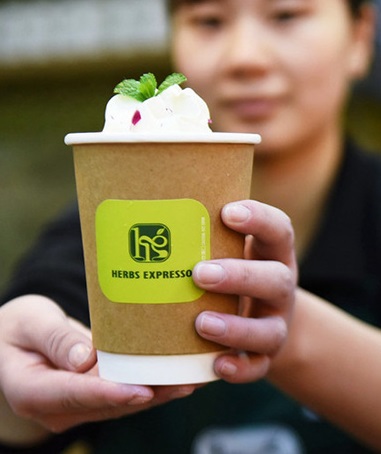
One way for TCM to redefine itself to fit into the present age is to link up with a popular beverage like coffee. A time-honoured traditional Chinese medicine store Huqingyutang has opened a cafe named “HERBS EXPRESSO” to sell ‘coffee’ in Hangzhou (Zhejiang). Unlike regular coffee, which is extracted from coffee beans, the cafe’s ‘coffee’ is sourced from herbs and processed with a coffee machine. Actually, the ‘coffee’ is a coffee-flavoured herbal drink, the cafe’s manager said. Mixing fresh fruits, milk and cream, the taste of the new herbal drink is better than the traditional herbal soup. “By improving the taste of herbal drinks, we want to promote traditional Chinese medicine culture to the world,” the manager added.
Under the weather? Go to the pub!
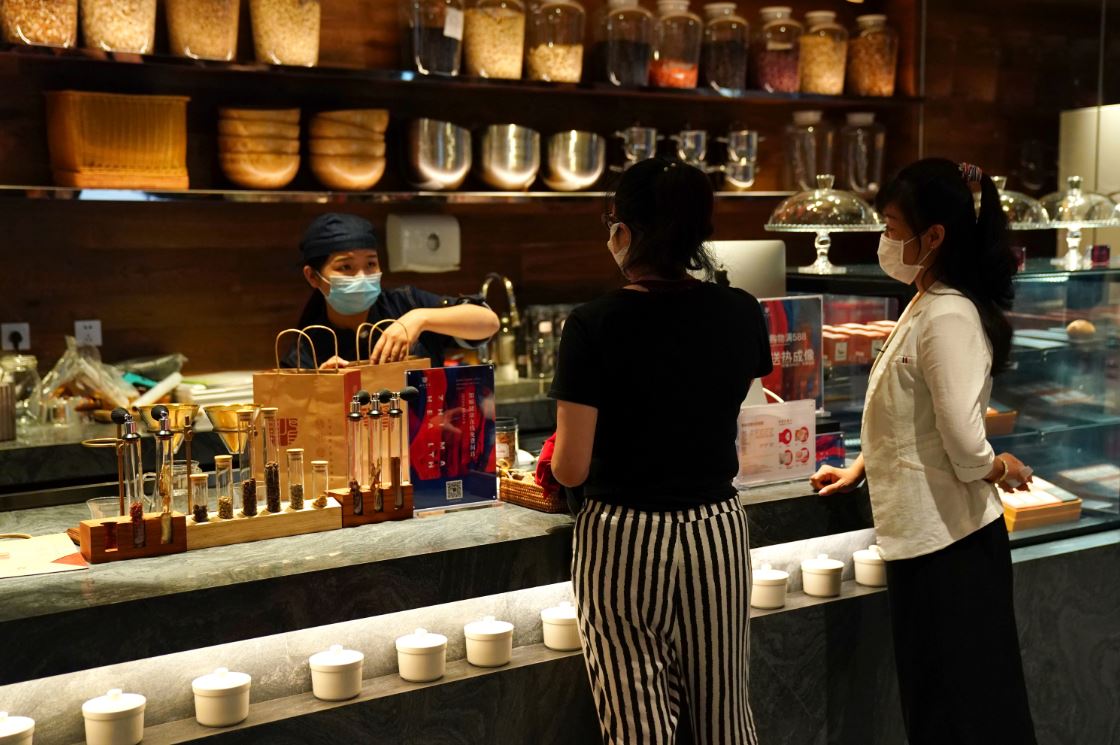
Tongrentang Group, a renowned traditional Chinese medicine pharmacy, founded in 1669, has opened two fusion cafes that offer drinks and healthcare services in Beijing in 2020. The cafe provides different kinds of coffee drinks that are infused with herbs such as licorice, monk fruit and cinnamon. It also offers various teas that are mixed with Chinese wolfberry (goji) and grapefruit. The cafe also has an area where shoppers can buy featured products such as honey, goji, cubilose (bird’s nest) and ginseng. Tongrentang plans to open 50 flagship stores in major cities nationwide in the next five years to offer comprehensive healthcare consulting services. On top of that, it will open more than 3000 landmark cafes in major commercial areas.
China’s traditional health craze that started in the 2020s triggered a renewed interest in TCM among young Chinese consumers. A bar in Chengdu made a bold step in developing traditional Chinese medicine cocktails. Priced around RMB 100 per glass, the drinks on offer at Soul Asylum claim a wide range of effects, from weight loss to enhancing male vitality and nourishing a person’s blood.
Among the bar’s most popular cocktails is a drink promising to “boost energy and improve blood health,” featuring ingredients like ginseng, Sichuan lovage root, rum, red dates, and egg yolk. Another top seller aims to “enhance male vitality” through deer antler and whiskey.
Foreign interest
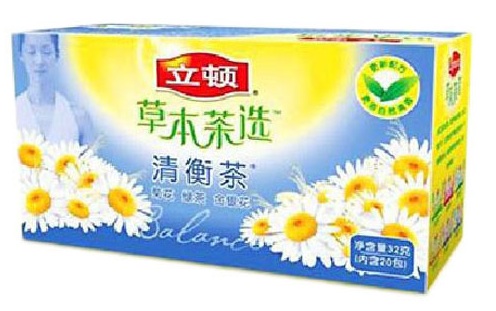
Multinationals have started to note this development as well. Lipton is marketing a tea on the Chinese market with extracts from Chrysanthemum, honeysuckle and lily. The tea is named: Qing heng cha, ‘clearing balance tea’.
I will list the ingredients and add the various activities attributed to them according to the Chinese Materia Medica:
Honeysuckle (Lonicera japonica)
Clear heat, relieve toxic fire – hot, painful swellings in the throat, breast, eyes; intestinal abscesses.
Expel wind-heat – fever, aversion to wind, sore throat, headache; also for summer-heat.
Clear damp heat from the lower jiao – dysentery, lin syndrome.
Clears liver and the eyes (sweet, cold) – wind-heat in the liver channel manifesting with red, painful, dry eyes or excessive tearing, or yin deficiency of the kidneys and liver with floaters, blurry vision, or dizziness.
Green tea
I wonder why Unilever has not yet started marketing this range (there or more such teas available on the Chinese market).
Meanwhile, the famous Pu’er tea from Yunnan is also marketed worldwide a slimming aid and a way to lower blood lipids.
Traditional Chinese Medicine has played an important role in the treatment of COVID-19 infections. Clinical treatment shows that several kinds of TCM used during the outbreak in China helped reduce illness in patients and improve the cure rate, according to Li Yu, director of the Department of Science and Technology, National Administration of Traditional Chinese Medicine. In the next step, TCM treatment can be used for patients in the recovery stage. This is the stage in which TCM herbal compounds gradually change from pure medicines to health supplements.
Punk yangsheng
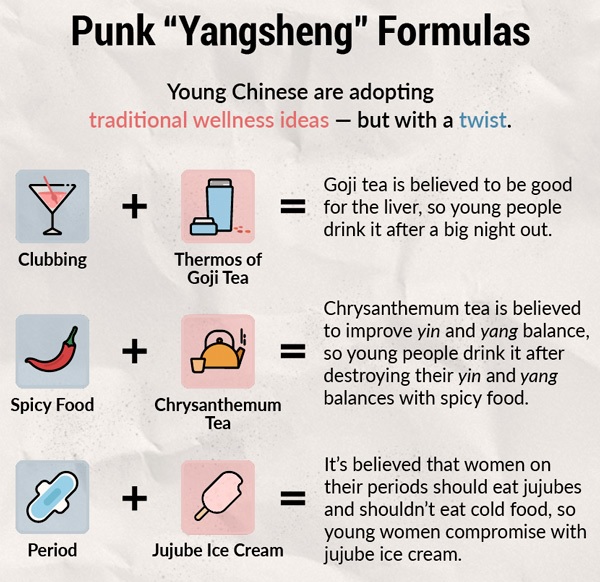
A vogue that started in China around 2020 is Punk Yangsheng. Punk refers to unhealthy living habits of young Chinese, like sleeping late or not at all, clubbing, eating junk food, etc., all in a quest to make lots of money. Still being Chinese the want to compensate for their unhealthy habits by engaging in the yangsheng, or body-healing, habits of older generations. Middle-aged people might sip goji berry tea to stay young; their children are now buying bottled beverages with infused goji berries to make up for lack of sleep. other trending yangsheng drinks include those that promise results like a clearer complexion, more energy, weight loss, and reduced oedema. Priced between RMB 20 and 40, they’re not cheap. But that doesn’t seem to have curtailed their appeal. The following illustration shows more examples of how food or drinks with TCM herbs are used in this way.
TCM in animal feed
A new development is the use of selected TCM herbs as ingredients for animal feed. Practitioners in China have prescribed bitter blends of medicinal plants and herbs for centuries to ward off disease in humans. Now, farmers are adapting the age-old elixirs — a dash of ginseng here, a speck of licorice there — for use on livestock. They’re hoping to tap into the growing popularity of traditional medicine and health food in Chinese society. The expected results are not only delicious but healthy: lean, juicy meats that can protect against colds, arthritis and other illnesses. A Guangxi farmer began mixing 22 kinds of herbs into the daily feed for his livestock several years ago. The pigs that he raises sell for more than double the price of ordinary pigs, and some customers even eat his meats instead of taking medicine. Farmers like Mr. Lin hope that China’s increasingly health-conscious middle class will help bring medicinal meats into the mainstream. The health-food market in China reached $1 trillion last year, and it is expected to grow 20% annually for the next several years.




















 Peverelli on Chinese food and culture
