Healthier Alternatives to MSG: Totole’s Innovation Journey

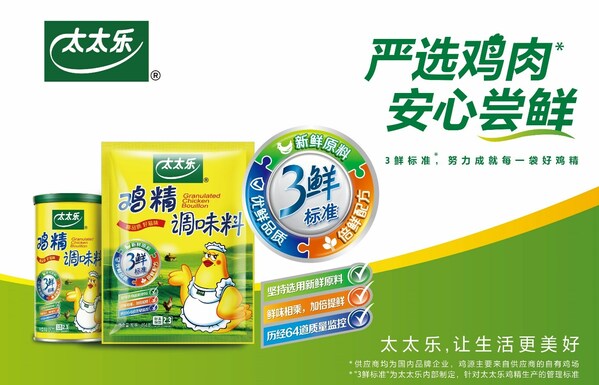
After the development of industrially produced MSG, China soon became the world’s largest producer and consumer. However, MSG also has certain health hazards (like the so calle ‘Chinese restaurant syndrome’), so the search for healthier flavour enhancers continued. Chicken powder, actually a combination of powdered chicken meat, salt and MSG, was launched in China towards the end of the previous century as a new generation flavour enhancer. Taitaile (literally: “the lady (of the house) is happy”) became the leading producer. It adopted Totole as its official English name.

Established in 1988, Shanghai Totole Food Ltd. is one of the parties involved in drafting the national industrial standards for chicken bouillon and chicken powder in China. In 1999, Totole linked up with Nestlé to take full advantage of international resources to accelerate product and technology research and development. Adhering to the corporate vision of “Totole Makes Life Better”, Totole has been committed to the research and promotion of umami science, driving the technological innovation of umami industry, and constantly bringing healthier and tastier condiments to the consumers. A Totole Sales Conference was held in Shanghai in February 2023, on which the firm confirmed its goal of achieving sales of RMB 10 billion in 2023.
第一支柱产品:三鲜鸡精

2022 has been a challenging year for Totole and a year of accumulation and breakthroughs – Totole keeps pace with changes in consumer demand and continues to innovate in diversified categories and international market development. The company also engaged in the field of sustainable development, helping green public welfare projects.

Two-wheel drive

Since its establishment more than 30 years ago, from the initial production of umami products represented by chicken essence, Totole has developed into a diversified condiment enterprise covering two categories: solid compound flavour seasonings and liquid freshening seasonings. The strategy is referred to as “two-wheel drive”. Chicken powder (essence) will remain its flagship product, but most R&D effort will go to developing liquid and finished products. These includes ranges of instant soup, compound spices for home cooking (e.g. yuxiang

太太乐产品全家福

Domestic marketing

At present, some emerging channels such as O2O, group buying, and e-commerce are playing an increasingly important role in the Chinese condiment industry. In terms of O2O, Totole takes “fast response, multi-innovation and high efficiency” as the criterion, focuses on cross-brand joint activities, fully explores the application scenarios and convergence points between various brands and products, and customizes a total of 12 joint activities on Meituan, Yonghui, Hema and other online platforms. With the help of on-site media tools like DTC (direct consumer)/community group buying, Totole can accurately reach the consumers and accelerate the integration of product and application.

International marketing

Totole is also committed to spreading the concept of “umami” to all parts of the world. At present, its products have been exported to more than 70 countries and regions such as the United States, Canada, Indonesia, the European Union and the United Kingdom, Japan, South Korea, Singapore, Malaysia, Cambodia, the Middle East and Africa. The company is set to improve its Halal certification, and has obtained the European Shandong Halal, the American IFANCA Halal, the Asian Halal and the MUI (Indonesia) certifications to effectively compete in the Muslim nations. Totole mushroom essence, the next generation of flavour enhancers after chicken powder, has won the title of Top Brand in the Indonesian market.

I am sure that I will be able to extend this post soon with new developments at Totole.

Peter Peverelli is active in and with China since 1975 and regularly travels to the remotest corners of that vast nation. He is a co-author of a major book introducing the cultural drivers behind China’s economic success.

Key Players in China’s Food Industry: 2021 Rankings

The Chinese site Food Forum has published the top 5 companies for a number of industries. I am listing them in this blog. It is useful to stay in touch with who is on top in China. I have added links to posts in which a company is introduced, but I advise interested readers to search for posts discussing all these companies using the search function of this site.

Dairy

RankCompany2021 turnover (RMB 100 mln)
1Yili1084.62
2Mengniu881.41
3Bright265.10
4Feihe225.45
5Junlebao203.00

Beverages

RankCompany2021 turnover (RMB 100 mln)
1Wahaha519.15
2Nongfu Spring296.96
3China Food197.84
4China Resources113.79-122.36
5Baiyunshan108.51

Alcoholic beverages

RankCompany2021 turnover (RMB 100 mln)
1Moutai1060.59
2Wuliangye617.31
3China Resources333.87
4Tsingtao246.39
5Yanghe246.39

Seasoning

RankCompany2021 turnover (RMB 100 mln)
1Haitian235.97
2Yangpu Nanhua113.02 (2020)
3COFCO Sugar87.11
4Fufeng86.01
5Yihai59.43

Leisure food

RankCompany2021 turnover (RMB 100 mln)
1Three Squirrels97.70
2Liangpin Puzi91.44
3Qiaqia59.85
4Weilong Meiwei48.00
5Lyfen40.50

Cereal products

RankCompany2021 turnover (RMB 100 mln)
1Chef Kong732.50
2Uni-President242.63
3Wantwant239.85
4Dali201.74
5Jinmailang200.00

Peter Peverelli is active in and with China since 1975 and regularly travels to the remotest corners of that vast nation. He is a co-author of a major book introducing the cultural drivers behind China’s economic success.

Decoding China’s Light Industry and Food Sectors

One of the first things you need to know about a (potential) Chinese partner is to what system it belongs

This is a blog about food, drinks and their ingredients. However, as Chinese society, including its economy, is organized in a very unique way, it is useful to get more insight in its basic structuring. In fact, several aspects of that structure have been mentioned indirectly in various posts, in particular those about Mengniu Dairy and Yanjing brewing.

Economic sectors

An important type of context is the industrial sector. Chinese economy is divided in a number of industries, headed by a central ministry or organization with ministerial status in Beijing. Each province and autonomous region has a Department corresponding with the central organization. Lower administrative regions have, again corresponding, Bureaus. Chinese usually refer to this as the system (xitong) to which they belong. According to the official parlance, a state-owned enterprise is the property of the entire people, but the central administrative organization of its industrial sector has been given the power to manage the enterprise in the name of the people. The central organization will then delegate that power to its corresponding lower level organization. Those organizations also establish and operate schools and colleges related to their sectors.

An example will help clarify the situation: food manufacturing is typically regarded as Light Industry in China. A state-owned flour plant in Suzhou (Jiangsu), will therefore be typically managed by the municipal Light Industry Bureau, which will report to the provincial Light Industry Department, which operates under the China National Light Industry Council in Beijing. This is the reason why so many company names in China start with the name of the city or province in which it is located: it refers to the main governing body. I have mentioned the Changyu Winery in earlier posts. Its official name is Yantai Changyu Wine Group, which indicates that its CEO is typically reporting to the government of Yantai Municipality in Shandong province.

The value of the place name in a Chinese brand name is attested by the story of Yanjing Brewing laid down in an earlier post. Located in Shunyi County, the brand name originally envisioned was Shunyi Beer, but a ministerial official proposed to change it to a name that was related to Beijing. As Beijing Beer already existed, it became Yanjing Beer.

There are also dedicated light industry colleges like the Zhengzhou University of Light Industry. As attested by several posts in this blog, Zhengzhou is located in one of China’s major food producing regions, the home of, e.g., China’s top snack producer Sinian.

This way of organizing creates a kind of matrix structure in which a Chinese company has to account for its activities and results to the local government, but simultaneously to its sector organization. To stick with Changyu, it is accountable to Yantai Municipality and the Light Industry sector. These two merge in the Yantai Municipal Light Industry Bureau, but it can happen that the provincial or national Light Industry organizations contact Changyu for information about its operations.

Personnel

In the current stage of the development of China, this structure does no exercise a huge influence on issues related to production or marketing and sales. Larger state-owned companies are still affected in the field of human resource, in particular in filling the positions of top managers. Leading functions in companies like Changyu are usually appointed by the organization on the Ministry of Personnel, which also has branches in provinces, cities, counties and other administrative levels. The Party organization is also involvement in such appointments. Nowadays, only people with proven expertise and experience in the field will be considered for appointments of top functions in state owned enterprises, but the political aspect remains. This means that the social networks of the top executives of Chinese companies exercise considerable influence on the day to day managed of the enterprises.

Social embeddedness

The combination of the various stakeholders to which a Chinese enterprise is accountable and the social network can be called: the social embeddedness of Chinese companies. Insight in the affiliation of a Chinese enterprise is vital for Western companies who are seeking or have engaged in partnerships with Chinese counterparts. Too often, Western managers believe that their Chinese partner is ‘a company just like we are’ and that the CEO of the Chinese partner has ‘the same responsibilities as I have’. They aren’t and they don’t. Such misunderstandings will certainly play a role in the problems of companies like FrieslandCampina or Fonterra in China recently reported in the media.

Eurasia Consult’s founder Peter Peverelli is an expert in determining the social embeddedness of Chinese companies and the consequences for their Western partners

Food & beverage covers several sectors

The theme of this blog, food, drinks and ingredients, involves a complex situation, as the manufacturing of these three product groups is dispersed over more than one sector. Light Industry is definitely the largest one, but a number of food companies, in particular those using primary agricultural produce as raw materials, are operating under the Ministry of Agriculture. A special type of companies under Agriculture is State Farms. This name is based on the fact that the first of such companies were large state-owned farms established in rougher regions with no existing agriculture or other economic activity. These farms later also established processing plants of their own. A small number is part of the hierarchy of the Ministry of Commerce. The latter is in charge of distributing goods rather than making them, but in the early decades of the PRC, that ministry also established production units. An industry that is very disperses over those sectors is dairy processing. Interestingly, FrieslandCampina and Fonterra mentioned above are both dairy companies.

Light Industry Top 50 2017

As Chinese ministries (try to) keep track of the industrial statics of their respective sectors, the regularly publish compilations like the top 10, 50, 100 manufacturers of a certain product or sector. The China National Light Industry Council recently published the Top 50 Light Industry companies of 2017. I will list the top 10 in this post.

Rank company sector
1 Maotai spirits
2 Wuliangye spirits
3 Yili dairy
4 Mengniu dairy
5 Wahaha beverages
6 Yanghe spirits
7 Xiwang starch sweeteners
8 Bohai soybean oil
9 Hefeng meat
10 Haitian soy sauce

From this list it is obvious that food, drinks and ingredients are the major sector of Light Industry in China. Actually, it covers a broad range of products, like: toothpaste, detergents, brooms, toys, etc. However, the Top 10 and in fact the entire Top 50 consists of food companies. Regular readers of this blog will recognise several of the companies in this list.

Universities

As mentioned above, universities also play an important role in the development of the Chinese food industry. Their role is so vital, that I have dedicated a special post to them.

Peter Peverelli is active in and with China since 1975 and regularly travels to the remotest corners of that vast nation. He is a co-author of a major book introducing the cultural drivers behind China’s economic success.