A rapidly growing beverage category in China are the milk teas. They are a combination of the bubble teas that originated in Vietnam and based and traditional milk or butter teas drunk by Mongolians and Tibetans.
In the course of 2018, China’s tea aficionados have embraced a new trend, one that is encapsulated in the growing popularity of the milk tea brand, Heytea. Originally sold in a tiny alleyway in Jiangmen, southern China’s Guangdong province, the brand went viral on social media because of its signature “cream cheese” series — a cup of hot sweet tea topped with a spoonful of savoury cream cheese. Since then, Heytea has developed into a franchise with more than 80 outlets in 13 cities across the country. There are also outlets in North America.
Milk tea now has many brands and more are still being added. Some are already established brands: for example, Naixue, Chagee, Mixue Ice Cream & Tea and Chabaidao.
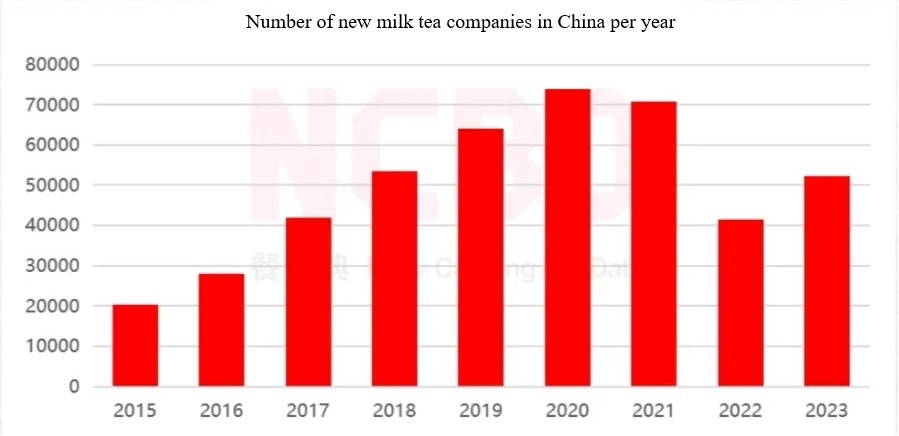
This table shows the number of new outlets opened per year.
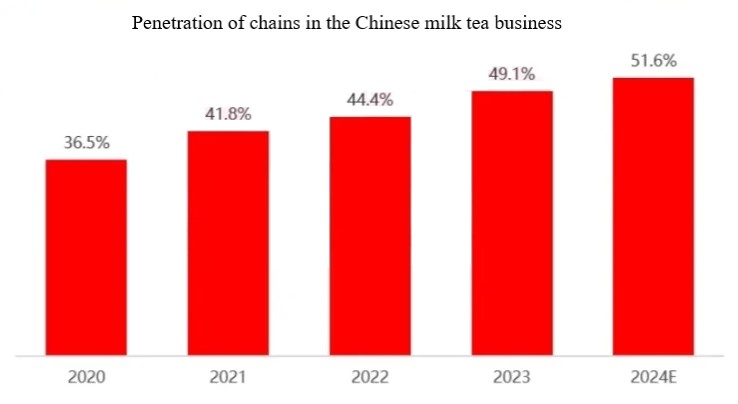
The penetration of chains has been steadily increasing in this business.
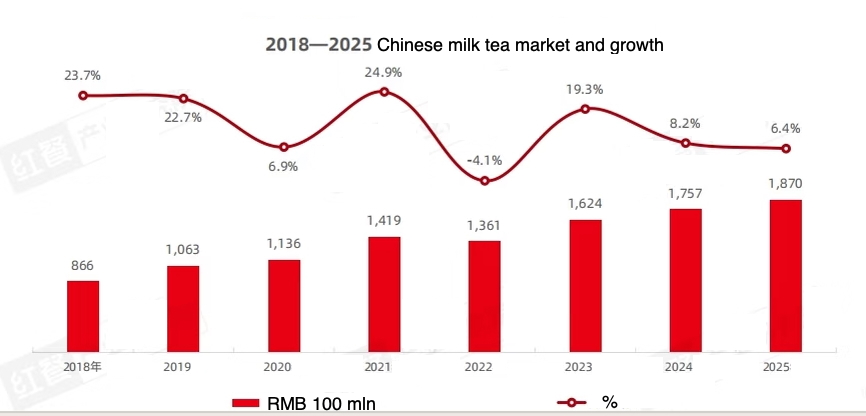
Here is an overview of the market size in RMB 100 mln and annual growth in %.
The following table lists the turnover and profit for a number of major players in this market for 2024.
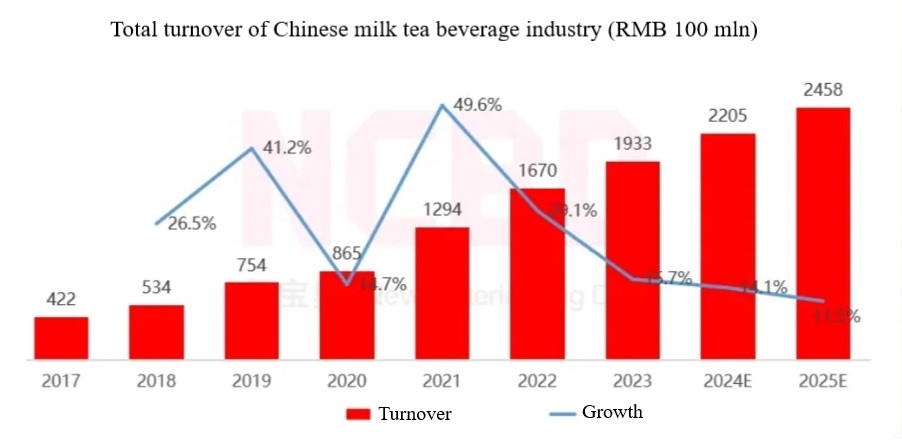
This positive trend can be expected to continue, as the total turnover of this business is expected to grow, at least during the coming few years.
The 2023 New Tea Drink Research Report, released by the China Chain Store and Franchise Association and Meituan New Catering Research Institute, predicts that by the end of 2025, the market size of Chinese-style tea drinks will reach RMB 242.5 billion.
Food is a core aspect of Chinese culture. Although Chinese are spending less and less time in the kitchen, they still have the same high expectations for flavour, texture, nutrition, etc., of their meals. This makes the Chinese market for meal replacers very different from that in most Western nations.
The Chinese market for meal replacers is therefore even more promising in terms of profits. Chinese customers expect the highest quality ingredients and they want them fresh. They also like to be regularly triggered by new flavours.
This mini-blog shows the historic and projected growth of this market (unit RMB 100 mln): double digits for several years to come, with interesting niche segments.
The Chinese bakery business is booming, but the market is also extremely volatile. There is no better moment to enter the Chinese market for suppliers of any bakery ingredient than now.
I have collated a few statistics that are recent enough to give a rough impression of the size of the market.
The first table indicates the development of the value of the market and the projection of the near future.
Some interesting details about consumer behaviour:
Whether online or offline, women are still the main consumers of baked goods in China.
In terms of age, 70% of consumers are between the ages of 21 and 40.
In terms of price, consumers spending RMB 20 – 40 in a single consumption constitute the largest segment (35. 8%).
The next table shows the number of bakery shops in a selected group of major cities. This tells something about the geographic distribution. However, the smaller provincial cities currently show the highest growth.
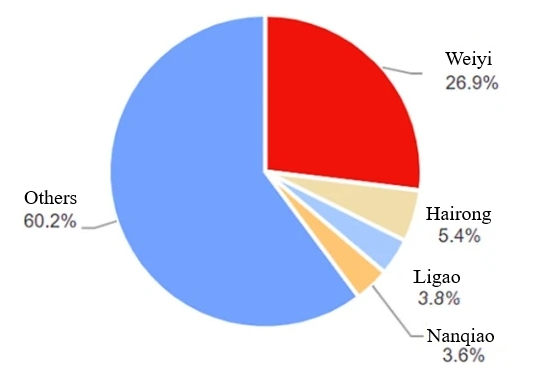
We should not forget the focus issue of this blog: food ingredients. This graph shows the major cream suppliers to the Chinese baking industry. As you can see, the market still consists of a few major brands and a large number of small suppliers.
In the turbulent and increasingly diversified Chinese beverage market, sugar-free and low-fat have become the choices of more and more consumers. The following picture is taken from an influencer promoting ‘clean label’ products. However, official food and beverage labelling has only just started in China. As you can see, this influencer follows international practice.
Nutrition information (100 gr): energy 174 kjoules; protein: 4.4 gr; fat: 1.4 r; carbohydrates: 2.8 gr; sodium: 7 mg.
Ingredients: potable water, black beans, black rice, sesame.
According a recent survey, the market size of China’s sugar-free beverage industry has increased from RMB 2.26 billion in 2015 to 19.96 billion in 2022, and is expected to reach RMB 61.56 billion in 2025. In addition, according another survey, 75% of consumers believe that health is a focus issue in choosing which beverages to buy. In addition to taste, ingredients have become one of the most important beverage purchase considerations for consumers.
To meet the needs of consumers and guide them to make healthier decisions, projects for beverage grading have been proposed. Recently, Shanghai has started the first batch of pilot projects for the grading of ‘nutritional choice’ for beverages, and mainstream brands such as Naixue tea and Bawang Chagee tea have been selected as the first objects for testing, which has caused heated discussions in the industry.
Beverage grading
As the name suggests, beverage grading is the classification and rating of beverages based on certain criteria. These criteria usually include the ingredients, texture, taste, etc., of the beverage. The ‘Nutritional Choice’ grading piloted in Shanghai is based on the content of non-dairy sugar, saturated fat, transfat and non-sugar sweeteners in beverages, and comprehensively classifies beverages through four grades from A to D, in decreasing order. This allows consumers to make more rational consumption choices.
According to Shanghai Centre of Disease Control, the ‘Nutritional Choice’ beverage classification method mainly refers to domestic and foreign standards, and the full indication ‘Nutritional Choice’ can be used in various contexts, such as beverage packaging, ordering procedures, and menus. The classification of a beverage’s grade depends on its ‘shortcomings’. For example, if a beverage has a sugar content of C, saturated fat and transfat of A and no added non-sugar sweeteners, the beverage will be classified as C.
Singapore as example
In December 2022, the Singaporian government began to officially implement a classification policy for prepackaged beverages in the retail market, which also used four grades according to the sugar content and saturated fat content: A, B, C, and D. ‘A class (dark green)’, ‘B class (light green)’, ‘C class (yellow)’, ‘D class (red)’. Grade A means that sugar content and saturated fat are the lowest, and grade D represents the highest content. In addition to packaged beverages, all kinds of handmade beverages such as freshly squeezed juice and milk tea will also be labeled in this way soon. The labeling is the responsibility of the manufacturer, importer or distributor.
It is understood that milk tea brands like Nai Xue, Bawang Chagee, Happy Lemon, and Hangzhou Leyuan are the first batch of brands to try out the ‘nutritional choice’ classification. On March 27, Naixue’s Shanghai stores and ordering outlets fully implemented the ‘Nutritional Choice’ logo, and Naixue’s ready-to-drink (RTD) products were also superscripted with the ‘Nutritional Choice’ logo. The data show that Naixue’s tea freshly made drinks and RTD bottled beverage products are mostly concentrated in the A and B grade ranges, with obvious health attributes and high recommended values. It is worth mentioning that after the introduction of the ‘Nutritional Choice’ label, the number of consumers choosing grades A and B has increased significantly.
As for Bawang Chagee, the medium-sized cup with less sugar is classified as B-grade, and the Oriental Iced Tea as A-grade. Bawang Chagee also emphasizes healthy sugar, promoting the choice of low GI foods (glycemic index less than 55), food GI value less than or equal to 55, are good choices, but this does not mean that the lower the GI value, the better. Tea lovers also need to choose according to their own situation to avoid falling into knowledge misunderstandings.
In addition, Zerup Zero Sugar Drink, Watsons Soda, Suntory Sugar-Free Oolong Tea, etc., are classified as Grade A, F&N Ice Cream Soda, Wahaha AD Calcium Milk are classified as Grade B, FairPrice Whole Milk, Nongfu Spring Brand Tea, Green Oolong Tea, Yuzu Green Tea, Coconut Palm Coconut Water, Benasong Coffee and other products are all classified as Grade C.
Future
The ‘Nutritional Choice’ classification has enabled the beverage industry to move towards a more professional and refined business. With the continuous promotion of the ‘grading system’, more brands may join the ranks in the future. This will also be extended to food. Compared to beverages, there are more types of foods, and the content and proportion of nutrients are more complex. For example, a food can be evaluated based on the content of key nutrients such as protein, fat, carbohydrates, dietary fibre, vitamins and minerals in the food. At the same time, the content of nutrients such as sodium and sugar that are not conducive to health in food can also be considered, so as to evaluate the nutritional value of food more comprehensively.





 Peverelli on Chinese food and culture