
A longer stay in China offers the opportunity to get to know a wide variety of people. At an organic products market, we met an older couple, Mr. and Mrs. Xiong, who set up a French bakery. Both are retired civil servants, but still work daily in their own bakery, with their son, where they bake authentic European bread and related things.

Bread
Bread is not a traditional product in China. Chinese eat steamed bread (mantou). When European communities began to form in a number of large cities at the end of the 19th century, this also attracted bakers. As a result, bread gradually became known in China, but when the Chinese also started baking bread, it was of a different type than what Europeans like to eat. Chinese bread, like bread in many other Asian countries, has the consistency of cotton wool, is snow-white and quite sweet. It’s more like cake than bread.
Foreigners
Over the course of the nineties and later, foreign communities arose again in the larger Chinese cities. This created a need for firmer bread and bread with more fibre. Western fast food chains and hotels also needed bread, which had to come fresh from a local oven. A number of European entrepreneurs started baking European bread. However, as usual, it didn’t take long for Chinese entrepreneurs to start seeing opportunities in this market as well.
French connection
The history of the business of the Xiong family started, when their son opted to study at Le Cordon Bleu in Paris. There he got to know all aspects of gastronomy, but chose patisserie as his specialty. His parents came to visit him in Paris and also fell under the spell of French culture in general and gastronomy in particular. That is also so surprising, when you consider that food and drink occupies a central place in both cultures.
Suburb
The Xiongs set up their first bakery in a suburb in eastern Beijing. There was no place for a store there yet. They sold their bread through third parties. It was also still in the hobby stage at the time. When they went on holiday, baking also stopped temporarily. That did make many of their customers grumble. When they had to close that bakery because the local government had other plans with the area, they moved the company to its current location near Beijing’s embassy district. That was a success, as the French embassy is one of Xiong’s regular customers.
Three in one
The bakery, officially called Uncle and Aunt Xiong in Chinese and La Maison de Xiong in French, shares a space with a coffee shop and a bar. The space itself is again part of a co-worker space, a space where small independent entrepreneurs can (co-)work. Upon entering, it feels like you are back in Europe. However, appearances are deceiving. Where Europeans would work together on the basis of strictly agreed rules, the various entrepreneurs there mainly work on the basis of mutual respect and trust. For example, we talked to the Xiongs in the bar for more than an hour, because the bar attracts few customers during the day. We drank coffee from the coffee shop that fitted perfectly with a fresh scones from Xiong.
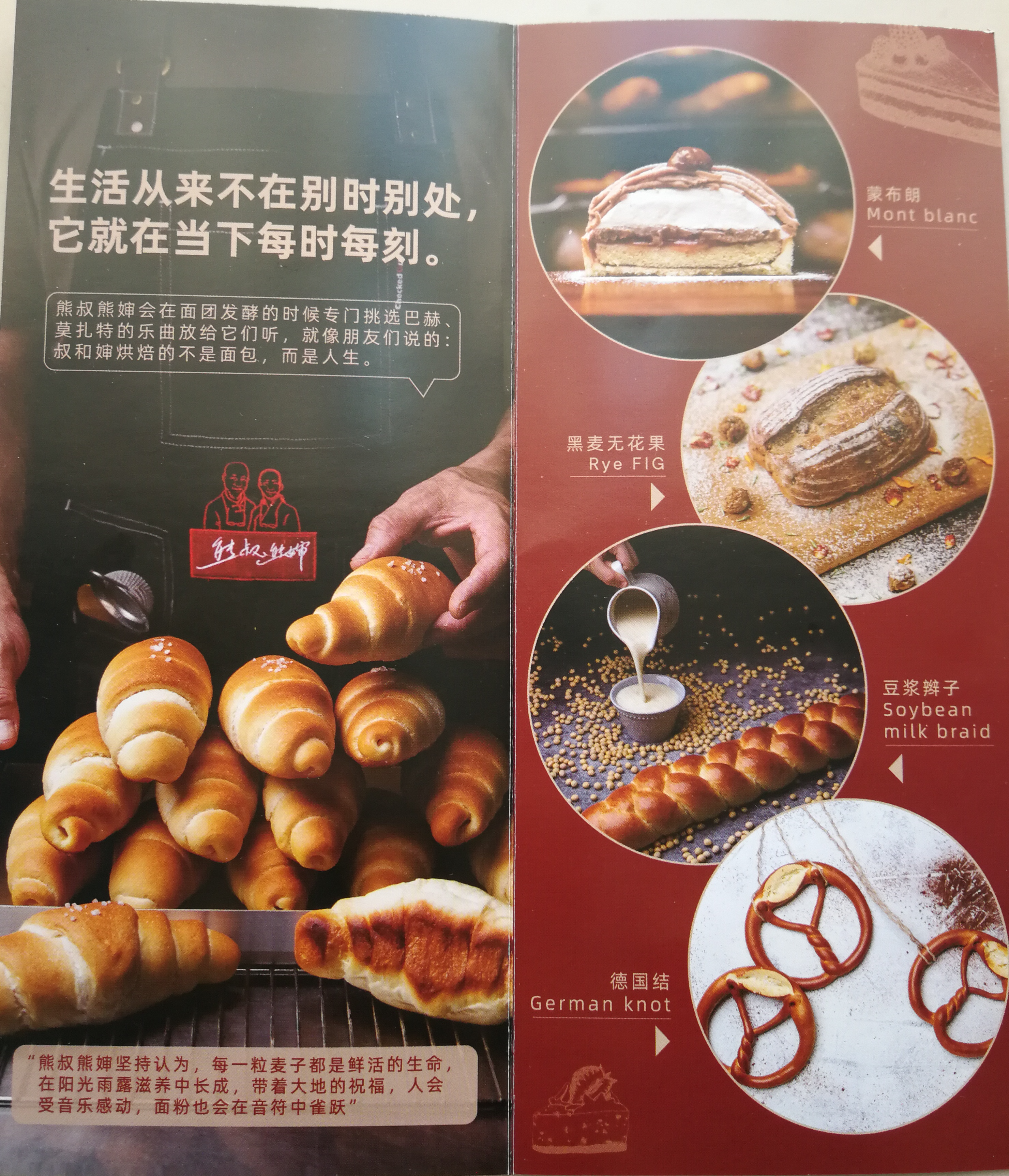
Product range
The store’s showcase offers a completely different image than that in most bread chains in China. You can buy several types of sturdy brown bread. Most do have extra ingredients such as figs or walnuts, but it has a firm bite and is not so sweet. There is white bread, but also sturdy in structure, available in various shapes. An invention of the Xiongs is soy milk bread, bread made with soy milk instead of cow’s milk or water. It is a successful attempt to make higher protein bread that fits better into the Chinese flavour palette. We didn’t see much patisserie that day apart from two types of scones. You can of course place an order from the brochure and pick it up later in the store or have it delivered to your home.
Enterprising
The Xiongs are now in their seventies, but when you hear them talk about their plans, they seem thirty or more years younger. They start early in the bakery every working day and are not ready until after noon to take it down a bit. In addition, they have also bought a property near the Great Wall that they want to furnish as a holiday home. There, guests can enjoy not only fresh bread, but also other local, organically grown products. The air is cleaner than in Beijing due to its high elevation. All this fits into the increasing interest among Chinese consumers in organic products. There is also a branch in Shunyi, a northeastern suburb of Beijing with much more expensive residential areas.
Next step
The Xiongs want even further. Their concept is well suited for franchising, where others take over the entire concept for a fee, from products to the layout of the store, etc., for a fixed amount per period. A change in management will be required for such a step. First of all, you have to hire an experienced professional manager for this; not necessarily someone who can bake bread, but someone who can lead the staff and supervise the, growing, number of franchisees. It’s not that far yet and the Xiongs are behind the ovens almost early every morning with great pleasure.
Peter Peverelli is active in and with China since 1975 and regularly travels to the remotest corners of that vast nation. He is a co-author of a major book introducing the cultural drivers behind China’s economic success
 Peverelli on Chinese food and culture