
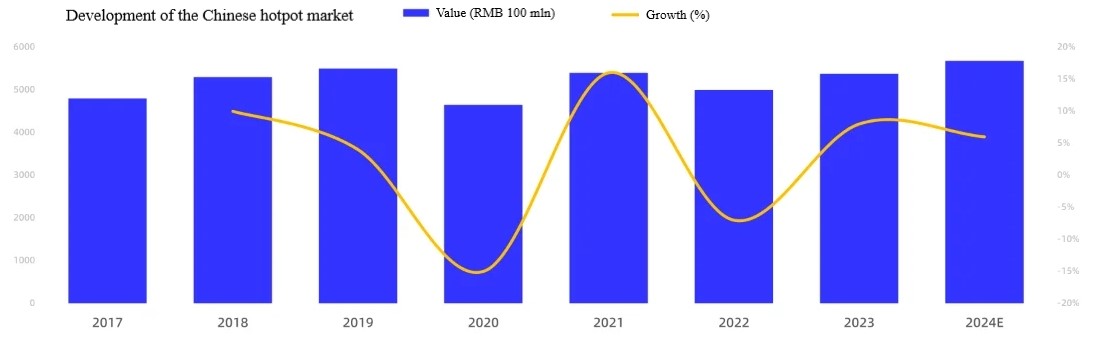
Hot Pot has grown so important that this traditional Chinese way of eating had developed into a full grown market. A specialised trade fair has been launched for it: Shanghai International Hot Pot Industry Trade Fair. The value of the 2023 Chinese hot pot sector was RMB 596.6 billion and is expected to exceed RMB 600 billion in 2024.
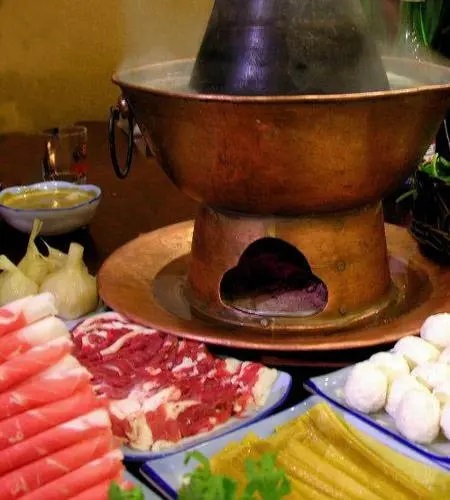
If there is one Chinese dish, or better: eating experience, that virtually all foreigners who have been to China enjoy, it is hot pot. The most traditional version is what Chinese refer to as shuan yangrou, literally ‘dipping mutton’. Eaters dip thinly sliced mutton in a boiling broth in the middle of the table, then dip it in a sauce with sesame paste as its base and other flavourings added on the basis of personal preference. While mutton is the main ingredient, various vegetables, bean curd, mushrooms, etc., can be dipped as well. This used to be winter favourite for the northern Chinese, as it is a way of eating that warms you up inside and outside. I hold dear memories of hot pot from my first winter in Beijing in 1975.
Modernisation
The consumption of hot pot increased with the growing spending power of Chinese consumers. This heightened interest caused a number of changes, adapting to the higher variation of likings of the patrons, also incorporating new technologies. Apart from mutton, beef and other types of meat were added. The charcoal as a source of heat was gradually changed to alcohol gel, which is considerably less smelly, and later electricity. There is even an annual Hot Pot Exhibition held in Chongqing. Chongqing has even constructed a complete Hot Pot Industrial Park.
Market structure
The hot pot market consists of three segments. The first includes the suppliers of raw materials: meat, vegetables, seafood, etc.; or simply: the stuff that is dipped in the soup. The following illustration shows a number of the most important ones (May 2024)

The intermediate segment includes the suppliers of the soup base and the condiments in which you dip the boiled ingredients.

The final segment comprises the providers of hot pots; the hot pot restaurants brands.

North versus South
The traditional northern hot pot also got influenced by the southern type. Southern Chinese have a different concept of hot pot. They throw about everything edible in a pot and fish it out using small metal nets. The Chongqing version uses a very spicy broth. Southern hot pot includes meat, but it is not the core ingredient. Most private restaurateurs who set up hot pot restaurants could not afford to stick to the shuan yangrou tradition and name there cuisine literally huoguo ‘hot pot’ (literally: ‘fire pot’). Hot pot gradually became an equivalent of a way of communal eating that required little effort. At home, you just placed a pan of broth on an induction plate, surrounded with plates with various raw ingredients. The same applied to hot pot restaurants, where the main activity in the kitchen was slicing meat and vegetables.

Instant hot pot
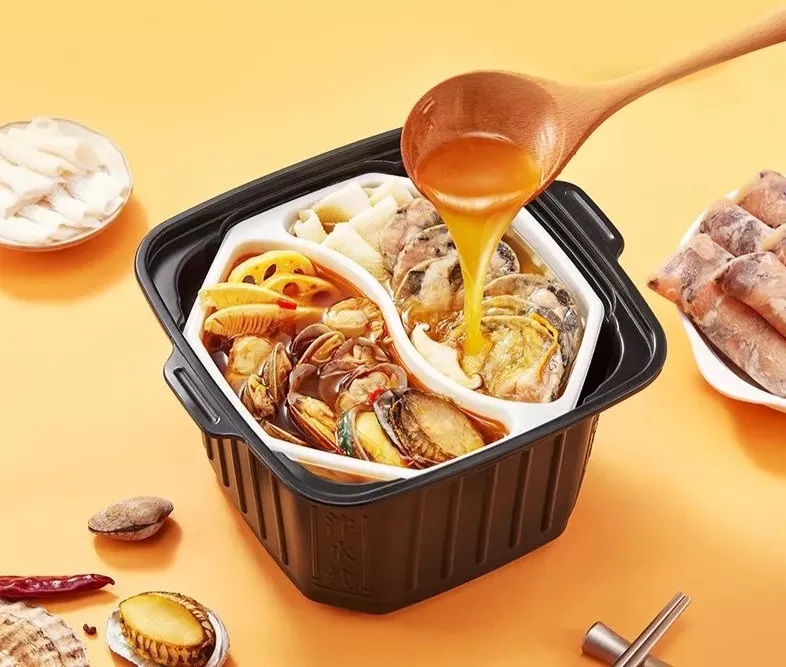
A new development in the Chinese convenience food market is the appearance of self-heating noodles, congee, etc. Instant hot pots appeared soon afterwards. The photo shows a typical Chongqing hot pot with a spicy and non-spicy section by Qingxixi, launched in 2021. Qingxixi promotes the product as only containing zero fat or low fat ingredients.
In-Shop Hotpot: A Post-COVID Development
A recent development in the culinary industry is the in-shop hotpot, a dining experience where hotpot is prepared and served in a corner of a food establishment. This concept offers consumers a more cost-effective option compared to traditional restaurants, as the establishment incurs lower operational costs. In-shop hotpot has gained significant popularity among young professionals with limited budgets who seek to reduce their food expenses while maintaining a flavourful dining experience.
Growing market for small hotpots

Small or individual hotpots have always existed, but started to become a market of their own in the 2020s, which met the needs of the growing demographic segment of singles. With the continuous rise of the wave of ‘one person’s meal’, the model of ‘one person one pot’ was in line with the independent dining needs of single consumers. At the same time, its high cost performance also meets the needs of consumers in third and lower tier cities. With the acceleration of urbanisation and the increase of urban population, the consumption potential of those markets is further opened. According to statistics, the market size of China’s small hotpot industry in 2024 reached RMB 58.8 billion, an increase of 12.07% year-on-year.
Women form a small majority among China’s small hotpot consumers, accounting for 51.4%. In terms of age, 70% of the consumers are in the 20-39 years bracket (2024 statistics). Young consumers pay more attention to personalised and convenient dining experience, and are more sensitive to price, which is more suitable for the positioning of the small hotpot. The proportion of one-person meals is as high as 44.2%, mainly for single consumers or dining alone, followed by small group dinners, accounting for about 33.4%. In terms of consumer concerns, taste is the most important factor, accounting for more than 70%, followed by ambiance and price, accounting for about 65.5% and 63.9%. Small hot pot consumers are relatively sensitive to price, and the highest proportion of groups who can accept prices between RMB 20 – 40.
A whole new market
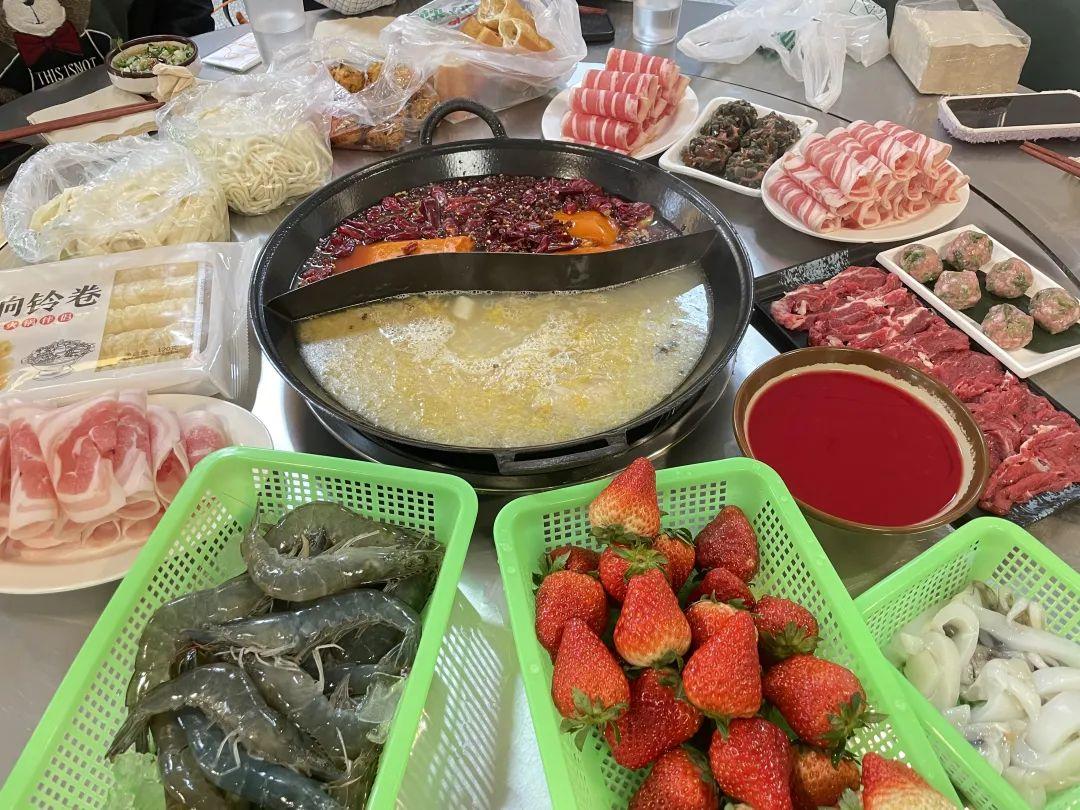
Probably also aided by the renewed interest in home cooking caused by COVID-19, the hot pot rage has recently created an complete new market for packed hot pot ingredients. Hot pot chains like Haodilao started this by selling ready-to-use blocks of hot pot condiments. You simply melted it in hot water and you had an instant dipping broth. Meat processors followed suit by launching packed sliced mutton and beef. Fish followed soon. Chopped and sliced vegetables also appeared on the shelves of Chinese supermarkets. A recent study estimates the value of the market for hot pot meat alone at RMB 30 billion. The same study estimates the value of market for hot pot condiments at RMB 49 billion. A Chinese netizen posted the following photo of the various products he had purchased for a hot pot meal at his home with a few friends.

As you can see, it includes drinks and a cake for dessert. The only fresh ingredient is a plate of vegetables at the top of the photo.
So, is this a good development, all that packed food, or is it against the trend towards healthier eating? As far as the meat is concerned, I know from personal experience that the appearance of frozen pre-sliced mutton and beef felt as a liberation from slicing it yourself. Apart from being sliced/chopped and packed, these products have not been heavily processed. Fact is that ‘hot pot materials’ have become a sub-market of their own in China. The following table shows the historic development of the value of this market.
Hot pot buffet
A new vogue in Qingdao was launched in 2023: buffet style hot pot during which customers can pick whatever the see passing by.

Clean hot pot
Concepts like Clean Label have also reached China and started to get serious around 2022. However, the Chinese interpretation of ‘clean’ seems to be broader or lest strict than the Western. Here is an example of ready-to-use hot pot broth seasoning from Eurasia Consult’s database that is advertised as ‘zero additives’ site in China.

Product name: cow fat mildly spicy
Ingredients
cow fat, chili pepper, broad beans, wheat flour, water, MSG, spices, sichuan pepper, ginger, garlic, rock sugar, onions, fermented beans, yeast extract, chili red
Peter Peverelli is active in and with China since 1975 and regularly travels to the remotest corners of that vast nation. He is a co-author of a major book introducing the cultural drivers behind China’s economic success
 Peverelli on Chinese food and culture