
Looking into today’s convenience store refrigerators in China, you will find that bottled water is becoming more and more complicated. From electrolyte water, Chinese health water, to high potassium water and protein water, the water on the shelves is being given more and more functional labels. When ‘0 sugar 0 calories’ is no longer the trump card of differentiation, probiotics are becoming a new direction for many brands to bet on.
Developments
From light juice, sparkling water, to a straw containing live bacteria, probiotics are breaking away from the traditional yoghurt shell and quietly setting off a drinking water revolution in the form of ‘live bacteria water’.
Chinese health water increased by 182% year-on-year, and has reached a market size of RMB 1 billion more than a year after its first appearance on the market. Electrolyte water, 100% juice and sugar-free tea have also maintained double-digit growth.
According to the White Paper on the Research on Consumer Minds and Decision-Making Links in the 2025 Big Food and Beverage Industry released by Nielsen IQ and Xiaohongshu, 71% of consumers will study the ingredients, origin and nutritional efficacy in depth when buying food and beverages.
The problem
When ‘0 sugar’ and ‘low calories’ become the basic configuration of healthy drinks, healthy drinks makers have to urgently find new ways of making their products appear healthy: what more specific reason can a bottle of ‘healthy water’ give consumers?
High-potassium water subdivides electrolyte supplementation into more specific functional needs, Chinese health water takes warming (in the TCM sense) as the benchmark, ginger water cuts into high-frequency scenes with the pain point of ‘warming and sweating’, and protein water makes fitness tonic transparent and refreshing.
Consumers’ drinking scenes extend from ‘relieving summer heat and quenching thirst’ to multiple dimensions such as ‘exercise to replenish energy, health care, emotional pleasure, overtime and staying up late’. Drinking bottled water is being upgraded from basic hydration to a daily accurate way to supplement nutrients.
Upgrading process
The upgrade vein of healthy water replacement is very clear:
- The first stage is ‘subtraction‘. The brand is committed to solving the problem of ‘how to get closer to water’ and reduce the drinking burden of consumers through zero sugar, low calorie and short ingredient list;
- The second stage is ‘changing the base‘. In order to solve the problem of ‘how to make the sense of health more natural’, coconut water, juice, tea, kombucha, herbal plants and other natural bases began to be applied on a large scale;
- In the third stage, that is, the current stage of ‘precise addition‘, the brand begins to solve the problem of ‘how to increase the value’, by adding molecules such as electrolytes, high potassium, vitamins, protein and probiotics to drinks, and focussing on more specific drinking scenarios such as exercise, commuting, meals, night, state management, etc. , let the water undertake more accurate physical tasks.
Probiotics
In this stage of ‘adding molecules’, probiotics are becoming a special variable. It is not just an ingredient that is simply stuffed into the ingredient list, but a new window for drinks to achieve health upgrading.
The bacteria are ‘changing the shell’, but it is by no means as simple as changing the bottle. When it comes to ‘probiotics’, the first reaction of most people is lactic acid bacteria drinks, refrigerated yoghurt or drinking bacteria powder. But now probiotics are breaking away from the fixed category shell and appearing in different water replacement products. This is not as simple as changing a bottle, but to solve the problem of survival and taste adaptation of live bacteria in a water-based and normal temperature environment.
Light fruit juice × probiotics:
Sweet and sour fruit flavour lower the threshold for consumers to try, while live bacteria provide health value. Consumers do not need to know about complex strains to complete their first purchase.
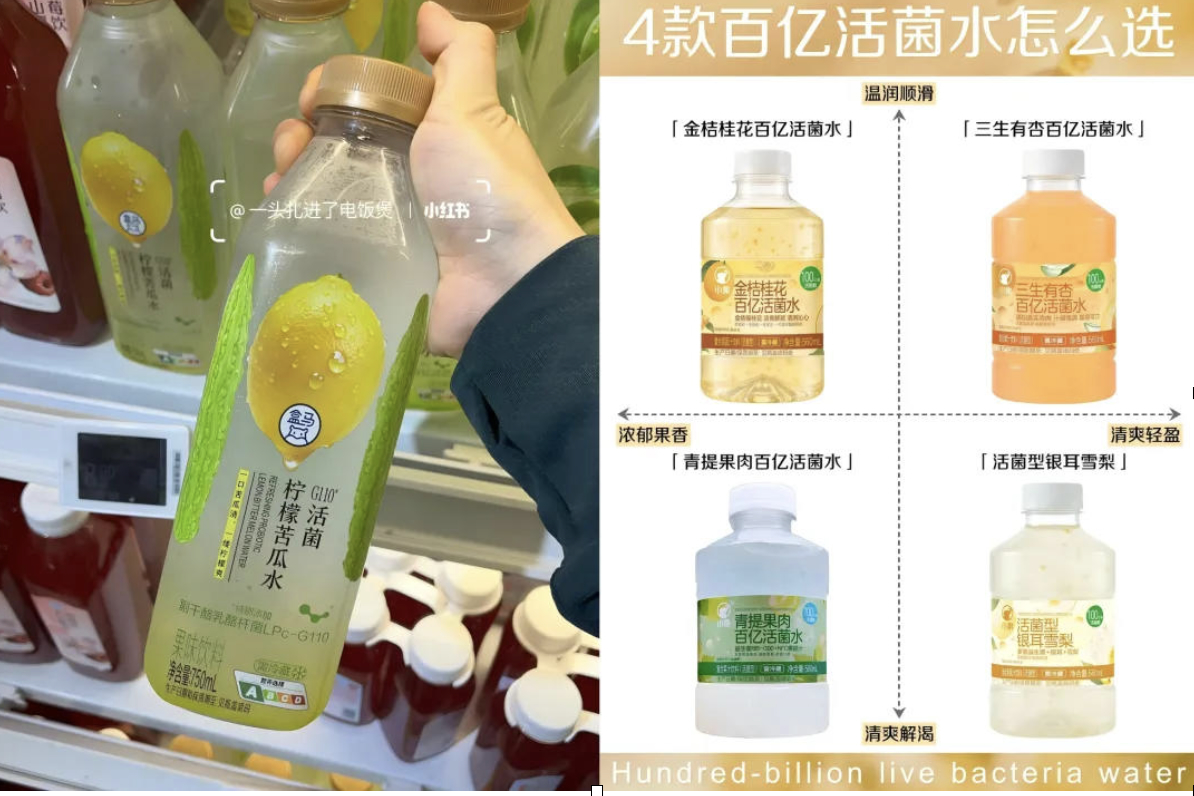
Hema’s J26 10 billion live bacteria green plum water is based on NFC green plum juice, and the number of live bacteria ≥20 billion CFU, positioning the meal scene; Xiaoxiang supermarket’s fragrant grapefruit granules and Qingti pulp live bacteria water, 10 billion live bacteria are added to each bottle, especially the Junyao BB-G90 strain is added to increase the chewing experience with real fruit grains, It is mainly delicious and healthy.
Electrolyte and energy drinks:
Electrolytes solve instant hydration, while probiotics provide longer-term and more daily health value narratives. Junyaowei Power launched probiotic electrolyte sparkling water and energy sparkling water, which superimpose instant energy charging and tonic in the same bottle of products.
From powder bag to straw:
Physically separating bacteria from liquids and mixing them when drinking can not only reduce the loss of activity in processing and storage, but also allow consumers to ‘witness’ the addition process.
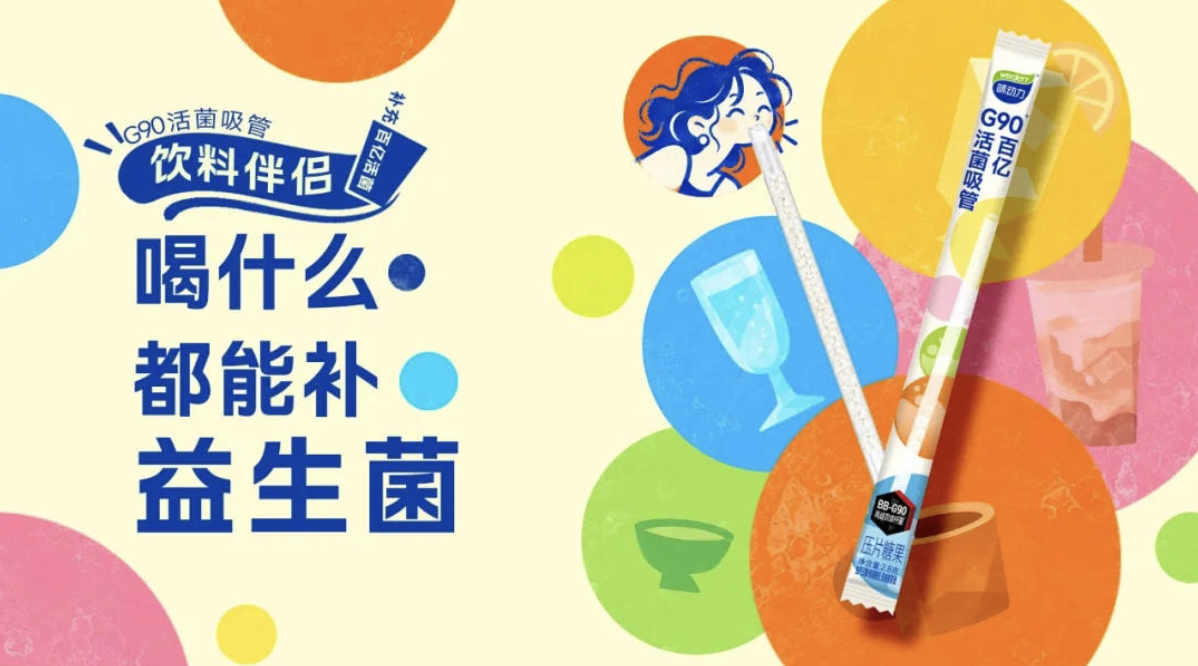
The newly launched 10 billion live bacteria straw of Junyao Health is the representative of this idea: storing live bacteria in the straw not only ensures the activity of live bacteria, but also makes the action of supplementing bacteria become routine – whether you drink plain water, juice or coffee, you can easily supplement probiotics by inserting a straw, so that healthy habits can naturally integrate into everyone’s daily water drinking.
There is no doubt about the health properties of probiotics. Different strains have different effects, so that healthy water has infinite possibilities.
Adaptable innovation
Recently, Hema, Xiaoxiang Supermarket and Dingdong Buy Vegetables have launched live bacterial light juices equipped with BB-G90 strains, forming a set of reference-based reference samples, intuitively showing how to make scene-differentiated product expressions of the same strain assets according to channel positioning.
Hema takes the route of large bottles with meals. J26 10 billion live bacteria green plum water is based on NFC green plum juice, with a variety of probiotics, refreshing and sour, suitable for meals, relieving and other scenes. It replaces the position of a large bottle of juice and sour plum soup in the refrigerator.
Xiaoxiang Supermarket takes the fruit grain + taste route. There are two kinds of live bacteria water, fragrant grapefruit fruit and green fruit pulp, 10 billion live bacteria in each bottle, adding Junyao Health BB-G90 strain, NFC juice with real fruit grains, and increasing the repurchase frequency with chewing feeling and multi-flavour matrix.
Dingdong buys vegetables and takes the flower-flavoured drinking route. Dingdong V5 Jasmine White Grape Water is based on NFC white grape juice, and also adds Junyao Health BB-G90, 10 billion CFU per bottle, low sugar, low calorie and 0 fat, with light pricing and floral flavour to test the refreshing light drinking people.
Up- and downstream
From the recent channels, we can clearly see the trend of ‘downstream customisation and upstream co-creation’. Retail channels such as Hema, Xiaoxiang Supermarket, and Dingdong Buy Vegetables are putting forward customised requirements to the supply chain based on their respective customer groups (such as meals, pulp chewing, flower-scented light drinks).
This is a big test for upstream raw material enterprises: we can’t just ‘sell bacteria powder’, we must provide comprehensive solutions including efficacy verification, base adaptation and survival technology. Like Junyao Health, as an enterprise with self-developed strains, its value is that it can make the same core strain adapt to different tastes, liquid substrates and storage conditions, and become the underlying technical base to support channel differentiation.
Can probiotic water stand firm in the new competition of drinks?
The continuous new products of Hema, Xiaoxiang and Dingdong have given a clear early signal: probiotics are breaking away from the fixed shell of yoghurt, lactic acid bacteria drinks and bacterial powder, and becoming a product module that can be migrated in beverage development.
For Junyao Health, the opportunity is not limited to the launch of its own brand of live bacteria drinks, but also the positioning of imagination. It is a standardised solution for channel-oriented output that includes strains, formulas, dosage forms, production and cold chains. In the long run, the competition of the future track will not be limited to the number of live bacteria. Flavour, live bacteria retention, efficacy evidence, shelf cycle, and channel loss cost all need to be able to run through at the same time.
The competition of the water replacement track is changing from a simple ‘flavour competition’ to a ‘technical competition’ at the bottom. Whether it is the keen customisation demand at the channel end or the strains and preservation technology cultivated by upstream enterprises, they are pushing live bacterial water to more everyday consumption scenarios.
How much increment this new track can eventually run depends on whether it can cross the gap from ‘fresh concept’ to ‘national drink’. When the basic technical infrastructure is in place, it is worth looking forward to whether live bacterial water can really rewrite the pattern of the water replacement market.
(Adapted from Foodaily 12/11/2026)
Peter Peverelli is active in and with China since 1975 and regularly travels to the remotest corners of that vast nation. He is a co-author of a major book introducing the cultural drivers behind China’s economic success.

