
Most Chinese will immediately guess: Henan.
Hebei
According to the statistics, the output of instant noodles in Henan Province accounts for nearly 33% of the country. However, this output is distributed in the instant noodle industrial belt from Xinxiang in the north to Luohe in the south. If the scope is narrowed down to cities and counties, the most concentrated place of the instant noodle industry is actually not Henan, but a county called Longyao in Xingtai City, Hebei Province. It is the home of Jinmailang.
Longyao
As a large grain-producing county in Hebei Province, Longyao has become the world’s largest instant noodle production base driven by leading enterprises. Longyao is an agricultural county that mainly relies on wheat cultivation.
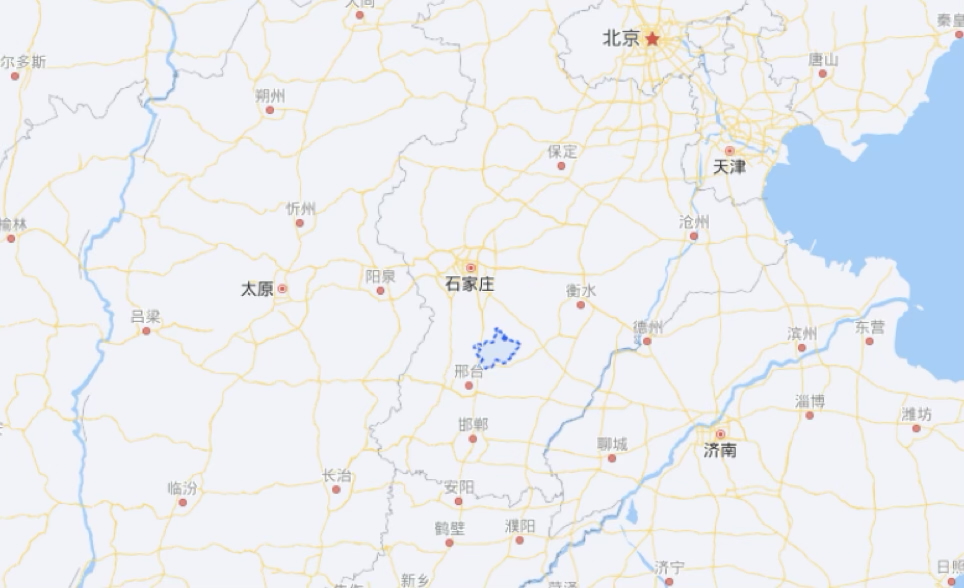
Regional location of Longyao County
However, it is in this small county the nation’s instant noodles production started. It gave birth to the richest man in China’s instant noodle industry and became the world’s largest instant noodle production base with an annual output of 14 billion packs of instant noodles. It was founded by Longyao people themselves, rooted and developed in Longyao. Now it has become a local brand of Longyao that is on an equal ar with Master Kong and Uni-President: Jinmailang.
Hurun
In the ‘2022 Hurun Top 100 Chinese Food Industry List’, Jinmailang ranked 48th (Chef Kong ranked 25th). In terms of value changes, other enterprises on the list either have negative growth or double-digit growth at most, while the year-on-year growth of Jinmailang has reached an amazing 126%, becoming the enterprise with the fastest value growth rate on the list. Jinmailang’s annual production capacity is 12 billion packs of instant noodles. It processes 5500 mt of wheat per day and 1.8 mt mt p.a., it ranks in the top six in its industry in the world and the top three in China. When we add the capacities of other related enterprises in Longyao, the regional annual production capacity of instant noodles is as high as 14 billion.
Pillar of the local economy
Jinmailang’s instant noodle production has long realised intelligent automatic production. The Longyao food industry, which is driven by instant noodles, has an annual revenue of more than RMB 17 billion and the more than 100 food manufacturing and supporting enterprises in the county contribute one-third of Longyao’s total profit, which makes it a proper pillar of the local economy. Longyao is also the world’s largest production base for paper containers and bottle caps.
Beginning
In 1992, Wei Yingzhou, a Taiwanese businessman, founded Dingyi Food in Tianjin, and Chef Kong instant noodles soon became popular in China. In this year, Fan Xianguo, a native of Longyao, took the money saved from running a small workshop and partnered with more than a dozen people to form the Tianshuai Group to produce single-crystal rock candy. Chef Kong’s popularisation made Fan Xianguo see the huge market for instant noodles, but the partners did not agree to do this. Therefore, in 1994, Fan Xianguo took a few people to establish Hualong Group. This time he got the decision-making power. An instant noodle giant who can be equal to Chef Kong in the future was born.
Rural market
At that time, Chef Kong and Uni-President were aiming at the urban market. There was no way to sell it in the countryside at all. They could only see some mixed brands, even instant noodles without packaging. From the start, Hualong targeted the blank area of the rural market. A strategy they had learned from Mao Zedong. An important contributor to the success of the Communist Party was the strategy to ‘let the countryside encircle the cities’. Its first instant noodles was called ‘Hualong Noodles’, which focussed on cheap and affordable. The advertisement of ‘Hualong noodles, you see them every day’ was painted all over the walls of rural areas. Hualong instant noodles also quickly occupied the rural market. In just three years, Hualong began to aim at the national market.
National
In 1997, Hualong established more than 600 sales networks in more than 20 provinces and began its own plan to occupy the instant noodle market north of the Yangtze River. At this time, Wang Lushan, Fan Xianguo’s hometown, was also an agent of Hualong Group in Gansu. He followed Hualong Market all the way, made a lot of money, and also had the idea of working for his own account. In 1999, Longyao’s second brand that stirred up the national instant noodle market was born. Wang Lushan, who was familiar with the old owner’s products and routines, established Zhongwang Group. With two brands of instant noodles, he quickly became a brand that was higher than Hualong in the rural market at that time. In 2000, it achieved sales of RMB 100 mln, and two years later, it became one of the top five instant noodles in China.
Jinmailang
Around 2000, the sales of Hualong instant noodles began to grow rapidly. In that year, Fan Xianguo gave up the Hualong trademark and launched a new brand ‘Jinmailang’. Jinmailang cooperated with Nissin Group (Japan), a global boss leader in instant noodles, and became the world’s largest noodle-making enterprise at that time. Subsequently, it launched the new-tech instant noodle brand Dajinye.
Wugu Daochang
On Wang Lushan’s side, he found the marketing director of Hualong before, began to cooperate with Chef Kong, and then launched a new non-fried instant noodle brand Wugu Daochang. Wugu Daochang did very well. In 2006, it also achieved annual sales of RMB 2 billion. That year, Zhongwang also topped the top 100 Chinese enterprise growth list with a growth rate of 2003%. After that, although Wang Lushan’s Zhongwang Group declined due to blind expansion, Longyao’s instant noodle industry and other related supporting industrial chains rose rapidly because of this competition between, what was locally referred to as: ’two dragons fighting’.
Decline and back
Since the 1990s, China’s instant noodle industry has been booming, and the turnover has increased for 18 consecutive years. However, since 2013, the instant noodle industry has begun to go downhill. The reason is very simple. 2012 was the first year of the rise of China’s takeaway industry. The fierce battle of Meituan, Eleme, Dianping and other platforms in this year’s ‘thousand-group war’ made instant noodles ‘out of favour’ from people’s list of instant foods. In fact, any food became instantly available. With the upgrading of the consumer market and the consideration for a healthy, nutritious and balanced diet, instant noodles were no longer a must or even an option for many people to pursue a convenient diet. It was not until the pandemic that the instant noodle industry showed signs of rebound again. According to the statistics, the market size of China’s instant noodles in 2018 was RMB 103.9 billion, and it increased to RMB 182.38 billion in 2022. It is estimated that by 2025, the market size will reach RMB 231.23 billion.
Innovation
Technological innovation is an important driver behind the continuation of the status of Longyao as China’s top instant noodles base. As early as six years ago, Jinmailang was selected as one of the top 10 innovative food companies in China in 2018 with 926 patents, together with the top international food groups of Mars, Pepsi and Starbucks. At the beginning of 2022, Jinmailang announced that it had completed a financing of RMB 600 million from investor Jiahua Capital.
Peter Peverelli has been actively involved in and with China since 1975 and frequently travels to the most remote regions of that vast nation. He is a co-author of a substantial book that explores the cultural factors that have contributed to China’s economic success. Peter has been involved in the Chinese food and beverage industries since 1985.
 Peverelli on Chinese food and culture