Innovative Cheese Snacks Designed for Children

Cheese consumption has been increasing at an incredible speed in China during the past few years, considering that not so long ago, almost all Chinese were abhorred about the smell of cheese. Cheese supply volume in China has surged from 140,000 tons to 270,000 tons during the period 2017-2022. This figure is expected to maintain double-digit growth, far above the world average for the coming years.

Although the average cheese consumption in China is far below many Western countries as well as Japan and Korea, it has significantly increased from 80g/person/year in 2017 to 130g/person/year in 2021. At the 2022 China Cheese Development Summit Forum, the Dairy Association of China released an action plan, proposing that the national cheese production would reach 500,000 tons by 2025. Much of the cheese sold in China is processed, but non-processed is increasing.

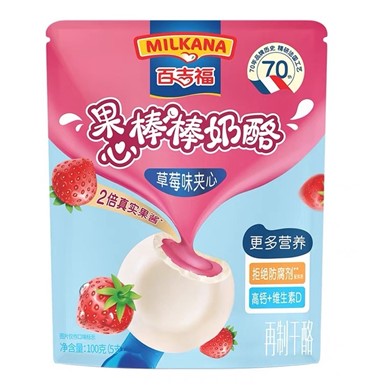
A uniquely Chinese development is that Chinese cheese producers are focusing their own R&D on developing one-bite cheese snacks, for all ages, but in particular for children. This is partly a result of the pressure of the Chinese authorities to increase dairy consumption among children. Such products include cheese sticks, cheese slices, cheese strips, etc. Cheese sticks form the most popular type, which was first launched by Milkana, but was popularized by Milkground. Presently, driven by the increasingly intensive market competition, dairy enterprises have rolled out a wide range of cheese sticks with distinctive features. Apart from various funny shapes, including ‘cheese lollies’, they are also experimenting with flavours. A good example are Milkana’s strawberry flavoured cheese sticks.
This ad by Milkground presents their range of cheese sticks in various flavors: coconut, grape and natural. It promises a calcium content 7 times that of liquid milk. It has added Vitamin D. The animals indicate how fast your child will grow, if you let them snack on Milkground cheese sticks.

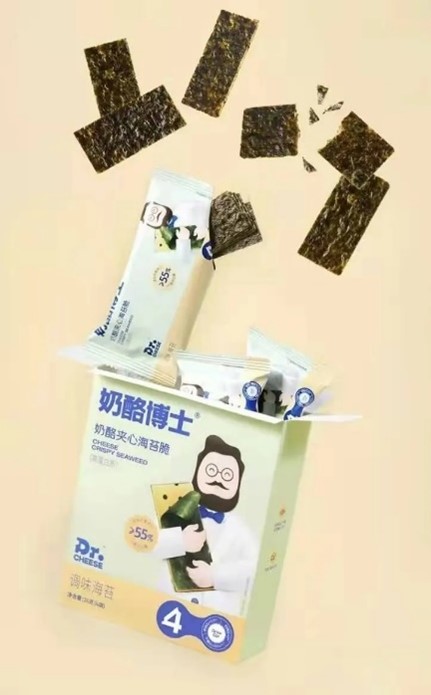
The current trend towards more nutritious snacks is also influencing the design of cheese sticks. Dr Cheese has launched a cheese stick sandwiched between two layers of dried seaweed.
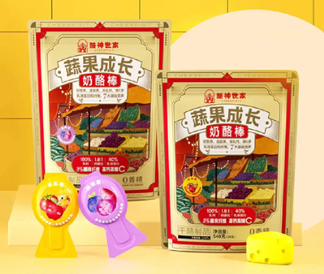
Cheespirit has launched a series of innovative products in 2023: ‘Vegetable & Fruit Growing Up Cheese Sticks’. The company claims to have selected 8 kinds of ‘super vegetables and fruits’ to create high-calcium and high-VC cheese sticks, containing 3% dietary fibre. The calcium is 100% milk calcium, with a 1.8:1 calcium-phosphorus ratio. The product contains 40% whey protein, as well as algal oil DHA and various trace elements derived from vegetables and fruits, providing nutrients such as protein, dietary fibre, vitamins and other basic nutrients needed by children. It contains no preservatives. It uses two innovative two-colour-flavours: Lele orange (tomato, carrot and apple compound flavour) that contains β-carotene; and absolute purple (purple sweet potato, purple cabbage blueberry complex flavour) containing anthocyanins to help the children’s growth.
If this post is of interest to you, you may also want to read:

Cheese in China – a gargantuan challenge

Peter Peverelli is active in and with China since 1975 and regularly travels to the remotest corners of that vast nation. He is a co-author of a major book introducing the cultural drivers behind China’s economic success. Peter has been involved with the Chinese food and beverage industries since 1985.

Understanding China’s Maternal and Infant Water Market

China’s new generation of parents has become extremely finicky about the quality of any product used for or by their newborns. Many posts in this blog already reflect the growing concern for healthy food among young Chinese consumers. This concern only multiplies, when they are starting a family. One innovative product that has come from this development is special purified water for infants. As a drinking water designed for infants and pregnant women, maternal and infant water has many advantages. First of all, it undergoes strict purification and filtration treatment to ensure that the water quality is pollution-free, and can provide a safe and reliable drinking water source for infants and pregnant women. Secondly, maternal and infant water is enriched with a variety of minerals and trace elements, which are essential for the growth and development of infants and young children and the health of pregnant women. According to recent data, China’s maternal and infant water production has increased to 228 mio bottles in 2023; Demand grew to 224.75 mio bottles.

Overview of the maternal and infant water industry

Maternal and infant water is a pure natural mineral drinking water specially for pregnant women and infants to drink, with rich mineral ions, strong antioxidant capacity, good nutrient absorption, low soluble total solids and other characteristics. Maternal and infant water is the ‘natural mineral water’ that meets or exceeds the national standard of the Chinese Nutrition Association. Maternal and infant water must be high-quality raw water derived from nature, without any pollution in the water intake area, and retain the natural mineral elements in the water under the premise of safety and cleanliness; Filling must be carried out close to the water source with special hygienic protection.

According to the National Bureau of Statistics, the number of births in China reached 9.02 mio in 2023, a decrease of 540,000 from 9.56 mio in 2022. On the whole, the number of births in China is showing a downward trend, but considering the large size of China’s population, the number of births still remains at a relatively high level. Moreover, with the implementation of a series of policies and regulations and supporting measures to actively support childbirth, the decline in the number of births in China is expected to decrease in the future. This is expected to usher in development opportunities for the maternal and infant market.

The value chain

The upstream of the value chain is mainly mineral water resources and packaging materials, among which mineral water resources directly determine the output and quality of the products; The midstream refers to the production and manufacturing of maternal and infant water, represented by brands such as Nongfu Spring, which have won the trust of consumers with strict quality control and unique market positioning; The downstream link refers to the consumption of maternal and infant water, and its sales channels mainly include shopping malls, supermarkets, convenience stores, e-commerce, etc., and the development level of these channels directly affects the market demand for maternal and infant aquatic products.

The development of the industry

The data shows that from 2015 to 2023, the scale of China’s maternal and infant water market has continued to grow, and the scale of China’s maternal and infant water market reached RMB 1.043 billion in 2023. However, it is worth noting that in 2023, the size of China’s packaged drinking water market has exceeded 200 billion, so maternal and infant water accounts for less than five thousandths. It is expected that with the continuous development of the maternal and infant water market in the future, more and more brands and manufacturers will begin to increase the publicity and promotion of maternal and infant water, improve consumers’ awareness and acceptance of maternal and infant water, and thus stimulate the growth of industry demand. In addition, the expansion of sales channels has further promoted the development of the maternal and infant market. In addition to traditional supermarkets and baby stores, more and more e-commerce platforms and social media have also started to sell and promote baby water.

There are four main producers of infant water, with Nongfu Spring, already market leader in the Chinese mineral water market, ranking first place. Contact me for an in-depth market study.

If you are interested in this post, you may also want to read:

Infant formulae in China – a showcase of Chinese food policy

Peter Peverelli is active in and with China since 1975 and regularly travels to the remotest corners of that vast nation. He is a co-author of a major book introducing the cultural drivers behind China’s economic success. Peter has been involved with the Chinese food and beverage industries since 1985.