
ecently, the Shenzhou 23 manned spacecraft was launched, and three astronauts took temporary residency in the Tiangong space station. This time, an astronaut will venture a one-year in-orbit stay. A one-year stay is the ultimate examination of the life support system. The relevant person in charge of the China Manned Space Engineering Office pointed out that ‘the self-sufficiency of the food system determines how far we can go in the future.’ From ‘all relying on delivery’ to ‘making and planting on the spot’, China Aerospace Food is undergoing a fundamental change.
Recipe update: high-quality experience on the tip of the tongue
In 2003, Yang Liwei completed a 21-hour space flight on Shenzhou 5. At that time, the twenty or thirty kinds of food he carried were all ready-to-eat simple meals, and a piece of coconut mooncake was a rare treat. Today, the categories of food on the space station exceed 190, and the astronaut’s meals can be different for 10 days. Mapo tofu (a spicy beancurd dish), tomato eggs,, stir-fried lotus root, cumin potato… These home-cooked dishes with the characteristics of various regional Chinese cuisines have become the normalised meals on the space table.
‘Not only take care of full belly, but also your mood.’ According to the experts of the China Astronaut Scientific Research and Training Centre, taking Mapo Tofu as an example, the scientific research team has completely retained the original taste of the dishes: spicy, hot, fragrant and tender, after thousands of process optimisations in response to technical problems such as fragile ingredients and splashing soup in the weightless environment. Customised meals that fit the eating habits of the astronauts can effectively comfort their homesickness, when they stay in orbit for a long time.
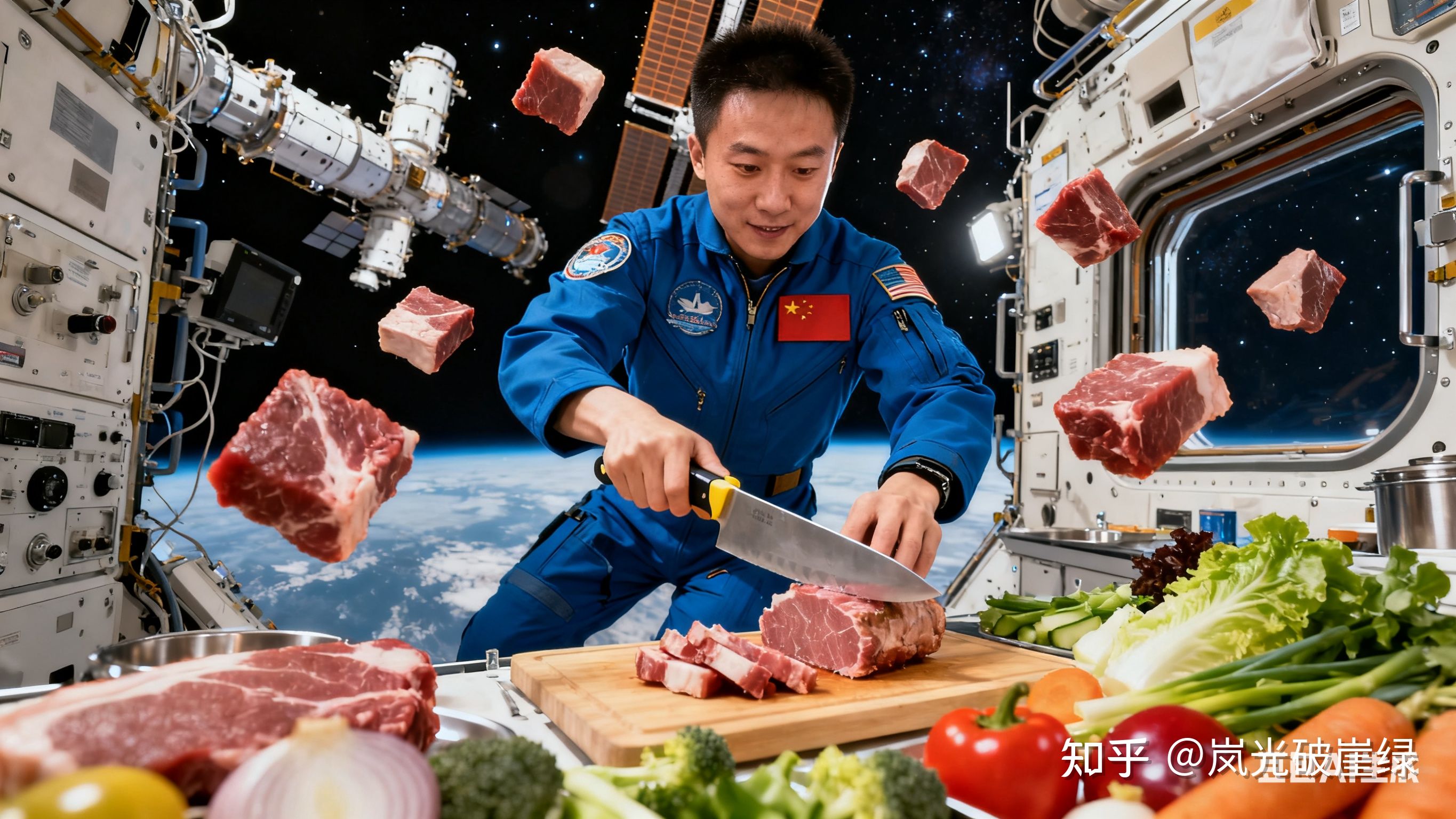
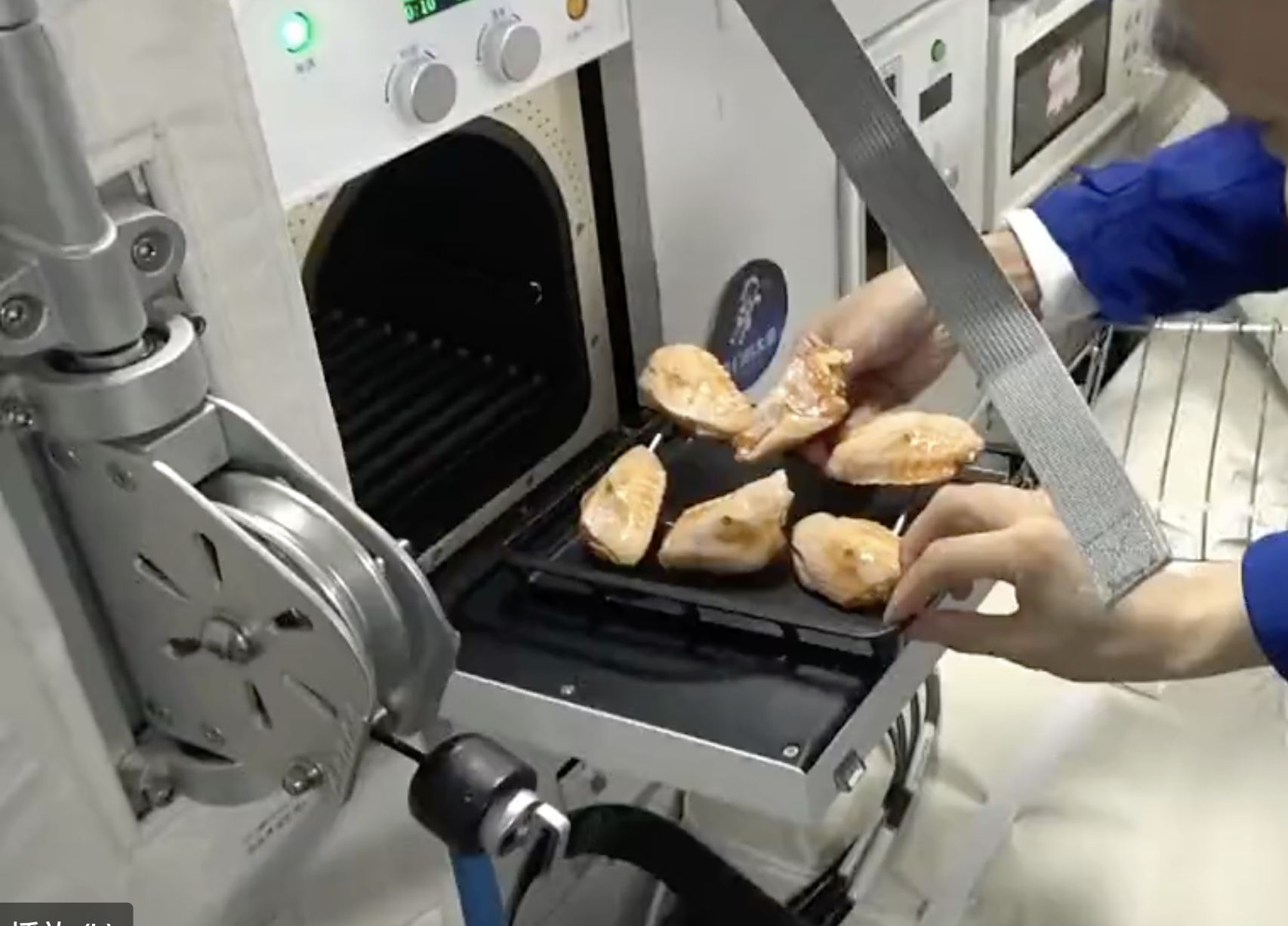
Behind this growing abundance of space catering is the breakthrough of the core equipment of aerospace cooking. In November 2025, the hot air roaster on board the Shenzhou 21 spacecraft was officially put into use on the space station. The equipment has successfully overcome a number of technical bottlenecks such as smoke purification in a closed space, drifting of ingredients in a weightless environment, and difficulty in collecting food residues. It has raised the upper limit of the heating temperature of space food from 100 degrees to 190 degrees Celsius. It can complete the production of hundreds of delicacies within 30 minutes, and work with fresh ingredients such as chicken wings and steak. Space in-situ cooking – from raw to cooked, the whole process is completed in orbit.
‘The process of baking food by hand is a kind of psychological healing in itself.’ Liu Weibo, a researcher at the China Astronaut Scientific Research and Training Centre, says that aerospace medical research has confirmed that diversified hot food supply and immersive dining experience can effectively reduce the level of cortisol in the body of astronauts and alleviate the loneliness and anxiety of long-term orbiting. For one-year long-term stay missions, high-quality experience on the tip of the tongue is not the icing on the cake, but an important support for astronaut mental health intervention.
Packaging
In addition, space-specific food packaging technology has become a key support to ensure the safety and long-term storage of ultra-long-cycle space food.
The special meal box for astronauts equipped with the Shenzhou 23rd mission adopts multi-layer composite high-blocking special materials to build a closed structure that is almost vacuum. According to the technical information, the use of this meal box can realise the long-term storage of staple food at room temperature for three years without adding any preservatives, and adapt to the supply needs of one-year ultra-long in-orbit. At the same time, the research and development team has optimised the operation problems in the weightless environment, innovatively designed special water inlets and exhaust ports, realised the safe preparation of food inside the closed space, and completely avoided the risks of space water drift and food pollution.
It is reported that this aerospace-specific packaging technology not only serves the orbital mission of space station, but also forms a mature technical reserve, providing an important reference for the upgrading of the ground high barrier and additive-free food packaging industry.
Breeding in orbit
Advanced cooking equipment solves the problem of ‘how to do space ingredients’, and in-orbit breeding technology completely solves the core problem of deep space exploration ‘where does the grain come from’.
The space application system carries 9 scientific experimental projects through Shenzhou No. 23, including the ‘Molecular Mechanism Research on Multi-Generation Genetic Stability and Environmental Adaptive Regulation of Space Rice’ led by Zheng Huiqiong’s Team of the Centre for Excellence and Innovation in Molecular Plant Science of the Chinese Academy of Sciences. This is also the world’s first attempt to complete it in orbit. The complete growth closed-loop test of ‘seed to seed to new generation seed’.
This experiment sets up 4 cultivation units and is divided into 2 groups of control: one group carries out a reproduction experiment of rice to explore the ‘intergenerational memory’ effect of crops in the space environment and verify the adaptability of the offspring of space-selected seeds to the microgravity environment; the other group adopts the regeneration rice cultivation mode to retain the rice pile root system to achieve secondary germination and growth. , compare the growth differences and trait stability of the two breeding modes in the special environment of space.
Zheng Huiqiong said that near-earth orbits can rely on ground freight supply, but in the future, deep space exploration missions such as the moon and Mars are not sustainable to rely entirely on ground supply, and in-site grain production is a must. She acknowledged that there are still unknown challenges in in-orbit breeding at present. The impact of the space environment on crop genetic traits has not been fully clarified. Whether multi-generation breeding seed quality will deteriorate is the core topic of this experiment.
According to public data, by the end of 2025, the China Space Station has completed a total of 10 batches and 7 types of plants in orbit cultivation experiments, producing about 4.5 kilograms of fresh fruits and vegetables. Lettuce, cherry tomatoes and other crops have taken the lead in realising closed-loop cultivation in the whole growth cycle in space. This verifies the feasibility of space in-situ planting technology and accumulates key in-orbit data and technical experience for deep-space large-scale grain production.
While the space food system has achieved a leapfrog upgrade, industry experts pointed out that deep space complete food self-sufficiency still faces multiple technical barriers and needs to maintain rational research and judgement.
Genetic stability is an unknown number to be verified. The multi-generational breeding of rice in orbit is still in the stage of scientific research and experimentation, and the advantages and disadvantages of the ‘cross-generational memory’ effect generated by the special environment in space have not been decided. Once there is seed degradation, it will directly restrict the future deep space large-scale grain production.
Energy
Energy consumption, a multiple-choice question to be solved. High-power cooking equipment such as hot air baking machines consumes high energy, while the power resources of the space station are limited. High-power equipment operation is easy to crowd out the energy consumption of scientific experiments. The engineering team is continuously optimising the energy-saving plan to balance the electricity needs of food security and scientific research tasks.
Nutritional balance, a closed loop that has not yet closed. In the one-year ultra-long residence mode, there are limitations in the supply mode of pre-packaged food and short-term fresh fruits and vegetables, which cannot fully match the intake of trace elements of astronauts in orbit and the needs of scientific diet for a long time. The ground scientific research team needs to rely on real-time health monitoring data, dynamically optimise the nutritional formula, and continuously improve the meal security system.
Civilian use
Technological breakthroughs in the field of aerospace food are continuing to feed back the civilian market and empower the domestic food industry to improve the quality and upgrade.
In April 2025, the group standard of ‘General Technical Requirements for Aerospace Ecological Agricultural Products (Ecological Ingredients)’ was released, transforming the strict aerospace food production, cultivation and quality control standards into general norms for the civil industry for the first time, providing a reference for the high-quality upgrading of domestic agricultural products and food industries. Cui Yajuan, a researcher at the Beijing Institute of Nutritional Sources, commented that the implementation of aerospace-level standards has forced food and agricultural enterprises to upgrade their equipment, optimise management and improve quality control. With the gradual popularisation of standards, the overall quality and technical level of the domestic food industry will be comprehensively promoted.
At present, aerospace breeding agricultural products have been commercialised. Some catering enterprises in Wenzhou, Zhejiang Province took the lead in introducing space-bred eggplants, tomatoes, green peppers and other ingredients to develop specialties. After testing, the core nutritional indicators such as soluble sugar and vitamins of fruits and vegetables cultivated in space are significantly better than those of ordinary varieties.
From the 21-hour short-term flight of Shenzhou No. 5 to the one-year long-term stay of Shenzhou No. 23, behind the leap of time is the fundamental change of aerospace food from a single ‘grain transportation and supply’ to autonomous ‘grain cultivation and grain production’. Every upgrade of the space table is a powerful demonstration of China’s deep space exploration strength. Nowadays, the technology dividend of aerospace food continues to sink, from space laboratories to fields and consumer markets. This ‘table revolution’ across the world is pushing China’s food industry to fly higher and more steadily.
Peter Peverelli is active in and with China since 1975 and regularly travels to the remotest corners of that vast nation. He is a co-author of a major book introducing the cultural drivers behind China’s economic success
(Adapted from the China Food Newspaper)
 Peverelli on Chinese food and culture